This approach aims to maximise the distinctive strengths, competitive advantages, and cultural identities of each region and locality, while promoting the pioneering, leading, and spillover roles of growth-driving regions, economic corridors, and growth poles.
This represents a new approach to economic regions as Viet Nam has recently reorganised its administrative units and begun operating a two-tier local administration model nationwide.
Notably, Resolution 27 marks an important paradigm shift in regional development, moving towards an approach based on potential, advantages, resources, environmental conditions, and linkages between regions and localities, rather than organising development space based primarily on administrative boundaries.
In this spirit, the resolution sets out three overarching guiding principles on the role of regional development; the reorganisation of national and regional development space; and mechanisms for regional coordination and linkages.
Regional development is identified as a means of organising national growth, reorganising development space, allocating resources, and enhancing national competitiveness in the new context.
This, in turn, requires strong innovation in development and growth models, shifting from a predominant reliance on existing resources towards creating, leading, unlocking, and activating new potentials.
Notably, among the 10 groups of key tasks and solutions, Resolution 27 sets the goal of developing at least five internationally competitive cities by 2045, serving as hubs connecting and promoting development within regional and international networks.
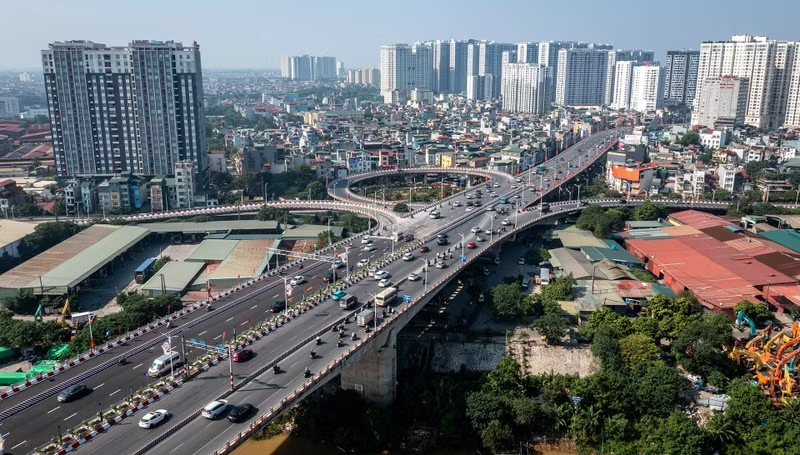
Simultaneously, priority will be given to developing the country’s two largest growth poles: the Ha Noi metropolitan region and Ho Chi Minh City. This serves as a crucial orientation for the ongoing urban redevelopment in the country’s two major economic engines.
Under the 100-year Master Plan for Ha Noi, the capital aims to maintain an average economic growth rate of around 11% per year during 2026–2030, while gradually shifting its development model from a monocentric urban structure towards a multi-polar, multi-centred, and multi-tiered structure by reorganising urban space, redistributing economic activities, and establishing new growth poles.
Digital and green transformations, innovation and the development of a circular economy have been identified as key drivers of rapid and sustainable growth and enhanced competitiveness. The knowledge economy is set to become a core development driver as Ha Noi moves towards becoming an innovation hub in the Asia-Pacific region.
For Ho Chi Minh City, a new structure for a city of more than 14 million people is also taking shape as its Master Plan for the 2025–2050 period, with a 100-year vision, is being formulated.
Following the merger, the city is in a position to implement integrated functional spatial planning by combining its industrial, port, and logistics capabilities with its financial and technological hubs and modern infrastructure to connect ecosystems and create new resources.
More importantly, Ho Chi Minh City is also a testing ground for new development models and is regarded as the country’s “institutional laboratory,” as it continues to take the lead in implementing breakthrough mechanisms to create new development models.
With new thinking and a new vision for reorganising national development space, developing six socio-economic regions with 22 specific targets for each region, and implementing 10 groups of key tasks and solutions, Resolution 27 is expected to help unlock resources and create new growth drivers, paving the way for Viet Nam’s new development model in the years ahead.