In 2025, widespread flooding caused by heavy rainfall left most cities across the country from north to south facing severe inundation.
Citing this situation, Pham Doan Khanh from the Viet Nam Disaster and Dyke Management Authority highlighted the pressing need for adaptation in the development of Viet Nam’s urban system.
Deputy Minister of Construction Nguyen Tuong Van underlined the need for urgent adjustments to urban infrastructure planning to enhance resilience and adaptability to climate change and natural disasters, based on innovation and digital data.
This is especially critical for major cities such as Ha Noi, Ho Chi Minh City and Da Nang, which are increasingly grappling with extreme heat, air pollution and flooding.
Only through renewed thinking and planning and governance methods, he stressed, can Viet Nam build a safer, greener and more sustainable urban system for the future.
Sharing the view that urban quality of life should not be measured solely by income or material conveniences, but also reflected in a safe, healthy and civilised living environment, Tran Thu Hang, Director of the Department of Planning and Architecture at the Ministry of Construction, highlighted a key issue: the need to shift from managing development to governing development, so that planning meets future needs and living values.
As a special-class city with a population of nearly 10 million, Ha Noi will inevitably have to follow this trend of renewing governance in order to adapt to increasingly complex climate change impacts.
The severe, large-scale flooding seen in 2025 has placed the capital under urgent pressure to enhance flood management capacity, improve resilience, strengthen warning systems and handle temporary flooding more effectively, with the aim of creating a more sustainable and liveable city.
According to Ha Noi Vice Chairman Truong Viet, a fundamental shift in the capital’s thinking lies in its decision to roll out smart city development through pilot implementation in designated development areas, based on a controlled testing mechanism (sandbox).
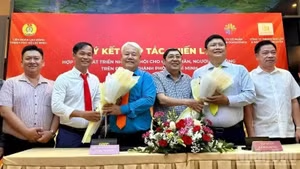
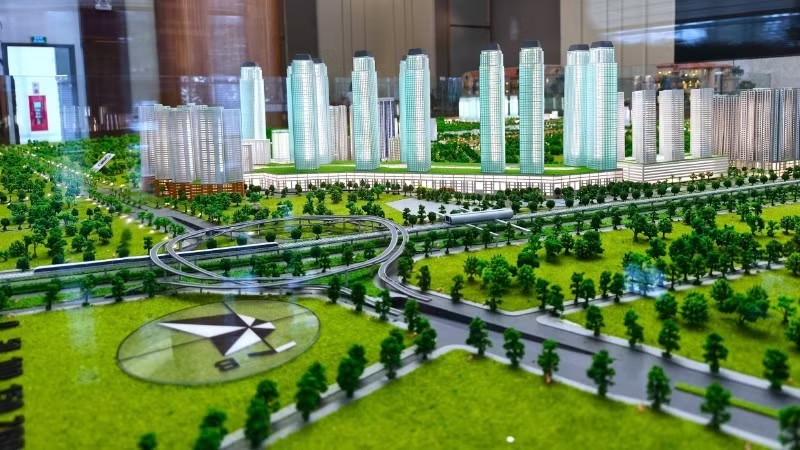
These changes in Ha Noi’s governance mindset are opening up significant opportunities for smart urban development projects. One example is the Tien Xuan Urban Area Project, a smart city model designed to connect with and support the Hoa Lac Hi-Tech Park.
Speaking about the project, a representative of SJ Group Joint Stock Company said that the development of the Tien Xuan smart urban area is of strategic significance within the overall Hoa Lac satellite urban system, contributing to the formation of a science and technology urban area in line with the approved master plan, where people and the community are placed at the centre.
Echoing this approach, Luu Duc Minh, Deputy Director of the Academy of Construction Strategy and Cadres Training under the Ministry of Construction, noted that the project exemplifies a move towards a new-generation sustainable smart city model, driven by science, technology, innovation and digital transformation, while putting people and communities at its core.
With renewed thinking from policymakers, active engagement from the business community and the growing role of the sandbox model, the capital is expected to establish a solid foundation for entering a new phase of development aligned with green growth objectives, sustainable development and Viet Nam’s long-term commitment to net-zero emissions.