Battlefield files and unfinished diaries
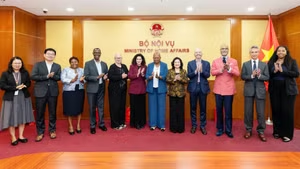
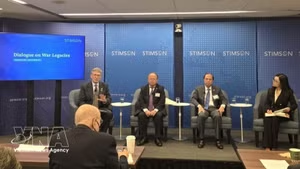
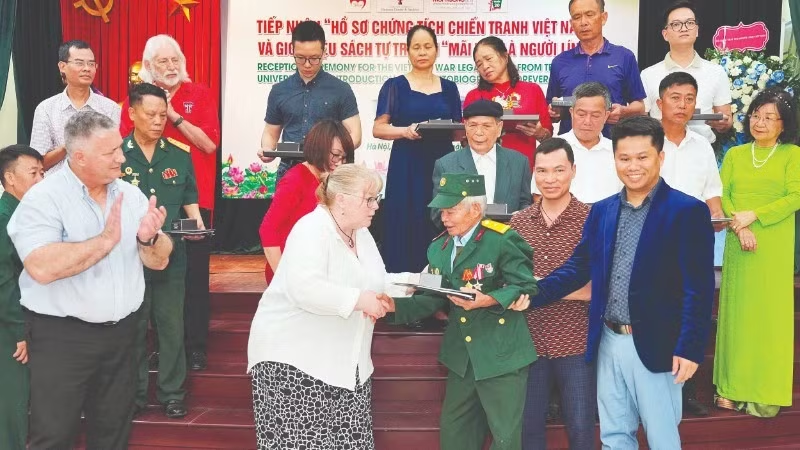
Tran Binh fell silent as he touched a sheet of paper bearing the signature Tran Luy. In 60 years of life, it was the first time he had seen his father’s handwriting. The document in his hands was not an original relic, but a copy from a file once seized on the battlefield and transferred more than half a century ago to the Combined Document Exploitation Center (CDEC) of the US military. In Ha Noi on July 10, 2025, US Ambassador Marc Knapper handed him the copy during a ceremony returning war-related documents.
Martyr Tran Luy was killed in Da Nang in 1969 when his son was only four years old. When leaving for the front, he had no chance to leave behind a photograph or keepsake. For Binh, his father’s image had existed only through his mother’s recollections and fragmentary stories from former comrades.
After more than 15 years searching former battlefields, the family finally brought his father’s remains home for reburial. Yet the journey of tracing his roots has not ended. Now 60, Binh still does not know his father’s ancestral hometown. The newly returned document, he says, is a guiding light for continuing that search.
Between 1954 and 1975, following battles in southern Viet Nam, the US military and the former Sai Gon administration seized hundreds of thousands of documents, including diaries, handwritten letters, work logs, personnel lists, and unit maps. These were transferred to CDEC for microfilming and intelligence analysis, with most originals later destroyed.
After the war, the archive collection was moved to the US. Today, the Viet Nam Center and Sam Johnson Viet Nam Archive (VNCA) houses approximately 30 million pages of materials relating to Viet Nam, including more than 261,000 CDEC files. Each file contains valuable data: names, units, locations, coordinates of seizure sites, brief reports, and operational notes.
File CDEC F034602980541 was among the first to be disclosed when the project began. It is a 72-page notebook of Political Commissar Huynh Minh Luong of Company 1, Battalion 9, Regiment 3, Division 9, active in the southeastern battlefield. The diary begins in August 1966 and ends on December 6, 1967, when it was seized in the Loc Ninh–Binh Long area, a fierce combat zone along National Highway 13 in the lead-up to the 1968 Tet Offensive.
Cross-checking the list of martyrs of Battalion 9 who were killed in late November and early December 1967 in Bu Dop shows the name Huynh Minh Luong (also known as Loi), from Chau Thanh, Ben Tre Province, who was killed on December 7, 1967. The timing, location, and unit correspond with the data contained in the file. Shortly after the record was made public, many veterans and volunteers proactively reached out to help trace information about the martyr’s relatives.
Two years ago, Nguyen Thi Hoa from Nghe An Province was overcome with emotion when reading her father’s words written to his daughter, then less than one year old. In the reproduced diary of her father, martyr Nguyen Quang So, he wrote: “Hoa, my child! If one day the country is reunified and I return, I will bring this diary with me — it has stayed with me through the harsh days fighting the Americans. And if I fall (as is inevitable in combat), the political section will send it back to you…”
He was killed on February 26, 1969. Two years later, the family received the death notice. With no portrait and no keepsake, the diary, recovered through CDEC data, returned as a fragment of his spirit and a precious clue to identify his burial place.
Over the past three years, more than 40 families of martyrs and several surviving veterans have received returned files. From 2026, with funding from the US Government, VWAI will expand in scope: not only returning documents but also supporting verification of missing cases, cross-checking coordinates, coordinating searches, and conducting DNA identification to confirm the identities of fallen soldiers.
Healing the wounds of war
The project’s co-director, Professor Ronald Milam, a US veteran who served in Viet Nam in 1970–1971 with the 1st Brigade, 82nd Airborne Division, is now Director of the Institute for Peace and Conflict at Texas Tech University. More than half a century later, he has returned to Viet Nam with a different mission: promoting cooperation and reconciliation, assisting in the search for missing Vietnamese service members, and transforming wartime records into data serving humanitarian purposes. “Yesterday, we stood on opposite sides of the battlefield. Today, we can sit together, share our wartime stories, and honour those who sacrificed,” Milam said.
Before the US Government officially launched and funded the VWAI project, since 2022 Ronald Milam, together with professors and students of Texas Tech University, had collaborated with the organisation “Trai tim Nguoi linh” (Soldier’s Heart) to implement the non-profit project “Viet Nam War Records”.
The initiative was carried out following a proposal to coordinate the search and verification of witnesses in order to receive and return wartime documents and memorabilia collected by Dr Alex-Thai Dinh Vo.
According to official statistics, approximately 180,000 martyrs nationwide have yet to have their remains located; around 300,000 sets of remains have been recovered but remain unidentified. Meanwhile, more than 260,000 CDEC files at VNCA have yet to be fully examined.
“If we were to publish one file per day, it would take about 715 years to introduce all the materials currently available. The workload is enormous, but each file may help a family recover a final message, an image of a loved one, or a clue to a martyr’s burial place,” said Colonel and writer Dang Vuong Hung, media coordinator of the VWAI project.
At a document handover ceremony in Ha Noi, wounded veteran Do Xuan Thuyen, 80 years old, travelled hundreds of kilometres in a wheelchair to receive a copy of his notebook. Turning each page slowly, he reread lines written in his youth, as if touching a sacred fragment of memory long thought lost.
Files once serving the purposes of war are now fulfilling a profound humanitarian mission: restoring identities to the fallen, returning keepsakes to families, and contributing to the healing of wartime wounds.