On May 14, on response to the requirement to achieve 11% GRDP growth in 2026, Vu Dai Thang, Chairman of the Ha Noi People’s Committee, signed and issued Directive No. 11/CT-UBND on boosting growth in the second quarter and the latter half of 2026.
The chairman requested departments, sectors, and local authorities to focus on synchronously implementing solutions aimed at creating a breakthrough for the capital’s economy.
During the first four months of 2026, Ha Noi’s economy recorded many positive results. First-quarter GRDP expanded by 7.87%, higher than the national average; the industrial production index rose by 8.6%; total retail sales of goods and consumer service revenue increased by 11.6%; tourist arrivals surged by 31.3%; and state budget revenue reached nearly 320 trillion VND, equivalent to 49.2% of the annual target.
However, the city also faced numerous challenges, including GRDP growth falling short of the planned 10.23%; exports declining by 0.9%; slow growth in private-sector investment; mounting inflationary pressure; and unresolved bottlenecks related to infrastructure, transport, and the environment.
To generate momentum for growth in the remaining months of 2026, the city identified the need to accelerate traditional growth drivers, particularly public investment, consumption, exports, tourism, and infrastructure development.
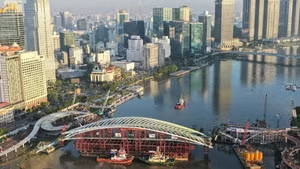
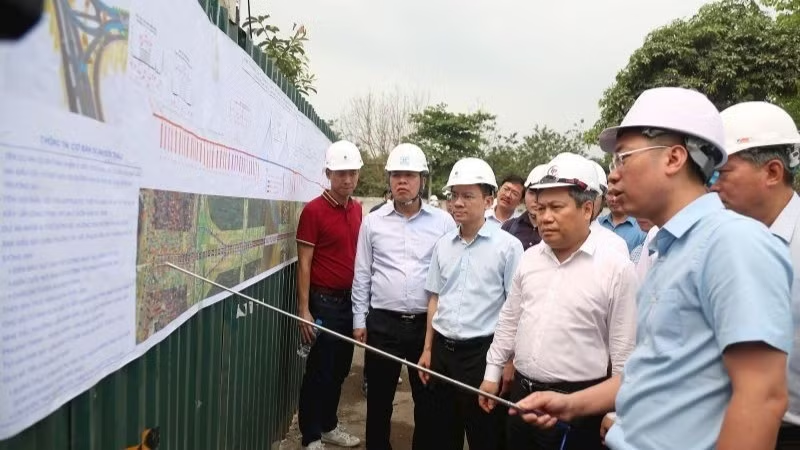
The city requested faster progress on key projects such as Ring Roads No. 1, 2.5, 3, 3.5, and 4; seven bridges spanning the Red River; and urban railway lines, while also addressing obstacles related to site clearance, construction materials, and investment procedures.
The Department of Finance will advise the city on assigning specific monthly disbursement KPIs for each quarter to project investors while reviewing and reallocating capital from delayed projects to key projects with stronger disbursement capacity.
The Department of Finance will advise the city on assigning specific monthly disbursement KPIs for each quarter to project investors while reviewing and reallocating capital from delayed projects to key projects with stronger disbursement capacity.
In the area of trade and exports, Ha Noi will intensify trade promotion activities in key markets such as the US, the Middle East, India, and Africa; support businesses in reducing logistics costs; and help resolve difficulties related to VAT refunds and access to export credit.

The city also called for stronger development of the night-time economy, along with a series of cultural, tourism, and trade events around Hoan Kiem Lake, West Lake, Son Tay, Ba Vi, and traditional craft villages in order to stimulate consumption and increase tourist spending.
Alongside traditional growth drivers, Ha Noi is focusing on fostering new engines of growth based on science and technology, digital transformation, and governance reform.
Departments and sectors have been instructed to step up decentralisation, delegation of authority, administrative reform, and the development of data-driven governance models to shorten investment procedure processing times.
The Department of Planning and Architecture will formulate a plan to implement the Capital Master Plan with a 100-year vision, connect planning databases and build a shared spatial data platform serving urban management and development.
The city will also intensify efforts to attract high-tech investment, complete infrastructure at Hoa Lac High-Tech Park and new industrial parks in order to draw high-quality FDI projects, research and development centres, and green industries.
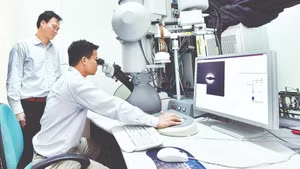
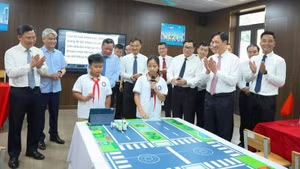
The Department of Science and Technology has been tasked with implementing the capital’s “major challenges” in smart urban development, transport, environment, energy, and the digital economy. The education sector will roll out the “Next 1,000” programme aimed at identifying and nurturing scientific and technological talent at an early stage, while promoting STEM, AI, and data science education in schools.

The city will formulate underground space planning, invest comprehensively in drainage systems, retention lakes, wastewater treatment, and the restoration of inner-city rivers, while also studying the application of artificial intelligence in environmental monitoring and urban management.
Under the new growth scenario, Ha Noi aims for GRDP growth of 10.47% in the second quarter, 11.86% in the third quarter, and 13.19% in the fourth quarter, thereby fulfilling its 11% growth target for the whole of 2026.