Building a service-oriented administration
Recognising the importance of mass mobilisation work, the Government Party Committee has focused on directing agencies and units to closely follow Politburo Decision No. 23-QD/TW, dated July 30, 2021, which promulgates the regulations on mass mobilisation work of the political system, and to synchronously implement contents appropriate to their functions and tasks.
One of the notable results is that many Party organisations and agencies have actively applied science and technology and digital transformation to administrative reform to better serve the people.
The government has issued numerous programmes and resolutions to accelerate administrative procedure reform and modernise methods of direction and administration in serving people and businesses. At the same time, it has proactively applied technology to make administrative operations more transparent through the National Public Service Portal and the system for monitoring and measuring service indicators for people and businesses, enabling people to monitor and rate the results of administrative procedure processing by each administrative agency online in real time.
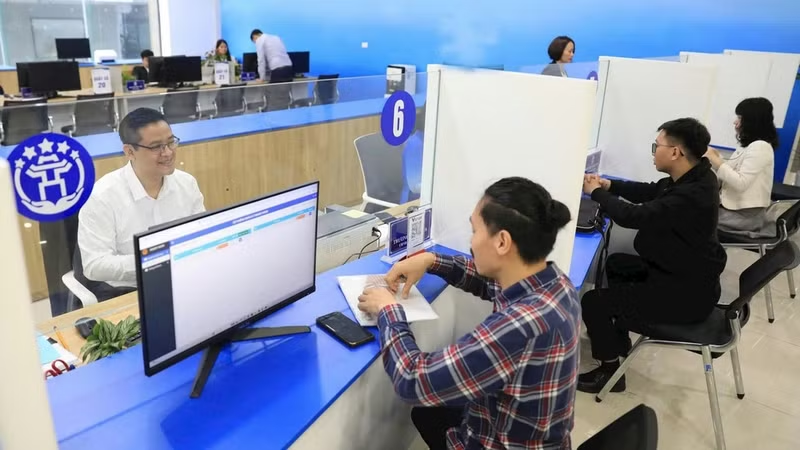
Under the direction of the government, provincial- and commune-level Public Administration Service Centres in 34 provinces and centrally-run cities have been operating under the two-tier local administration model, with 32 out of 34 localities having established 3,139 commune-level Public Administration Service Centres.
Party organisations in ministries, sectors and localities have also proactively directed the transformation towards better serving the people.
Every year, the Ministry of Home Affairs takes the lead and coordinates with relevant agencies to conduct a survey of approximately 36,000 randomly selected people representing residents from all regions and areas across the country. The survey results are compiled and analysed to develop and approve the Satisfaction Index of Public Administrative Services (SIPAS), and to advise the government on organising its announcement and public disclosure, thereby contributing to strengthening transparency and accountability and creating incentives for state administrative agencies to improve the quality of their services. The national average SIPAS score has continuously improved over the years, rising from 80.08% in 2022 to 83.09% in 2025.
Le Thi Thanh, Vice Chairwoman of the People's Committee of Ham Rong Ward, Thanh Hoa Province, said that synchronous administrative reform at all levels has facilitated grassroots authorities in implementing a modern and civilised public administration model. In addition to investing in upgrading equipment and facilities, the Ham Rong Ward Public Administration Service Centre also fully displays administrative procedures for people to monitor. The ward’s People's Committee has attached an EMC code to the ward's electronic information portal to connect it with the system for monitoring and measuring the provision and use of digital government services.
At present, all administrative procedure dossiers of organisations and citizens are digitised, scanned, and digitally signed, with the required dossier components and processing results attached to the province's electronic single-window information system in accordance with regulations. The efforts of officials of Ham Rong Ward have been recognised and highly appreciated by the people.
Accelerating digital transformation
Recently, on July 20, 2026, the Politburo issued Directive No. 09-CT/TW on strengthening the Party's leadership over the implementation of grassroots democracy in the new period, setting out the requirement to accelerate administrative reform; strengthen publicity, transparency, and accountability; and digitise documents containing contents related to the Law on the Implementation of Grassroots Democracy, ensuring that such information is completed in a timely manner and is easily accessible, particularly in areas directly related to the legitimate rights and interests of the people.
Based on implementation practices, Party committees and agencies under the Government Party Committee have all agreed that this is an important task of mass mobilisation work in the coming period. Lai Xuan Lam, Deputy Secretary of the Government Party Committee, said that the mass mobilisation work of the Government Party Committee would need to renew its contents and methods of operation to suit the realities of intensified globalisation, international integration, digital transformation, and the two-tier local administration model. One requirement for Party committees and agencies is to make use of the internet and social media to quickly grasp the thoughts, aspirations, and concerns of the people, while also narrowing the interaction gap between authorities and the people.
According to the Party Committee of the Ministry of Science and Technology, amid profound transformation, mass mobilisation work needs to renew its contents and methods to suit the trend towards digitalisation and people's information needs. There needs to be a strong shift from the method of "one-way communication" to "interaction, dialogue, and smart service."
Mass mobilisation by government authorities should be strengthened by optimising public services and the "Digital Fatherland Front" platform. Administrative reform should continue to be accelerated, procedures reduced and simplified, the quality of online public services improved, and the digitisation of dossiers and work-processing procedures promoted. The level of satisfaction and convenience experienced by people and businesses should be taken as the measure of the effectiveness of mass mobilisation by government authorities.
Administrative agencies should closely coordinate with the Viet Nam Fatherland Front and mass organisations to effectively implement the "Digital Fatherland Front" platform and online channels to carry out grassroots democracy effectively, thereby ensuring people's right to supervision and social criticism and their right to access information concerning state management activities.