The year 2025 recorded breakthrough shifts, laying a solid foundation for mass mobilisation work to continue delivering results, meeting the ever-higher demands of national development and the People’s expectations.
Mass mobilisation work has been renewed in thinking, content and methods, closely following the principle that “the People are the root”, and concretising the mechanism of “the Party leads – the State manages – the People are the masters”, rallying and promoting the People’s strength, intellect and affection in implementing the Party’s strategic decisions.
From organisational restructuring to renewed thinking and methods
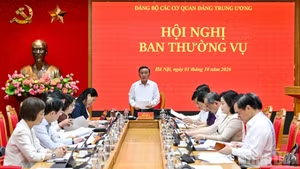
The year 2025 marked an important turning point as the policy of merging the Communication and Education Commission and the Mass Mobilisation Commission at all levels was rolled out in a synchronous and decisive manner. This is a strategic adjustment in the organisation and operation of the Party’s ideological and mass mobilisation work. After the merger, the apparatus has initially stabilised, ensuring smooth direction and administration; work has not been interrupted, and no local areas or sectors—especially at grassroots level—have been left unattended.
From the organisational changes, mass mobilisation work has undergone a profound shift in thinking and in how it is carried out. Most notably, it has moved away from one-way communication and mobilisation towards an approach grounded in listening, dialogue, accompanying the People, and serving them.
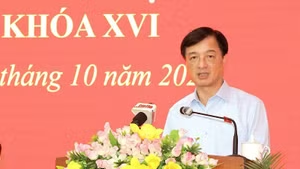
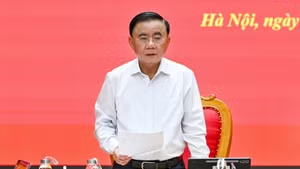
Reviewing communication, education and mass mobilisation work in 2025, the PCC’s Commission for Communication-Education and Mass Mobilisation pointed out that mass mobilisation work has been stepped up, affirming its pivotal role in strengthening the great national unity bloc and promoting the People’s mastery. The “Skilful Mass Mobilisation” movement continues to spread widely, forming thousands of models and advanced examples that drive economic development and social welfare. Thanks to synchronised solutions and the promotion of democracy, major decisions of the Party and State have won high public consensus, becoming broad political activities that awaken a sense of responsibility and the People’s awareness of being masters.
These results have been achieved because Party committees at all levels have proactively grasped the situation, organised dialogues, and promoted the application of digital technologies in receiving and handling public feedback — helping the Party and State adjust policies in a timely manner and in line with reality.
Practice in Ha Noi is a clear example. From studying and incorporating public opinions, the Standing Board of the Ha Noi Municipal Party Committee issued Directive No. 36-CT/TU, dated November 28, 2024, on strengthening mass mobilisation in planning work, and in compensation, support and resettlement when the state recovers land in Ha Noi City. Along with issuing guiding documents, Ha Noi has made planning maps and compensation data public on its online portal, piloted artificial intelligence to analyse public sentiment. This has laid the groundwork for many “digital mass mobilisation” models across the city, meeting new requirements and contributing to effective site clearance for investment projects, including Ring Road 4 – the Ha Noi Capital Region and bridge projects across the Red River.
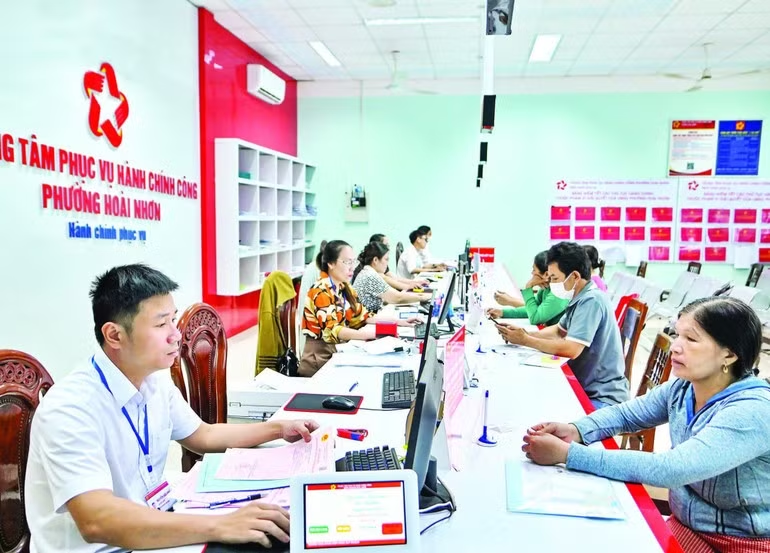
At the same time, when the two-tier local government model came into operation from July 1, 2025, grassroots mass mobilisation work continued to be strengthened and more closely linked with ideological work, creating unity between awareness and action, between “saying” and “doing”, and between the Party’s guidelines and the People’s consensus. Party-building units in communes and wards quickly stabilised their organisation and staffing, assigning responsible cadres appropriately, ensuring no “gaps” in leadership and direction.
Recognising new requirements for grassroots mass mobilisation work, the Standing Board of the Ho Chi Minh City Municipal Party Committee has focused on improving the quality of training and capacity building for grassroots cadres, with emphasis on skills in mass mobilisation, listening and providing explanations.
In Vinh Long, mass mobilisation work has been implemented with stronger coordination among Party committees, authorities and the Viet Nam Fatherland Front; the pioneering, close-to-the-People role of cadres and Party members has been promoted; and professional training for communication, education and mass mobilisation staff at grassroots level has been strengthened — especially in oral communication and public mobilisation skills.
In Gia Lai and many other localities, mass mobilisation work has been flexibly carried out in a way that stays close to the grassroots and target groups, promoting the role of reputable individuals, religious dignitaries, and cadres and Party members within residential communities. Practical mass mobilisation models have helped stabilise thinking, maintain social order, and nurture trust — creating a durable bond between the Party, authorities and the People.
A qualitative shift in the mass mobilisation cadre contingent
Alongside organisational consolidation and functional integration, 2025 also left an important imprint: a change in how mass mobilisation cadres and Party members work and act, especially at grassroots level. Applying information technology in mass mobilisation work has narrowed access gaps and enhanced interaction between cadres and the People. Technological development sets higher requirements for those doing mass mobilisation work: not only “listening to what the People say”, but also striving harder, being more responsible, and upholding exemplary conduct — always taking the lead, building consensus, and contributing to resolving public grievances decisively from the grassroots.
This shift is reflected clearly in the approaches of many localities. Standing Deputy Secretary of the Ninh Binh Provincial Party Committee, Dinh Thi Lua, said: The Standing Board of the Provincial Party Committee has proactively assigned provincial Party committee members to regularly attend grassroots meetings, directly engage in dialogue, and address residents’ concerns, especially in sensitive areas such as land-use planning, construction order and the environment. This approach both helps grasp the situation and demonstrates a clear sense of political responsibility in handling issues. Many cases have been resolved early, preventing them from accumulating into hotspots or prolonged complaints. In many hamlets, the effectiveness of mass mobilisation is evident throughout the implementation of key projects.
According to Nguyen Van Sinh, Secretary of the party cell of Minh Duc Hamlet, Co Le Commune, Ninh Binh Province: For key projects, the Party cell persistently persuaded residents to clearly understand the projects’ regional connectivity benefits, while ensuring public and transparent compensation plans. Once information was clarified, many households actively supported the projects, hoping new economic projects would bring benefits to the province. A typical example is the family of Nguyen Van Hoa, who had more than 700 sq m of residential land — including a house and solid structures — and cleared the site immediately as soon as he received notice from the authorities.
After the merger of the communication, education and mass mobilisation sector, mass mobilisation work emphasises the linkage between ideological work and mobilising the People, between “speaking so the People understand” and “acting so the People trust and join in”. Those doing mass mobilisation work, therefore, do not stop at explaining so the People understand the Party’s and State’s guidelines and policies, but must also deeply understand local characteristics, social psychology, and livelihoods of each target group, so as to choose appropriate and flexible mobilisation methods for each locality and each specific issue.
After the merger of the communication, education and mass mobilisation sector, mass mobilisation work emphasises the linkage between ideological work and mobilising the People, between “speaking so the People understand” and “acting so the People trust and join in”.
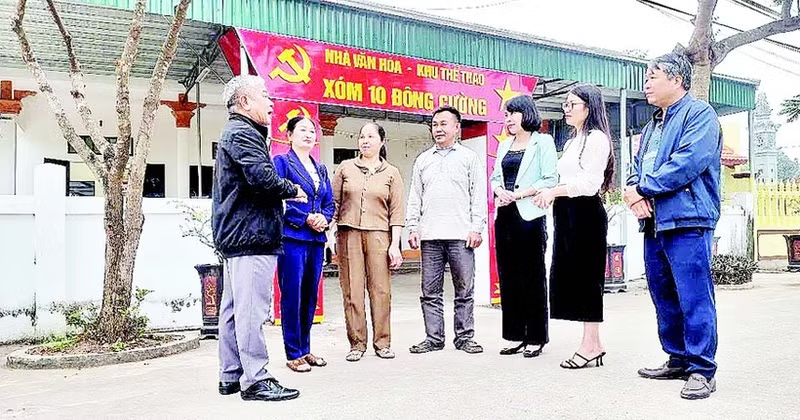
According to Ha Xuan Liem, Secretary of the Party Committee of Phieng Pan Commune, Son La Province, the Communal Party Committee’s Standing Board always prioritises training young ethnic minority cadres for mass mobilisation work. The Party Committee maintains the routine of flag-saluting and ideological activities under the flag, creating positive shifts in renewing leadership methods and governance practices.
Based on guidance from the Provincial Party Committee’s Commission for Communication-Education and Mass Mobilisation, the Party Committee, authorities and the Viet Nam Fatherland Front of Phieng Pan Commune have built mass mobilisation models tied to local realities, focusing on immediately removing difficulties faced by ethnic minority communities. Models that help residents repair houses, build roads, and shift crop structures suitable to local soils have been rolled out widely by full-time staff and Party cells. Many communal cadres have overcome difficulties in transport and travel conditions, staying with villages and residents, supporting the People in developing production and building new-style rural areas.
It can be affirmed that substantive innovations in mass mobilisation work in recent times are innovations in the mindset of serving the People. The draft documents for the 14th National Party Congress continue to require renewing mass mobilisation work in both content and communication methods, linking it with the effective implementation of socio-economic development policies, especially from the grassroots. These are very demanding requirements, calling for great determination and effort from Party committees, Party organisations, authorities, the Viet Nam Fatherland Front at all levels, and the contingent of cadres in the communication, education and mass mobilisation sector to excellently fulfil the tasks assigned by the Party.