In such areas, Party members serve as “pillars of support” in mobilising the strength of the entire population, contributing to maintaining political stability, national defence and security, and improving people’s livelihoods.
Proactively building source of Party members at grassroots level
Developing Party members in ethnic minority areas is not simply about increasing the number of Party members; more importantly, it is about building a core force right at the grassroots level — one that stays close to the people, understands them, and earns trust within the community. This is also an important requirement for consolidating the political system from the grassroots level and creating a long-term pool of officials for ethnic minority and mountainous areas.
From this awareness, many mountainous and border localities have proactively renewed their approaches, linking the admission of new Party members with the practical demands of grassroots realities.
Cao Bang is one of the localities that has implemented relatively synchronised and effective solutions for Party member development among ethnic minority communities. The Party Organisation of Cao Bang Province currently has 64,689 Party members, of whom ethnic minority members account for more than 93%, while 100% of hamlets and residential groups have Party cells.
Hoang Thi Hue, Deputy Head of the Provincial Party Committee’s Commission for Organisation, said Party committees at all levels in Cao Bang have oriented Party member development in association with socio-economic development tasks. Accordingly, many Party cells have proactively identified outstanding individuals from production models, household economies, and local start-up initiatives as potential Party member sources.
Party committees at all levels also place particular emphasis on developing young Party member sources by regularly identifying and nurturing promising ethnic minority youths, demobilised soldiers, pupils, and students through emulation movements and practical local activities such as youth entrepreneurship, women’s economic development, and new-style rural area building.
In especially disadvantaged areas, particularly highland hamlets populated mainly by ethnic minorities where the number of local Party members remains limited, Party committees assign commune-level officials and Party members to directly oversee and participate in Party cell activities. In necessary cases, they are appointed as Party cell secretaries to guide, monitor, and maintain regular operations.
In especially disadvantaged areas, particularly highland hamlets populated mainly by ethnic minorities where the number of local Party members remains limited, Party committees assign commune-level officials and Party members to directly oversee and participate in Party cell activities. In necessary cases, they are appointed as Party cell secretaries to guide, monitor, and maintain regular operations.
These approaches have helped narrow gaps, build trust, and create strong motivation for ethnic minority people to strive for progress, thereby improving both the quality and sustainability of new Party member admission at the local level.
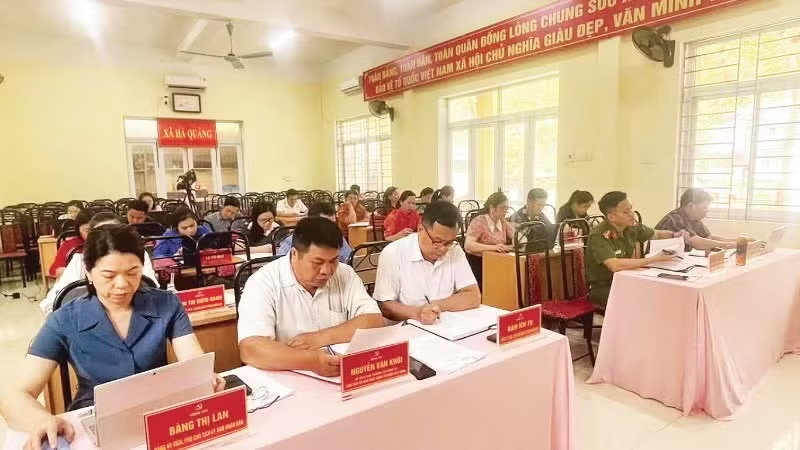
The Party Organisation of Ha Quang Commune has 49 Party cells with more than 1,400 Party members.
According to Trieu Thi Dien, Standing Deputy Secretary of the Ha Quang Communal Party Committee, the Ha Quang Communal Party Committee issued Plan No. 29-KH/DU dated October 28, 2025 on Party member development for the 2025–2030 period, aiming to admit at least 150 new Party members during the term.
To implement the plan, the Communal Party Committee proactively introduced numerous solutions to build Party member sources in line with Provincial Party Committee orientations and local realities. Since July 2025, the Ha Quang Communal Party Committee has admitted 28 new Party members, including students, public employees, non-professional workers at hamlet level, and many local agricultural workers.
According to Trieu Thi Dien, alongside quantity, Party organisations always prioritise standards in building Party member sources, especially political awareness, morality, and lifestyle, avoiding a focus on numbers at the expense of quality. These results demonstrate that when Party committees genuinely pay attention to building sources and stay close to the grassroots, Party member development work can achieve clear progress.
Removing obstacles from practical realities
In mountainous and border areas inhabited by large ethnic minority populations, where living conditions remain difficult, admitting new Party members still faces many challenges. A portion of young people leave their hometowns for work after completing their studies, leading to shortages in local Party member sources. Difficult socio-economic conditions also affect participation in socio-political activities and the process of striving for Party membership.
This reality requires Party committees at all levels to remain flexible and proactive in seeking suitable solutions. In Lung Nam Commune, after administrative restructuring, some hamlet Party cells were left with very few local Party members, directly affecting the leadership capacity and fighting strength of Party organisations.
According to Nong Van Thuan, Standing Deputy Secretary of the Communal Party Committee, the Standing Board of the Commune Party Committee assigned commune officials and civil servants who are Party members to continue participating in Party cell activities in hamlets with few members. At the same time, Party committee members were appointed as hamlet Party cell secretaries to maintain Party organisation activities and strengthen Party member development work.
The locality also prioritises nurturing non-professional workers at hamlet level, such as hamlet heads, heads of Front Working Committees, and heads of mass organisations, to create sources for Party admission. As a result, during the second half of 2025 and the first quarter of 2026 alone, the Party Cell of Lung Ga Hamlet admitted one new Party member and had three individuals attend classes on Party awareness training.
The admission of new Party members in ethnic minority areas can only be effective when Party committees persistently stay close to the grassroots, rely on the people, and care for their livelihoods. Each newly admitted Party member not only helps strengthen grassroots Party organisations but also affirms the role of Party members as “political nuclei” in difficult areas.
Practical experience in Cao Bang has shown many effective Party development models that could be replicated, such as those of the Party Organisations of Trung Khanh Commune, Doai Duong Commune, and the Provincial Party Organisation of Agencies and Enterprises.
Hoang Thi Hue, Deputy Head of the Provincial Party Committee’s Commission for Organisation, shared that under conditions of complex terrain, scattered populations, and shortages of local Party member sources, Party committees in Cao Bang have promoted their pioneering role by implementing many flexible solutions closely aligned with reality.
“These solutions not only remove immediate difficulties but also help strengthen public trust. In highland areas, where people’s lives still face many hardships, the image of officials and Party members who stay close to the people, understand them, and act responsibly towards them is itself the most persuasive form of communication,” she said.