In this context, continuing to consolidate grassroots Party organisations and enhance the quality of Party members is regarded as a fundamental solution to building a strong Party from its cells.
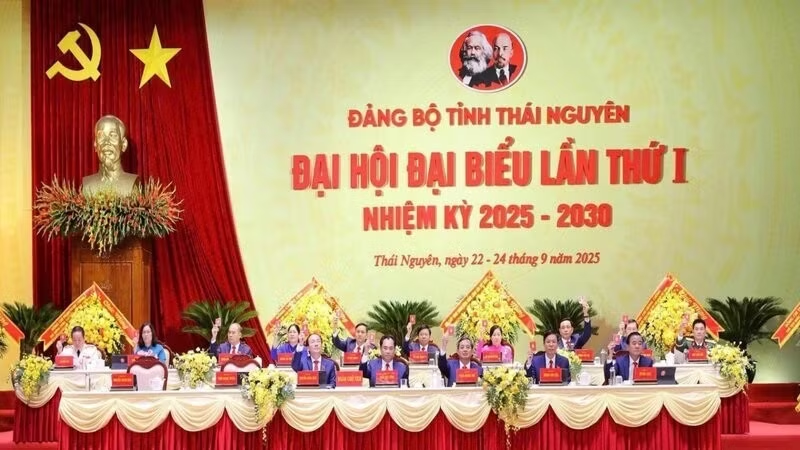
In thoroughly grasping and implementing the Resolution of the 14th National Party Congress, alongside effective measures and experience already put into practice, Party committees and organisations across Thai Nguyen Province have focused on intensifying efforts to create a pipeline of candidates and improve the quality of new Party member admissions.
Over the past term, the Thai Nguyen Provincial Party Organisation left a notable mark in party building with tangible results. As of 2025, the province had more than 140,500 Party members, with the annual admission rate consistently exceeding 3 per cent, surpassing the target set out in the resolution. In 2025 alone, through synchronous and resolute measures, the province admitted 4,285 new Party members.
These outcomes reflect the proactive and creative approaches adopted by grassroots Party committees. For example, the Party Organisation of Phu Binh Commune promptly translated higher-level directives into coordinated solutions, achieving 104 per cent of its membership recruitment target. In the education sector, the Party Committee of Phu Binh High School assigned Party-member teachers to directly develop educational plans and mentor outstanding pupils from an early stage, nurturing their ideals, ambition, and creativity. The school’s Party cell admitted 14 exemplary students into the Party, becoming a local bright spot in cultivating future members.
In the highland commune of Van Lang, the communal Party Committee has sought to harness the role of reputable community figures across its 19 hamlets and villages to promote awareness and encourage the public to align with the Party. These core figures have played an important role in enabling the Van Lang Communal Party Organisation to admit 23 outstanding individuals in 2025, fulfilling 100 per cent of the target set.
Closely following the core requirement of the Resolution of the 14th National Party Congress on building the Party in terms of ethics, the Thai Nguyen Provincial Party Committee has made clear that Party membership development must not stop at numerical targets but shift decisively towards enhancing substantive quality. According to the provincial Party Committee’s organisation commission, efforts to improve the effectiveness of candidate development in the 2025–2030 period must be accompanied by strong innovation in political and ideological education, particularly among the younger generation.
The provincial Party Standing Committee has assigned specific targets to 92 communal and ward-level Party organisations and affiliated units, requiring quarterly implementation plans and clearly defined responsibilities for each committee member, thereby avoiding perfunctory delegation or a pursuit of purely formalistic targets.
Accordingly, Party committees and cells must consistently prioritise raising awareness and strengthening the motivation of individuals striving to join the Party, while also providing regular guidance, support, and encouragement to foster proactiveness and self-improvement among Party members. Each member, especially committee members and leaders, must genuinely serve as a role model in professional competence, moral integrity, lifestyle, and dedication, bearing responsibility before the collective and the people.
Party committees and cells across Thai Nguyen have shared practical experience centred on three breakthrough solutions: enhancing members’ capacity for self-renewal, linking assessments of moral qualities with concrete work performance; tightening discipline and oversight at the cell level, ensuring that each cell becomes a “four-good” collective subject to supervision by both the organisation and the people; and strictly implementing screening mechanisms to remove from the Party those who no longer meet required standards or who have shown signs of ideological, moral, or lifestyle degradation.
The provincial Party Committee has instructed subordinate committees to emphasise the responsibility of leaders, encouraging proactive internal inspection and supervision. The head of each Party committee must bear primary responsibility for fostering a working environment in which positive values are protected and promoted, while negative behaviours are prevented and repelled.
Assigning tasks in tandem with clear mechanisms for inspection and accountability will ensure that Party membership development is not only sufficient in quantity but genuinely strong in quality, worthy of its role as a vanguard force, thereby laying a solid foundation for the successful fulfilment of objectives in the new revolutionary period.