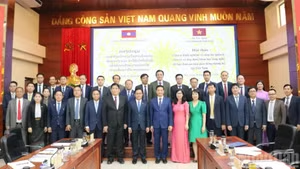
A series of administrative reform achievements has delivered positive changes, enhancing competitiveness and drawing strong investment flows into the province’s economic zones and industrial parks.
A lever for investment attraction
In 2025, Gia Lai rolled out a range of breakthrough administrative reforms, demonstrating decisive action to accompany and serve enterprises. According to the Provincial People’s Committee, the province has completed a review of 100% of its existing administrative procedures. Of these, 1,713 procedures have had their processing times reduced, with an average cut of 55.15%, far exceeding the Government’s 30% target. Notably, procedures related to licensing and certification — long considered bottlenecks — have seen marked improvements with clear results.
Vice Chairman of the Provincial People’s Committee, Lam Hai Giang, emphasised: “We do not pursue administrative reform as a movement; we reform to deliver substantive results, serving citizens and businesses with satisfaction as the yardstick.”
In practice, business registration procedures have been reduced from three days to just three hours. The full set of investment–construction–environment–fire prevention and fighting procedures outside industrial parks has been shortened from 242 days to 60 days, and to only 38 days within industrial parks.
This has been described as a large-scale administrative “revolution”, enabling Gia Lai to rise from a locality once limited in administrative capacity to a leading position nationwide. Specifically, in 2025 the province’s index for serving citizens and enterprises reached 96.63 points, ranking second out of 34 provinces and cities and placing it among those with outstanding scores.
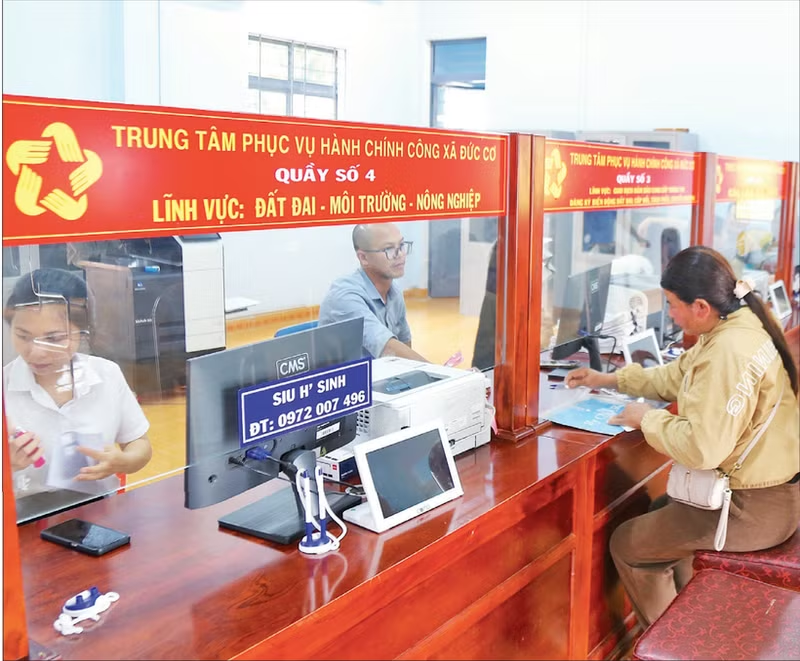
For the first time, Gia Lai has promulgated a list allowing 100% of administrative procedures to be carried out “irrespective of administrative boundaries”.
For the first time, Gia Lai has promulgated a list allowing 100% of administrative procedures to be carried out “irrespective of administrative boundaries”. Thanks to integration on the online public service platform, enterprises can submit dossiers and complete procedures anywhere within the province, effectively removing long-standing administrative barriers. This exemplifies the philosophy of “serving where citizens and businesses need”.
The province has also strengthened decentralisation and delegation of authority, issuing 14 decisions authorising departments and agencies to handle 258 administrative procedures, alongside two decentralisation decisions covering 42 procedures in the fields of industry and trade, home affairs, and the Provincial Economic Zone Management Board.
These measures reduce intermediary layers, shorten processing times, and enhance transparency and accountability. “The delegation model linked with personal responsibility is proving effective. We do not roll out the red carpet with words, but with professionalism, standards, and a spirit of openness in every working session with enterprises,” Lam Hai Giang affirmed.
Building a sustainable investment environment
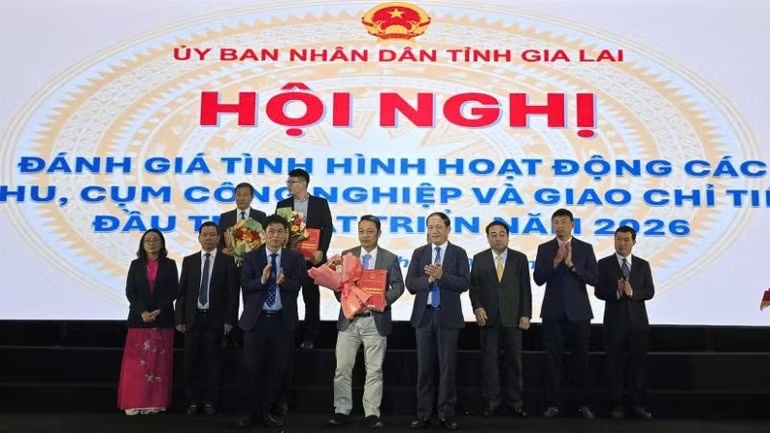
At a conference held in early February to meet enterprises, address difficulties, and accelerate project implementation in industrial parks and economic zones, Nguyen Tu Cong Hoang, Vice Chairman of the Provincial People’s Committee and Head of the Provincial Economic Zone Management Board, stressed: “The provincial authorities are committed to accompanying enterprises and resolving each specific difficulty. Every week, we hold thematic meetings to address emerging obstacles. Issues beyond local authority are reported to the central level; legal bottlenecks are proposed for amendment.”
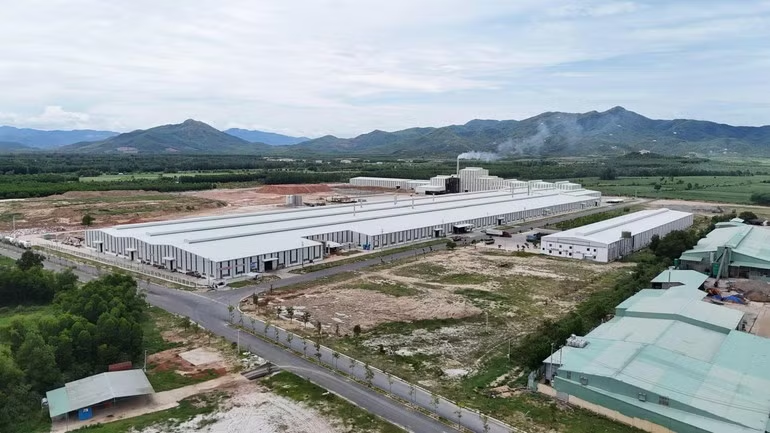
This spirit has significantly contributed to making Gia Lai a bright spot for investment attraction in 2025. The province secured 43 projects with a total registered capital of 82.27 trillion VND (3.16 billion USD), exceeding targets by 130.3% in number of projects and 360.8% in registered capital.
The province not only ensures transparent procedures but also supports enterprises throughout the entire chain of activities, from investment documentation to construction licensing and operational production.
Director of Hoa Sen Nhon Hoi-Binh Dinh Company, Dau Dinh Thuc, shared: “We feel completely assured implementing our project in an industrial park in Gia Lai. The openness, systematic administrative reform, and enthusiastic cooperation of officials make the difference that attracts investors.” Similarly, Project Director of G-One Viet Nam Industry Company, Xie Fei, expressed confidence: “Administrative procedures in Gia Lai are becoming increasingly swift, rigorous, and free from bureaucracy. This is why we have decided to expand our investment here next year.”
Gia Lai has paid particular attention to establishing substantive support models rather than symbolic ones. Instead of relying solely on traditional state administrative bodies, the province has successfully deployed an “Online public service agency” model at major banks such as BIDV and Agribank, as well as within the commune-level postal–cultural system.
It has also piloted public service kiosks at 10 armed forces units, enhancing civil–military connectivity and resolving procedures at the grassroots level. Notably, the province has boldly applied digital data to simplify documentation requirements, with 436 administrative procedures no longer requiring paper copies if information is already available in state digital databases.
Gia Lai considers administrative reform a continuous process with no end point. In the coming period, the province will continue to direct departments, sectors, and localities to review and eliminate unnecessary procedures; strengthen technological application and digital transformation in handling administrative procedures; and improve the quality of officials and civil servants directly serving citizens and enterprises.
Deputy Head of the Provincial Economic Zone Management Board Phan Viet Hung
Practical experience demonstrates that administrative efficiency cannot be separated from the quality of the civil service. In 2025, Gia Lai organised training for 6,276 commune-level officials and civil servants, focusing on professional skills, e-administration, and the use of AI in work processing. This workforce plays a pivotal role in the success of the two-tier local government model operating from provincial to commune level.
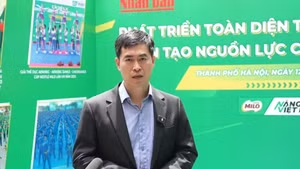
Deputy Head of the Provincial Economic Zone Management Board, Phan Viet Hung, underscored: “Gia Lai identifies administrative reform as a continuous process without a stopping point. In the time ahead, the province will continue to direct departments, sectors, and localities to review and cut unnecessary procedures; enhance technology application and promote digital transformation in resolving administrative procedures; and at the same time improve the quality of officials and civil servants directly serving citizens and enterprises.”
By shortening business registration times, Gia Lai is gradually removing institutional bottlenecks and creating a favourable environment for investment, production, and business activities. This forms a crucial foundation for the province to accelerate towards rapid and sustainable growth, contributing positively to the overall development of the region and the country.