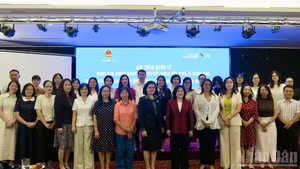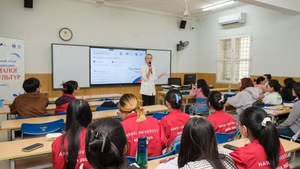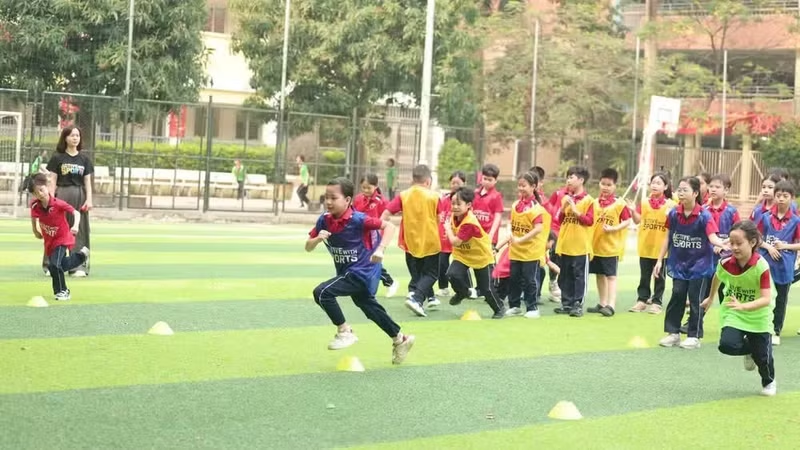
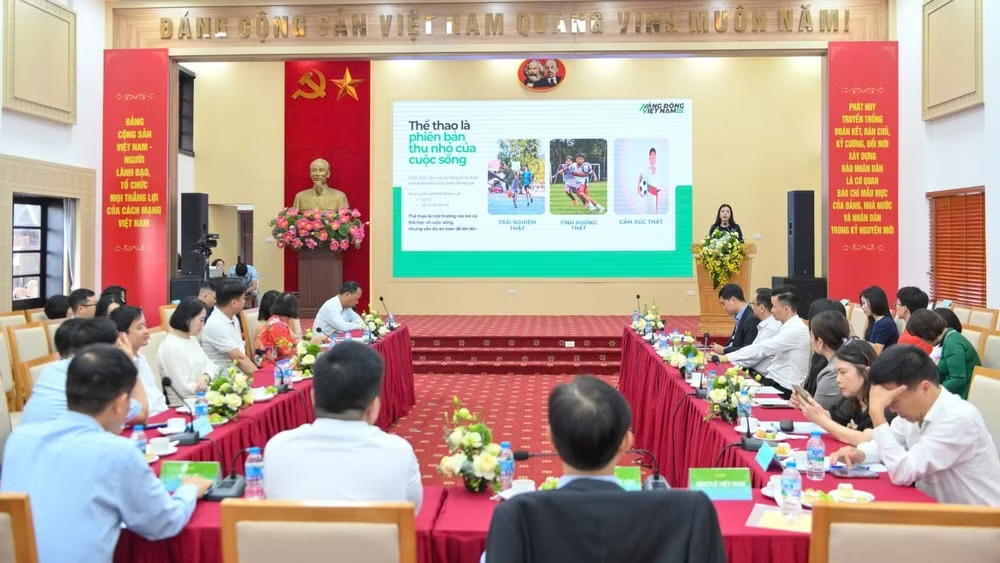
The seminar “Comprehensive development of Viet Nam’s young generation: Building resources for a new era”, jointly organised by Nhan Dan Newspaper and the Ministry of Education and Training, with the companionship of Nestlé Viet Nam, was not merely a professional forum. In essence, it was a multidimensional dialogue about the future of Viet Nam’s younger generation in a new development phase.
According to Le Bui Thi Mai Uyen, Deputy General Director of Nestlé Viet Nam, the company’s collaboration with Nhan Dan Newspaper and the Ministry of Education and Training in organising the seminar carries significant meaning for the community, especially as Viet Nam is entering a new stage of development.
For the first time, issues that are often viewed separately, such as education, nutrition, physical activity, school sports, and corporate social responsibility, were placed within the same framework: comprehensive human development.
When Vietnamese children still face a “double burden”
According to Do Trung Hieu, Deputy Head of the Culture-Society Department at Nhan Dan Newspaper, one of the important reasons why Nhan Dan Newspaper coordinated with the Ministry of Education and Training to organise the seminar was the concerning reality surrounding nutrition and physical development among Vietnamese children.
For many years, society has often assumed that improved material living conditions naturally mean children will develop better. However, reality presents a paradox: while many children in disadvantaged areas still suffer from micronutrient deficiencies and stunting, school obesity rates in major urban centres are rising rapidly due to sedentary lifestyles and excessive dependence on electronic devices.
In other words, Viet Nam is simultaneously facing a “double burden” of nutrition.
This reflects the reality that human development in the modern era can no longer be addressed simply by “eating enough” but must move towards “eating properly – living healthily – exercising scientifically”.
It is precisely from this reality that the seminar carries significance not only in terms of policy communication but also in demonstrating efforts to bring the contents of Resolution No. 71-NQ/TW and Resolution No. 72-NQ/TW into social life through concrete actions.
Modern education must not only cultivate intellect but also build physical wellbeing
From the perspective of state management, Nguyen Nho Huy, Deputy Director General of the Department of Students Affairs under the Ministry of Education and Training, said the ministry is strongly implementing the spirit of Resolution No. 71-NQ/TW and Resolution No. 72-NQ/TW, with particular emphasis on physical education, school health, and building exercise habits among pupils and students.
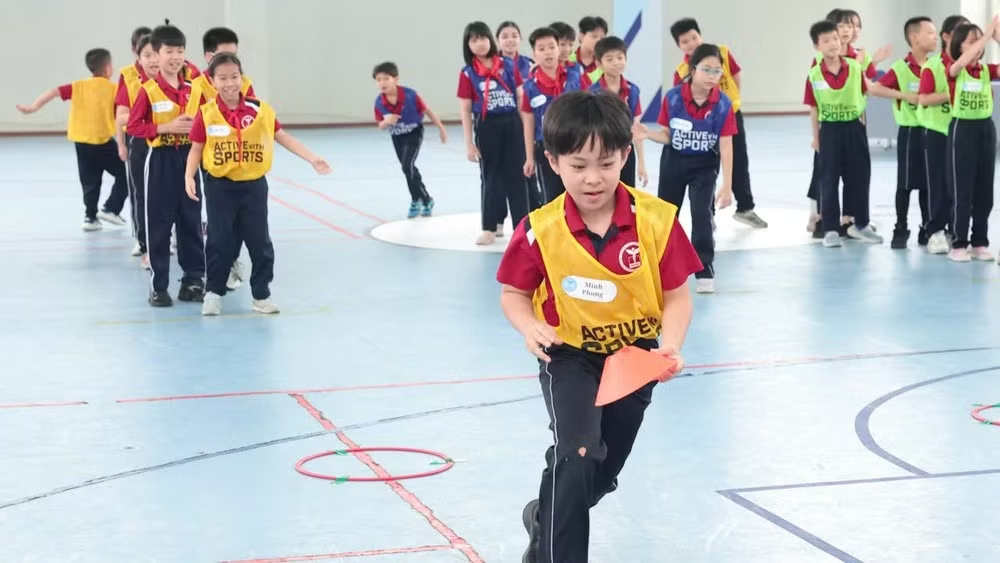
This message shows that educational thinking in Viet Nam is undergoing considerable change. For a long period, the education system faced immense pressure from examinations and academic achievements. Many schools viewed physical education as a “secondary subject”, while parents have often prioritised extra classes over physical activity.
As a result, many students excel academically but lack physical endurance, have limited movement skills, and are more vulnerable to psychological pressure.
Therefore, the education sector’s official recognition of school health as equally important as intellectual education represents a necessary adjustment in the strategy for human development.
This is also an approach consistent with modern global educational trends, where schools are expected not only to train academically capable learners, but also to help them become healthy, balanced, and highly adaptable to social changes.
Telling figures about the physical condition of Vietnamese people
From a scientific perspective, Assoc Prof, Dr Tran Thanh Duong, Director of the National Institute of Nutrition, presented notable data on the height, weight, and nutritional status of Vietnamese children today.
According to him, although the physical stature of Vietnamese people has improved significantly in recent years, there remains a considerable gap compared with many developed countries in the region. At the same time, nutritional imbalance is becoming increasingly evident.
The important point in his presentation lay not only in the figures themselves, but in the message that developing the nation’s physical strength is a long-term strategy requiring coordinated efforts between education, healthcare, nutrition, sports, and living environment.
For many years, society has often approached the issue of height and physical development in a short-term or campaign-based manner. However, in reality, the quality of human resources cannot be improved after only a few communication campaigns; it requires sustained investment across generations.
School sports - Where resilience and character are formed for the younger generation
Drawing from practical experience in professional sports, Truong Minh Sang, Head Coach of the National Gymnastics Team, said the school environment is the first place where talent is discovered and determination is nurtured in children.
More importantly, according to him, sports do not merely create athletes. The greatest value of school sports lies in building resilience in life: the ability to overcome failure, a sense of discipline, perseverance, and teamwork. In modern society, these are all especially important skills.
A child may perform very well academically, but without adaptability, resilience, or the ability to work collectively, it will be difficult for them to go far in a globally competitive environment.
Therefore, making school sports part of the human development strategy is no longer a movement-based option but an inevitable requirement of modern education.
Teachers not only impart knowledge but also inspire life values
From the perspective of practical education, Vu Chi Thanh, Principal of FPT Polytechnic College, emphasised the role of teachers as motivators for pupils and students. According to him, today’s teachers not only impart knowledge but must also become role models in learning spirit, self-improvement, and the courage to challenge themselves.
This is a particularly noteworthy observation at a time when young people are being strongly influenced by social media and the digital environment.
For today’s youths, inspiration can sometimes be just as important as knowledge.
A positive educational environment, where teachers accompany and inspire students, will help them become more confident in discovering their own abilities instead of merely chasing grades.
Nestlé Viet Nam and its more than 30-year journey accompanying the younger generation
Throughout the seminar’s presentations and discussions, the remarks by Le Bui Thi Mai Uyen, Deputy General Director of Nestlé Viet Nam, highlighted the increasingly clear role of businesses in Viet Nam’s human development strategy.
What is particularly noteworthy is the way enterprises perceive their social responsibility.
“With more than 30 years of operation in Viet Nam, we have a mission to contribute to improving the quality of life of Vietnamese people, especially by building exercise habits for the younger generation,” Mai Uyen emphasised.
This message reflects a major shift in the role of modern enterprises. Previously, businesses were mainly viewed through their economic contributions, but today they are increasingly becoming important social actors in community development issues.
According to Mai Uyen, Nestlé Viet Nam has cooperated with the education sector and numerous agencies and organisations to implement school-based physical activity programmes, build healthy playgrounds, and spread active lifestyles among Vietnamese children.
Notably, these activities go beyond sports alone. Behind them lies a philosophy of human development: if the younger generation is to possess sufficient capacity to enter a new era, children must develop evenly in terms of physical health, mental wellbeing, and life skills.
At a time when children are becoming increasingly dependent on electronic devices, lacking space for physical activity, and facing mounting academic pressure, the building of healthy lifestyle habits is becoming more urgent than ever.
From this perspective, the companionship of Nestlé Viet Nam demonstrates that public-private partnership models are gradually becoming an important direction in Viet Nam’s human development strategy.
And if implemented effectively, such programmes will generate community-wide activities, contributing to the formation of a healthier, more dynamic, and better-prepared younger generation for the country.
A generation with sufficient “intellectual capacity – physical strength – inner resilience” for Viet Nam’s future.

![[Video] Renewal and growth milestones of Ha Noi through the lens](https://en-cdn.nhandan.vn/images/1XgBTSIw0KyfD4abQsg-hd4ly6fBUHXC7_OAKyN4YwPfAhBw0Xs6rVX3rF0up9Tr6rLNn30Muc4bzp90E7yOqg/10-10-hanoi-cover.jpg.avif)