Competitive pressure and adaptive choices
Dang Tan Dat, a final-year student at the University of Languages and International Studies under Viet Nam National University, Ha Noi, feels the pressure as he prepares to enter the labour market in 2026. Competition now exists not only among students but also between fresh graduates and experienced workers, compounded by the rapid impact of technology.
He once believed that strong foreign language skills would give him an edge. That, he now realises, is not enough. To strengthen his prospects, Dat has enrolled in advanced Excel courses, studied import-export procedures, logistics operations, and digital communication skills. For him, knowledge must go hand in hand with practical capability. Continuous learning and self-upgrading are essential.
Among mid-career workers, Ha Manh Quan, 48 years old, from Ninh Binh Province, is seeking employment in Ha Noi after his company scaled down production in 2025. Rather than waiting to return to his previous position, he visited an employment service centre to update himself on 2026 recruitment trends and registered for a short-term training course in industrial machine operation. Through both in-person and online job exchanges, he has accessed vacancies in processing, manufacturing, and logistics. With labour market information now more transparent and updated more rapidly, he believes that upgrading his skills keeps opportunities open.
According to Ngo Xuan Lieu, Director of the National Employment Service Centre, 2026 has seen rising recruitment demand across sectors such as processing and manufacturing industries, logistics, e-commerce, accommodation, and food services. The nationwide network of employment service centres is expected to connect millions of workers with employers, with the share of trained labour steadily increasing.
He noted that while the proportion of workers holding qualifications and certificates continues to improve, labour supply and demand remain mismatched in terms of occupational structure and skill levels. Some localities face shortages of technical workers, while low-skilled labour remains locally oversupplied.
Looking beyond 2026, automation and artificial intelligence are expected to further reshape employment structures. Certain routine positions may gradually decline, while demand for workers skilled in data analysis, technology system operation, and supply chain management will rise.
Dr Le Thi Hong Diep, Lecturer at the University of Economics under Viet Nam National University, Ha Noi, observed that 2026 marks a clearer transition in job quality. The labour market is entering a new cycle associated with green growth, the digital economy, and deeper integration. Demand continues to increase in information technology, logistics, digital finance, and digital marketing. Employers are seeking candidates proficient in digital tools, capable of working in multicultural environments, and adaptable to rapid change.
She also pointed to the gap between training and practical requirements. University and college curricula need to be updated more swiftly and strengthened through closer links with businesses. Workers must equip themselves with soft skills, digital competencies, and a lifelong learning mindset to remain competitive. Flexible and hybrid working models are expected to become more common, creating broader opportunities for workers across localities while requiring stronger discipline, time management and self-learning capacity.
Logistics and demand for high-quality talent
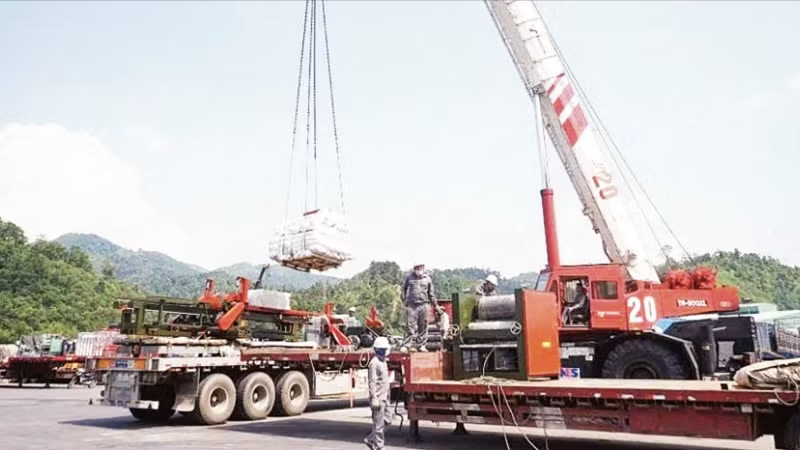
In logistics and market development, Nguyen Thi Phuong, General Director of Huu Nghi Xuan Cuong Joint Stock Company in Lang Son Province, said that in 2026, import-export activities through border gates continue to show positive signs, driving up demand for labour in both quantity and quality.
The company is investing in yard infrastructure, bonded warehouses, specialised transport vehicles, and digital management platforms to enhance customs clearance capacity. Rising cargo volumes require faster processing, greater documentation accuracy, and tighter supply chain coordination. This calls for personnel with solid professional expertise, proficiency in management software, and a sound understanding of international trade regulations.
In 2026, the company is recruiting customs declaration specialists, international transport coordinators, warehouse managers, market development officers, and logistics data analysts. Candidates with strong foreign language skills, firm knowledge of import-export procedures, commercial law, and the ability to work with foreign partners are highly valued.
“Logistics is closely intertwined with regional and global trade fluctuations. Any change in policies, tariffs, or procedures directly affects business operations, so we prioritise personnel with strong market-oriented thinking and the ability to adapt quickly,” Phuong emphasised.
Alongside recruitment, the company is strengthening internal training, updating knowledge on digital transformation, document digitisation, risk management, and operational cost optimisation. High-quality human resources are regarded as the decisive factor underpinning competitiveness in the 2026–2030 period.
Overall, the 2026 labour market demonstrates expanded employment potential driven by economic recovery and deeper integration. Yet opportunity goes hand in hand with higher standards for workforce quality. This year’s trend is therefore shaped along two main axes: expanding opportunities and elevating competency standards. Growth and digital transformation create new positions while imposing stricter requirements on skills, professionalism, and continuous learning.
In this shifting economic structure, each worker must proactively reposition themselves. Digital competence, adaptability, and a commitment to self-improvement will determine who can seize emerging opportunities.