Reducing methane emissions is therefore urgent — not only a commitment but also an opportunity to innovate technology, improve production efficiency, protect the environment, and promote circular economic development.
Methane’s impact and global commitments
At the 2021 United Nations Climate Change Conference (COP26), the US and the European Union launched the Global Methane Pledge, aiming to cut global methane emissions by 30% by 2030 compared with 2020 levels.
Although voluntary and non-binding, more than 150 countries have joined, reflecting broad consensus on the importance of short-term methane reductions. Viet Nam has committed internationally and developed an action plan linked to climate security, public health, and domestic economic growth.
Methane contributes directly to global warming and intensifies extreme weather events. It is also a precursor to tropospheric ozone, causing air pollution, respiratory illness, and increasing cardiovascular risks.
According to the 2020 greenhouse gas inventory, Viet Nam’s total methane emissions reached about 111.28 million tonnes of CO₂ equivalent across agriculture, waste, and energy sectors.
Methane leaks from fuel extraction pose fire and explosion hazards while polluting surface and groundwater. Effective management could transform this environmental challenge into an opportunity to boost production efficiency, reduce healthcare costs, and enable green economic sectors.
According to the 2020 greenhouse gas inventory, Viet Nam’s total methane emissions reached about 111.28 million tonnes of CO₂ equivalent across agriculture, waste, and energy sectors.
Agriculture, forestry, and land use accounted for 69.55 million tonnes — over half of total methane emissions. Waste contributed roughly 26.43 million tonnes, mainly from solid waste landfills and wastewater treatment. The energy sector emitted about 15.3 million tonnes, primarily from fugitive emissions in oil, gas, and coal activities.
Challenges and pathways for Viet Nam
On August 5, 2022, the Prime Minister approved Decision No. 942/QĐ-TTg endorsing the methane emission reduction action plan, targeting at least a 30% cut by 2030 relative to 2020. While the direction is clear, implementation faces significant challenges.
The first challenge is resources. Technologies for capturing, treating, and utilising methane — from landfills and coal mines to gas plants — require substantial investment. Green finance mechanisms, preferential credits, and environmental investment funds remain nascent, small-scale, and difficult for enterprises to access.
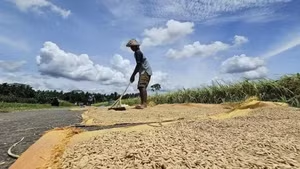
In rural areas, changing farming practices among millions of households is complex. Traditional wet-rice cultivation, post-harvest residue burning, and conventional livestock waste management demand effective models, technical support, and clear economic incentives to ensure sustainable change.
Another bottleneck is data and monitoring capacity. Many emission factors specific to Viet Nam are still under development, while local measurement, reporting, and verification systems remain inconsistent. This affects emission reduction assessments and limits Viet Nam’s ability to engage deeply in carbon markets and mobilise international resources.
Coordination mechanisms among sectors and regions also remain uneven. Methane reduction from a landfill or rice field is not a single-sector issue but involves land-use planning, public finance, farmer and enterprise support policies, and science and technology.
Methane reduction delivers rapid climate benefits and immediate improvements in air quality, public health, and resource efficiency.
Dr Luong Quang Huy of the Climate Change Department
Dr Luong Quang Huy of the Climate Change Department notes that methane reduction delivers rapid climate benefits and immediate improvements in air quality, public health, and resource efficiency. Agriculture’s priorities are two hotspots: wet rice and livestock.
For rice cultivation, the focus is on shifting techniques, adopting alternate wetting and drying irrigation, climate-smart farming, and expanding rice-shrimp and rice-fish models suited to ecological zones. Livestock goals include increasing biogas waste treatment and improving feed and herd management to reduce emissions from digestion and manure decomposition.
Waste management is moving from simple landfill disposal to integrated treatment with energy and resource recovery, alongside increased waste sorting, recycling, and reuse. Public-private partnership projects are proposed for solid waste and wastewater treatment, encouraging enterprises to invest in waste-to-energy and biogas plants to reduce landfill emissions. Methane monitoring and inventory systems will be established at large production facilities, livestock farms, and landfills.
Enterprises must proactively invest in and apply effective mitigation technologies, develop roadmaps, and integrate methane reduction into sustainable development strategies. Building and refining carbon credit management mechanisms, while embedding methane reduction goals into socio-economic development plans, will ensure environmental targets become central to development.