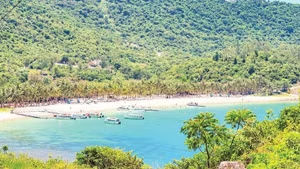
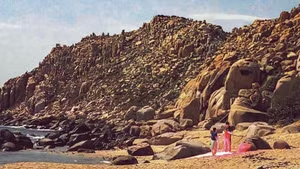
Con Dao has a distinctive island and marine environment, holds an important position in terms of national defence and security, and serves as a destination for cultural, historical and marine ecotourism of national and international significance. As part of its overall development orientation, Ho Chi Minh City has identified the development of Con Dao under a controlled green and smart island model.
Green lifestyles and daily practices
In recent years, Con Dao has welcomed an average of around 500,000-600,000 visitors annually. Most visitors come to the island not only to relax and enjoy its fresh air but also for spiritual purposes, including paying tribute to fallen heroes. Green lifestyles and daily practices have taken shape in Con Dao over many years. Visitors are gradually becoming accustomed to seeing everyday items made from environmentally friendly, reusable materials, such as toothpaste packaged in small paper bags and drinking water served in glass bottles.
Incense sticks, fresh flowers and offerings presented at Hang Duong Cemetery, Hang Keo Cemetery and the Con Dao Martyrs' Temple convey the affection, gratitude and remembrance of local residents and visitors. However, this also raises the question of how to ensure that spiritual activities remain solemn while minimising their impact on the landscape and the environment, as well as the risks they pose. In addition, many visitors to Con Dao have traditionally brought offerings accompanied by the burning of votive paper. Statistics show that in the past, around 1,500 sets of votive paper offerings were burned each day at historical sites on the island.
In response to this situation, Con Dao authorities began taking steps in 2024 to restrict the burning of votive paper, with a view to imposing a complete ban. The “green offering basket” model, proposed by the Management Board of the Con Dao Special National Relic Site, was approved by the local authorities for implementation. Accordingly, instead of offering baskets made and decorated with single-use, non-biodegradable materials such as foam, polystyrene, nylon and plastic bottles, green offering baskets are made from environmentally friendly materials such as wood and bamboo, woven sedge and water hyacinth, with flowers arranged in young banana trunks and water held in paper cups.
In late October 2026, when returning to Con Dao after many years, Nguyen Ngoc Quang, a visitor from Ha Noi, was delighted to find that the island remained unspoilt, with its landscape better maintained, cleaner and more beautiful. What impressed him most was the absence of scenes of votive paper burning, which had caused smoke and paper dust at Hang Duong Cemetery, and the introduction of “green offering baskets”.
“I fully support the ban on burning votive paper in Con Dao and the use of only biodegradable, harmless and reusable materials. If we do not start taking action now, pollution could become a real threat as the number of visitors to Con Dao continues to rise,” Quang shared. The support and agreement expressed by this visitor reflect the common attitude and actions of visitors, local residents and traders in Con Dao.
According to Pham Thi Tam, Deputy Director of the Ba Ria-Vung Tau Museum-Library (Con Dao branch), the “green offering basket” programme was initially implemented every Saturday. It was subsequently held for one week each month. Since January 1, 2025, the programme has been carried out every day. “When it was first introduced, some traders had reservations and some visitors were surprised. However, after two years, local residents and visitors have become accustomed to this green lifestyle and increasingly support it,” Tam said.
In addition, nearly 20 years ago, Con Dao National Park began implementing various projects and programmes to conserve, protect and expand green areas around the islands, particularly the mangrove forests surrounding them. Nguyen Khac Pho, Director of Con Dao National Park, said that in 2008-2009, the park began planting mangrove forests on Hon Ba Island, followed by further planting at Bai Duong on Hon Bay Canh Island. To date, nearly 10 hectares of mangrove forest have been planted at these two locations.
“Mangrove forests around the islands and shallow rocky areas provide breeding and sheltering grounds for many species of living organisms. The benefits are clearly evident: there are now more snails in the mangrove forests, and many fish come here to lay their eggs. We are currently implementing a coral nursery project with 10,000 coral fragments. Once the corals have grown, they will be used for planting at Bai Ong Dung and Bai Dat Tham,” Pho said.
Prioritising Con Dao's conservation
At its sixth (thematic) session in late October 2026, the Ho Chi Minh City People's Council adopted the city's master plan for the 2025-2050 period, with a 100-year vision. The plan designates Con Dao as one of the city's satellite centres, with development oriented towards marine and island ecotourism, historical and heritage tourism, high-quality resorts, nature conservation and scientific research, all linked to the protection of forest and marine ecosystems, national defence and security, and the development of a green, low-emission island.

Many experts and visitors to Con Dao share the view that, although concrete construction in the island's central area has accelerated somewhat in recent years, the island has basically retained its pristine, original character. This is encouraging. Given its new status, managing and developing Con Dao requires a distinctive, different and sustainable approach to the management of a coastal and island urban area.
Many scientists affirm that Con Dao's economy can only develop on the basis of ecotourism. Dr Nguyen Chi Thanh, Director of the Centre for Forest and Wetland Research, said that to conserve, protect and promote the island's natural values, planning schemes and directives must be translated into specific regulations. “The preservation of its pristine character must be regarded as a mandatory criterion when determining ecotourism products,” Dr Thanh proposed.
According to many scientists, Con Dao cannot be developed according to the conventional urban model or through mass tourism. Instead, it must position itself as a “paradise for resort and ecotourism”, based on three core pillars: “green island – smart island – liveable island”. One point highlighted by many scientists is that development in Con Dao must be subject to limits determined by the carrying capacity of its ecosystems, taking into account pressure on infrastructure, clean water supplies and waste treatment. This is because Con Dao has specific constraints in terms of land availability, water resources, energy, waste treatment and the natural environment's capacity for recovery.
The city's master plan for the 2025-2050 period, with a 100-year vision, identifies the conservation of Con Dao National Park and its forest, wetland and marine ecosystems as priorities, alongside the preservation and promotion of the value of historical and cultural relics. The plan also emphasises that tourism activities in Con Dao must remain within the ecosystem's carrying capacity, with a focus on high-quality tourism, green infrastructure, clean energy and solutions to reduce environmental impacts.
Bui Minh Thanh, Vice Chairman of the Ho Chi Minh City People's Committee, affirmed: “The city's consistent position is that it will not trade the environment, natural resources or historical heritage for short-term economic growth. Conservation must become the foundation, driving force and long-term competitive advantage of Con Dao.”