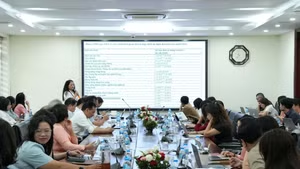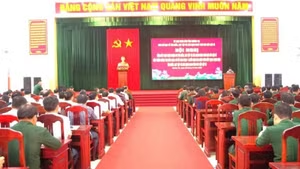
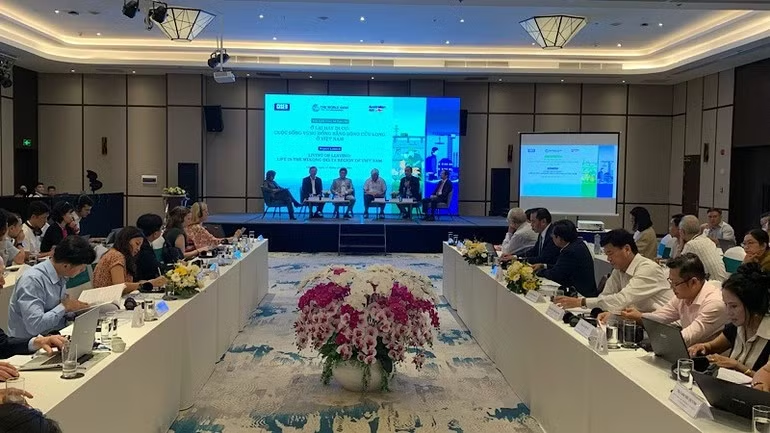
The conference was attended by Nguyen Anh Tuan, Party Central Committee Member and Deputy Head of the Central Policy and Strategy Commission; representatives of leaders from provinces and cities in the Mekong Delta region, as well as from the World Bank; and scientists and business representatives with long-standing engagement in the region.
The report said that the Mekong Delta is at a critical period in its development process. For decades, the region has been one of the country’s key agricultural production areas and has played a central role in national poverty reduction. However, in recent years, poverty rates have begun to rise again after many years of continuous decline.
Farming households’ incomes have weakened. Households are increasingly vulnerable to climate and environmental risks, particularly drought, saltwater intrusion, and extreme heat. These pressures have contributed to increasing migration as people leave the region to find jobs and earn livelihoods.
The region is facing challenges and vulnerabilities from drought, saltwater intrusion, and the Covid-19 pandemic, which have pushed many households back into poverty and eroded their assets. Nearly half of the region’s population currently lives in areas exposed to many risks, with salinity intrusion and land subsidence becoming increasingly severe.
The rates of the labour force employed in agriculture in the Mekong Delta remains significantly higher than in other regions of Viet Nam. This indicates that while the country as a whole has undergone rapid structural transformation, shifting labour from agriculture to higher-productivity sectors, but the Mekong Delta has lagged behind.
Many people continue to work in low-productivity sectors. Even when they move out of agriculture, their incomes remain lower than those in other regions. This constrains common income growth and leaves households more vulnerable to shocks.
The report also recommends that authorities at all levels and sectors invest synchronously in people, infrastructure, and climate-adaptive agriculture. Agriculture should shift towards higher-value crops, diversified systems, and modern agricultural extension services; logistics costs need to be reduced; transport, energy, and digital infrastructure should be upgraded; and housing, jobs, and services must be ensured so that migrants are not disadvantaged.
Speaking at the conference, Nguyen Tuan Anh, Deputy Head of the Central Policy and Strategy Commission, affirmed that Politburo’s Resolution No. 13-NQ/TW requires renewed development thinking for the Mekong Delta: moving from sector-by-sector and locality-based approaches to integrated, inter-regional approaches; shifting from “reacting” to proactively adapting; and consistently placing people at the centre of development. In this regard, the analyses and recommendations in the World Bank report is greatly similar and complement the major orientations of the resolution.
The key issue facing the Mekong Delta is not whether people “stay or migrate”, but how to enable them to “live better”, regardless of where they choose to live.
From a national strategic perspective, the core issue is creating a sufficiently attractive, safe, and inclusive development environment so that people in the Mekong Delta can feel secure in their livelihoods or proactively seek new development opportunities elsewhere without becoming vulnerable. This spirit is also clearly reflected in the Draft Political Report to the 14th National Party Congress, which emphasises requirements of inclusive development, upgrading human resource quality, and strengthening the resilience of the socio-economic system against external shocks, especially climate change.