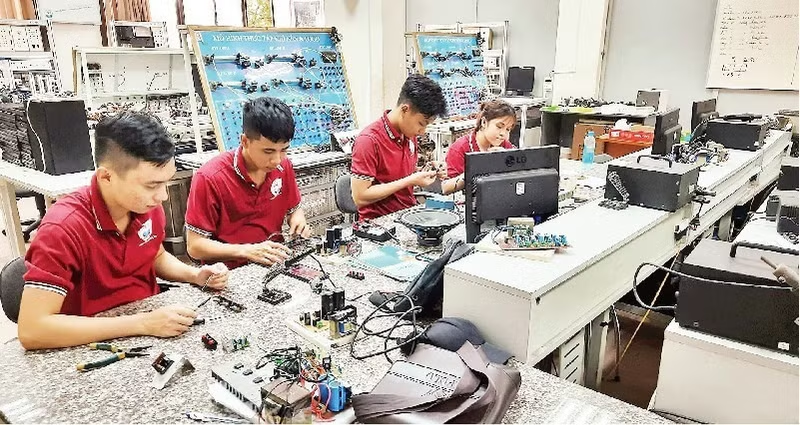
The draft affirms that developing human resources, particularly a high-quality workforce, is the decisive factor in implementing a new growth model based on science, technology, innovation and digital transformation.
It calls for stronger attraction and effective utilisation of talent through breakthrough mechanisms and policies to identify, nurture and deploy talent across the political system and all areas of social life. Salary policies and working conditions should also be improved to retain elite human resources.
Fundamental reform of education and training is emphasised, alongside the development of long-term strategies for the young workforce to help them master technology and nurture a strong aspiration to contribute.
Human resource development must go hand in hand with institutional reform. The draft stresses the need to synchronously improve institutions in order to create the most favourable environment for human resources to fully realise their potential.
According to Associate Professor Do Thi Tuoi, Head of the Department of Human Resource Management at the University of Labour and Social Affairs, to develop human resources that meet the requirements of the new era, the development of high-quality human resources must be regarded as a strategic breakthrough.
In the context of the Fourth Industrial Revolution, human resources are not merely a factor of production but must become the core of all change and the main driving force for overcoming the middle-income trap. At the same time, training must move beyond a local mindset towards the standard of the global citizen.
Viet Nam’s workforce needs to be equipped not only with strong professional expertise but also with digital skills, foreign language proficiency and a high capacity to adapt in multicultural working environments; it must possess a strong aspiration to contribute, along with creative and innovative thinking, and the ability to master technology rather than merely use it. Particular attention should be paid to building an elite workforce in key areas such as artificial intelligence, semiconductor and green transformation.
Achieving these goals requires breakthrough mechanisms in recruitment, remuneration and recognition to attract talent into the political system and major economic groups, while also creating the best possible working environment to retain and maximise the potential of intellectuals at home and abroad.
Associate Professor Tuoi also hopes that, in the coming years, Viet Nam’s education and training sector will thoroughly address the persistent mismatch between school-based training and the needs of businesses.
For example, the tripartite cooperation model among the state, educational institutions and enterprises has proven effective in practice and should be expanded. Training programmes should place greater emphasis on quality accreditation in line with international standards so that Vietnamese qualifications gain wider international recognition.
In recent years, numerous seminars on human resource development in Viet Nam have pointed to globalisation as an inevitable trend of the times. This trend offers many opportunities for countries and facilitates the development of organisations and businesses.
Globalisation enables every citizen to become a global citizen; coupled with the rapid expansion and development of information technology, science and engineering, it has created both opportunities and challenges for developing high-quality human resources to international standards.
In this context, many educational institutions have proactively strengthened cooperation with organisations in training and scientific research, and implemented advanced, effective training models so that graduates are well qualified and confident to participate in the domestic and international labour markets.
However, global citizens in developing countries also face certain risks, such as the loss of cultural identity and brain drain.
To avoid these risks, Associate Professor Tuoi argues that Viet Nam’s human resources should be developed in line with the principle of integration without assimilation, closely combining international skills with cultural identity and national pride.
Viet Nam’s labour market remains in a period of transition. Developing global citizens will be one of the fundamental values contributing to enhanced competitiveness and sustainable development.