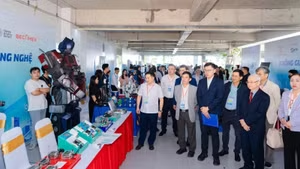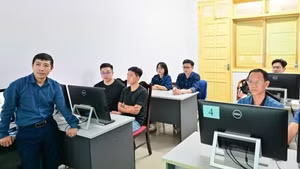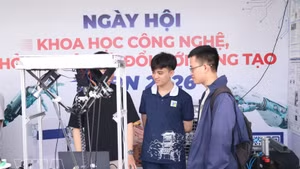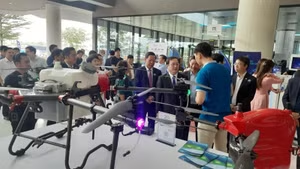
Putting ideas to the test in real-world settings
The National Innovation Centre (NIC), the United Nations Development Programme (UNDP) in Viet Nam, and Samsung are implementing the RE:ACT project—a youth innovation challenge for sustainable communities.
The project directs participating teams toward addressing real-life issues such as bridging the digital divide, supporting people with disabilities, energy conservation, safe chemical management, and the circular economy.
Following a selection process, 20 teams will undergo training and mentoring and pilot their solutions over six months; each team is eligible for a non-repayable grant of up to 15,000 USD.
Notably, the ideas do not stop at the proposal stage but are developed through a comprehensive process—from problem identification, solution development, and prototype refinement to real-world testing.
According to the NIC, the program aims to enhance the feasibility of youth-led initiatives, thereby increasing the likelihood that these solutions will generate tangible value for the community.
Another model implemented by the NIC, the UNDP, and their partners also demonstrates a comprehensive support approach spanning the journey from idea to market.
At the Demo Day 2026 event for the Viet Nam-Japan Incubation Programme, five out of the 12 participating startups signed memoranda of understanding or contracts with Japanese enterprises after completing a six-month incubation period.
These startups received training, connected with businesses, experts, and market partners, and piloted various operational models. NIC Deputy Director Do Tien Thinh stated that nearly 20% of the startups have secured opportunities for international commercial collaboration or investment, resulting in the establishment of over 10 investment and commercial partnerships.
In many localities, startup activities still lack connections to markets, mentors, and appropriate capital sources, whereas deep-tech startups require significant time and resources to develop.
Consequently, innovation centres, universities, research institutes, and investment funds need to strengthen their role in linking ideas, knowledge, capital, and markets.
This gap is particularly evident for enterprises born out of research findings; many technologies remain at the project or experimental stage without successfully transitioning into commercial products.
Furthermore, spin-off enterprises from research institutes and universities face challenges regarding capital, regulatory mechanisms, and market linkages.
Experts suggest that, alongside policy refinement, businesses need support in selecting programs tailored to their specific development stages to access resources more effectively.
At the same time, it is essential to create more space for technologies to be tested, refined, and perfected before entering the market.
From practical challenges to testing environments
Several localities are gradually creating opportunities for businesses to test and refine technologies through various mechanisms.
Ha Noi is implementing controlled testing mechanisms (sandboxes) for specific new technology sectors, establishing a venture capital fund based on a “public investment, private management” model, operating an exchange for trading ideas, and reviewing a proposal to test Phenikaa-X’s Level 4 autonomous vehicle system.
Alongside the creation of testing spaces, policies providing direct support for product development are also being implemented.
In Ho Chi Minh City, innovative startups in the digital technology industry receive support covering 50% of research, development, and pilot production costs, up to a maximum of 150 million VND per project. Support for technology licensing and innovation reaches up to 400 million VND per project.
As for Hai Phong, capital and pilot mechanisms are being combined through venture capital funds and regulatory sandboxes targeting semiconductors, AI, and Net Zero initiatives. Among the 45 key projects receiving support, 68% are making positive progress, generating stable revenue, and creating jobs.
At the national level, the Programme for the Development of the Digital Technology Industry for the 2026–2030 period, with a vision to 2045 has identified the task of developing shared infrastructure to support research, testing, and verification.
Tran Anh Tu, Deputy Director of the Department of Digital Technology and Artificial Intelligence under the Ministry of Science and Technology, noted that the semiconductor sector specifically aims to develop infrastructure supporting pilot production and chip verification, as well as to operate a national centre for semiconductor pilot production.
Testing infrastructure becomes more effective when linked to specific real-world challenges. Currently, cities and localities are grappling with issues in transportation, the environment, healthcare, education, logistics, digital transformation, energy, and urban governance; these challenges can serve as problem statements for startups, technology enterprises, and research groups to develop solutions.
The Viet Nam-Japan Incubation Programme serves as an example, where challenges in agriculture, healthcare, manufacturing, logistics, emissions reduction, and education are connected with technological solutions, standards, and market partners.
This is particularly crucial for new technologies, as enterprises seeking long-term investment in core technologies require real-world problems, initial markets, and environments for product validation.
According to Tran Anh Tu, the digital technology industry development program prioritizes the commissioning of tasks, procurement, and the leasing or purchasing of digital technology products and services; it also promotes the use of “Make in Viet Nam” digital technology products and services, connects supply and demand, and stimulates the domestic market.
Consequently, testing and market engagement need to be integrated into a unified process: testing infrastructure helps refine the technology, while commissioning, procurement, and initial customers create opportunities for the product to advance toward commercialisation.
Viet Nam’s startup ecosystem currently comprises approximately 4,000 startups and is set to enter the global top 50 rankings by 2026.
As the ecosystem shifts its focus toward quality, the ability to commercialise technology, scale businesses, and launch competitive products into the market is becoming increasingly critical.
Alongside incubation programs, various policies—ranging from the central to local levels—are creating favourable conditions for ideas to evolve into prototypes, undergo testing, and reach the market.
Access to validation environments and real-world challenges will enable these ideas to be refined and applied, ultimately generating economic value.