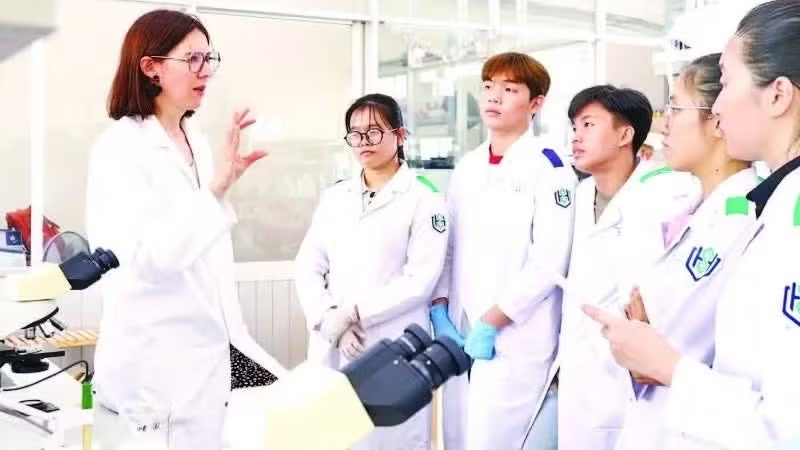
Dr Vu Thanh Binh, Deputy Director of the Department of Science, Technology and Information under the Ministry of Education and Training, said that efforts have been made in recent years to strengthen and develop the scientific workforce in higher education institutions in terms of both quantity and quality, with the aim of improving the effectiveness of science, technology, and innovation activities.
In particular, the number of professors, associate professors, and PhDs has increased rapidly, providing an important foundation for enhancing research capacity.
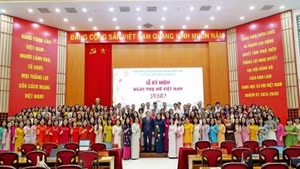
Higher education institutions under the Ministry of Education and Training currently have 281 professors, 2,472 associate professors, 8,768 PhDs, and 15,317 master's degree holders. These intellectuals are an important resource for improving the quality of scientific research and innovation and meeting the development requirements of higher education amid ongoing reforms.
At the same time, to help improve the quality of and strengthen the presence of Vietnamese science at international academic forums, the Ministry of Education and Training has directed higher education institutions to increase both the quality and quantity of international publications in prestigious scientific journals indexed by Web of Science (WoS) and Scopus.
As a result, in 2025, a total of 6,051 articles were published in journals indexed by Web of Science (WoS), 4,177 in journals indexed by Scopus, and 2,670 in other international journals.
Notably, research activities at higher education institutions have also been directed towards strategic technology fields, while providing scientific evidence for policymaking on education and training development as well as the country's socio-economic development.
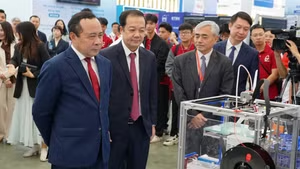
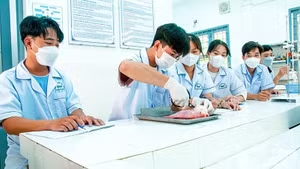
Many higher education institutions have focused on developing strong research groups, investing in modern laboratories, strengthening international cooperation, and promoting interdisciplinary research, laying the foundation for the development of core and strategic technologies.
Several science and technology projects in higher education have been completed, producing highly applicable products, technological processes, software, equipment, and technical solutions.
A notable example is Ha Noi University of Science and Technology, which has developed software that automatically generates PET images from CT images to support cancer diagnosis, thus helping to improve the quality of medical imaging, reduce investment costs for medical equipment, and promote the application of artificial intelligence in healthcare.
The university has also successfully researched the architecture and xAPP software modules for Open RAN 5G/6G networks, laying the groundwork for mastering next-generation network technologies and serving the development of national digital infrastructure and the telecommunications industry.
Despite these achievements, science, technology, and innovation activities in higher education still face shortcomings and limitations: investment resources remain fragmented; research facilities at many institutions do not yet meet the requirements for developing new and strategic technologies; and although research output has increased in quantity, the rates of commercialisation and technology transfer, as well as the creation of products with economic value, remain below their potential.
The implementation of new mechanisms and policies at some higher education institutions has also been slow, while their capacity to manage science, technology, and innovation activities remains uneven.
Therefore, further coordinated solutions, from State management agencies to higher education institutions, are needed to promote development.
From the perspective of building a science, technology and innovation ecosystem, Assoc Prof, Dr Bui Quang Hung, Director of the University of Economics Ho Chi Minh City, said consideration should be given to mechanisms supporting investment in research data infrastructure under an inter-university or discipline-based shared-use model, enabling universities without sufficient resources for individual investment to access international academic databases at reasonable costs.
It is also necessary to establish mechanisms for cooperation among higher education institutions, particularly strong universities, to make use of shared resources and infrastructure as well as multidisciplinary strengths.
Meanwhile, some experts and scientists have suggested that State management agencies should develop medium- and long-term science and technology programmes for higher education institutions, while completing mechanisms for investment in, management of, and shared use of laboratories, computing infrastructure, databases, and digital libraries among educational institutions, research institutes, and businesses.
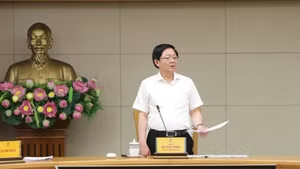
According to Deputy Minister of Education and Training Pham Quang Hung, to develop science, technology, and innovation, higher education institutions need to focus on five important shifts: from input-based management to governance based on objectives, outputs and impacts; from individual research projects to long-term research programmes, strong research groups, and centres of excellence; from the mindset of "research for publication" to research that creates knowledge and technology, trains human resources, and addresses practical problems; expanding the substantive cooperation among the state, universities, and businesses while strengthening international cooperation; and making targeted investments in basic science, education science, strategic technologies, and areas of strength at each institution.
The Ministry of Education and Training will continue coordinating with ministries and sectors to improve mechanisms and policies and address obstacles related to finance, assets, intellectual property, and the commercialisation of research results, thereby promoting science, technology, and innovation activities in higher education and achieving positive outcomes.