Modern agricultural trends
Over the past five years, agricultural products have not only ensured supplies for the domestic market but have also recorded strong growth in export turnover. However, the agricultural sector continues to face global challenges such as climate change, resource degradation, and increasingly stringent requirements from international markets, including traceability, low emissions, and environmental protection.
The strategic orientation towards green growth in agricultural production calls for stronger application of science and technology, with digital transformation being one of the important tasks to ensure food security as well as economic benefits.
According to the World Bank (WB), agroecology focuses on the interaction between the environmental, social, and economic aspects of the food system. The system must comprehensively apply smart and environmentally friendly processes and technologies, use inputs and resources efficiently, increase product value, ensure green and sustainable growth, and promote the diversity and cultural values of the system.
The application of advances in science and technology, towards a circular agriculture that adapts to climate change and creates green and sustainable value chains, is a common trend in global agriculture today.
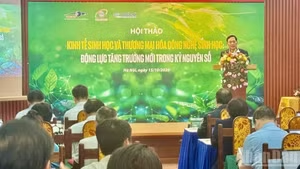
According to Dr Pham Hong Hien of the Viet Nam Academy of Agricultural Sciences (VAAS), green value chains will help the agricultural sector reduce losses during production and achieve low-emission targets; ensure product quality, increase value, protect the environment, and provide transparent traceability.
Therefore, the agricultural sector needs breakthroughs in developing production chains and forming circular value chains to meet environmental requirements, reduce emissions, improve resource-use efficiency, and enhance the competitiveness of products. Accordingly, a prerequisite for building and managing green value chains is the integration of multiple scientific and technological solutions, including biotechnology, modern agricultural engineering, and digital technology.
Bottlenecks to be addressed
Research by VAAS scientists shows that the application of science and technology in managing green value chains worldwide covers the entire process from production to consumption. Production technologies are deployed from the stages of variety selection and breeding, including gene editing, molecular markers, tissue culture and cloning, disease-free varieties, and crossbreeding, to modern cultivation technologies such as climate-smart farming, irrigation and fertiliser management and optimisation, intercropping, polyculture, circular farming, smart farms, GIS, and drones.
Biotechnology and microbiological technologies are also applied, including organic and microbial fertilisers, enzyme and microbial technologies, biological plant protection products, biological traps, and IoT in pest and disease management.
Technologies applied in processing and preservation include controlled-atmosphere technology, cold-drying technology, and bio-packaging technology. In consumption and chain management, many countries around the world have adopted blockchain for traceability; AI and Big Data for market forecasting; and farm and supply-chain management systems, enterprise resource planning (ERP), and logistics technologies.
In Viet Nam, a number of green agricultural value-chain models have gradually demonstrated their effectiveness. Smart rice cultivation models in provinces in the Mekong Delta use IoT, AI, and remote sensing to forecast weather, floods, and pests and diseases, while blockchain helps reduce irrigation water use by 30–50% and fertiliser and plant protection product use by 20%, with yields increasing by 10–15%.
The hydroponic vegetable–IoT–blockchain model in Da Lat, Lam Dong Province, applies recirculating hydroponic technology, pH and EC sensors, and automated greenhouses, helping increase yields sixfold, reduce irrigation water consumption by 80%, and eliminate the use of plant protection products.
A low-carbon coffee production model in Dak Lak Province has reduced irrigation water use by 40%, increased yields by nearly 30%, and cut CO2 emissions by 20%. In the north, various technologies have also been applied in fruit-growing areas in Son La, helping concentrated growing areas reduce labour costs by 30% and increase the proportion of Grade 1 fruit meeting EU market standards to up to 90%.
The benefits and effectiveness that science and technology bring to green agricultural value chains are indispensable in the current context. However, bottlenecks remain to be addressed.
According to Master of Science Nguyen Huy Hoang of the National Institute for Economics and Finance under the Ministry of Finance, Viet Nam's agricultural sector does not yet have many large-scale production areas, making comprehensive implementation difficult. In addition, the transition from traditional production to the application of science and technology requires substantial capital, while an effective green credit system has yet to be established.
Meanwhile, domestic production is always in a reactive position as it has to “chase” technological standards applied in major markets. The formation of concentrated production areas is also still in its infancy, while regional linkages to establish green value chains towards large-scale circular agriculture have yet to take shape. The supply of highly skilled labour is also limited.
Organising agricultural production according to value chains towards the formation of regional-scale production is an inevitable requirement for green and sustainable agriculture, enhanced competitiveness, and international integration. To achieve this, in addition to requirements for capital and human resources, science and technology must be made a top priority for research, investment, application, and replication in the development of high-quality, green, sustainable, circular, and large-scale agricultural production.