From scientific research, seedling production and processing to quality verification and brand development, a modern medicinal herb ecosystem is being established, helping to strengthen the position of Da Nang’s Ngoc Linh ginseng on Viet Nam’s medicinal herb map.
Often referred to as the “billionaire plant”, Ngoc Linh ginseng has created sustainable livelihoods, contributed to poverty reduction, and improved living standards for people in the mountainous and border communes of Da Nang City.
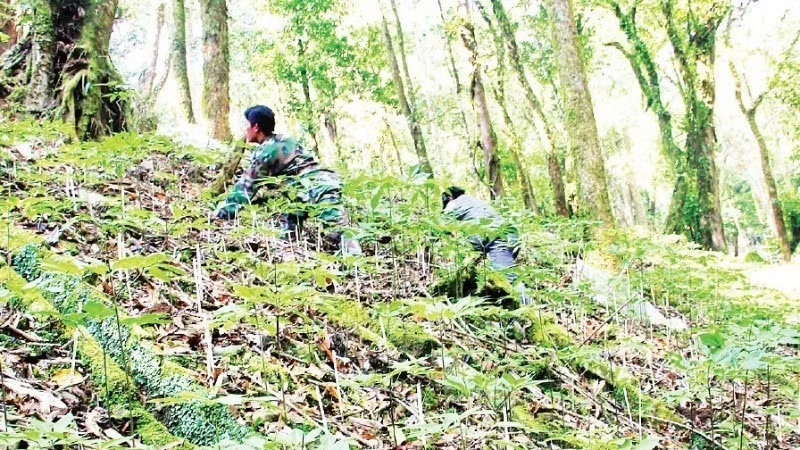
For hundreds of years, the Xe Dang, Ca Dong, and Bh’nong ethnic communities in the communes of Tra Linh, Tra Tap, Tra Van, Tra Leng, and Nam Tra My have cultivated and nurtured wild Ngoc Linh ginseng beneath the canopy of primary forests at elevations ranging from 1,200m to 2,000m.
The total cultivation area of Ngoc Linh ginseng in these communes has now exceeded 4,000 hectares. To date, Da Nang has 18 organisations and enterprises, along with 41 household groups, leasing forest environments for Ngoc Linh ginseng cultivation on a combined area of 825.44 hectares. More than 10 enterprises are involved in purchasing and processing Ngoc Linh ginseng.
These enterprises focus primarily on processed Ngoc Linh ginseng products, consuming approximately 50–60kg of raw materials annually.
In 2025, Da Nang approved the Programme for Research and Application of Science and Technology in the Development of Ngoc Linh Ginseng and Medicinal Herb Products for the 2026–2035 period, with a sustainable development orientation combined with genetic resource conservation.
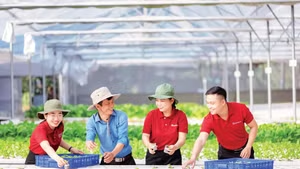
The programme promotes cultivation under forest canopies, greenhouse and net-house models, environmentally friendly production, eco-tourism, and healthcare services, contributing to the city’s sustainable socio-economic development during 2026–2035.
Currently, the Ngoc Linh Ginseng and Medicinal Herb Development Centre under the Da Nang Department of Agriculture and Environment manages 50.25 hectares of natural forest in Hamlet 2, Tra Linh Commune.
Areas designated for genetic resource conservation have been separately planned, while seedling production zones are being developed in a specialised manner to meet future cultivation demands.
The centre currently produces around 200,000 seedlings annually and aims to increase capacity to approximately 500,000 seedlings by 2030. In addition to preserving original genetic resources, the centre conducts scientific research, transfers technical advances related to Ngoc Linh ginseng and medicinal herbs, supplies seedlings and produces speciality products.
Pham Nam Son, Director of the Da Nang Department of Agriculture and Environment, said that the centre is developing a capacity enhancement project through 2030, with a vision to 2045, with a focus on five key areas: strengthening conservation and development of Ngoc Linh ginseng and medicinal herbs; expanding production and standardising seedling production processes; verifying the origin and provenance of seedlings; promoting scientific research and technology transfer; and enhancing cooperation and production linkages.
The project aims to transform the centre into a specialised scientific institution dedicated to Ngoc Linh ginseng and medicinal herbs. Da Nang is also working with THACO Group on a project entitled “Large-scale Industrial Cultivation of Ngoc Linh Ginseng Combined with Forestry Production and Medicinal Herb Cultivation Under Forest Canopies” in Tra Linh Commune and Tra Tap Commune.
The project covers a total area of 4,600 hectares, including 1,275 hectares for Ngoc Linh ginseng cultivation and 3,325 hectares for forestry production, medicinal herb cultivation under forest canopies, and supporting transport infrastructure.
Scheduled for implementation during 2026–2031, the project aims to sustainably develop Ngoc Linh ginseng raw material areas, increase economic value, and establish a closed value chain from production and processing to distribution, thereby contributing to local socio-economic development.
According to the development plan, Ngoc Linh ginseng cultivation areas will be established at elevations between 1,000m and 1,500m, with production organised on an industrial scale and integrated with medicinal herb and forestry cultivation.
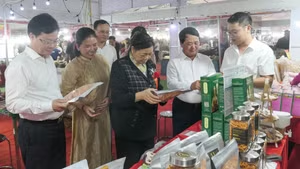
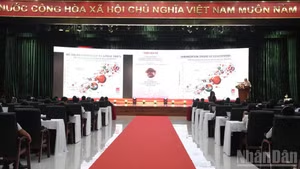
Ho Quang Buu, Vice Chairman of the Da Nang People’s Committee, said that the city has recently approved a programme to introduce and promote Ngoc Linh ginseng and medicinal herb products in 2026 under the theme: The Journey of the National Treasure Ngoc Linh Ginseng – Connecting Experiential Spaces for Ngoc Linh Ginseng and Da Nang Medicinal Herbs.
This is Da Nang’s first such initiative following the administrative reorganisation, aimed at implementing government and municipal policies on the development of Ngoc Linh ginseng and medicinal herbs while helping to establish a value chain encompassing production, processing, trade, and services.
The 11th Da Nang People’s Council for the 2026–2031 term recently adopted a resolution on mechanisms to encourage the conservation and development of Ngoc Linh ginseng and other medicinal plants during 2026–2030, with a total budget of approximately 136.4 billion VND.
Beneficiaries include local households, household groups, individuals, enterprises, cooperatives, and forest management entities investing in agriculture and rural development projects.
According to Trinh Minh Hai, Chairman of the People’s Committee of Tra Linh Commune, only 671.86 hectares of forest-front land have so far been leased in the commune. The area currently planted with Ngoc Linh ginseng is estimated at more than 2,000 hectares, with over 50 million plants.
The exceptional value of Ngoc Linh ginseng has not only helped residents of this highland commune escape poverty but has also enabled many to build prosperity.
During a field survey of Ngoc Linh ginseng cultivation areas in Tra Linh Commune, Le Ngoc Quang, Secretary of the Da Nang Party Committee, highlighted the need to secure long-term livelihoods for mountain communities. He noted that local Ngoc Linh ginseng cultivation remains largely spontaneous and small-scale, calling on the city to urgently review land resources and plan concentrated medicinal herb zones.
He also stressed the importance of implementing a project to establish a regional centre for research, genetic resource conservation, and ginseng seedling development, with the aim of fostering cooperation among multiple localities.
Relevant authorities were urged to accelerate the identification of cultivation zones, develop standards, establish traceability systems, and strengthen the Ngoc Linh ginseng brand in order to combat counterfeit and low-quality products in the market.