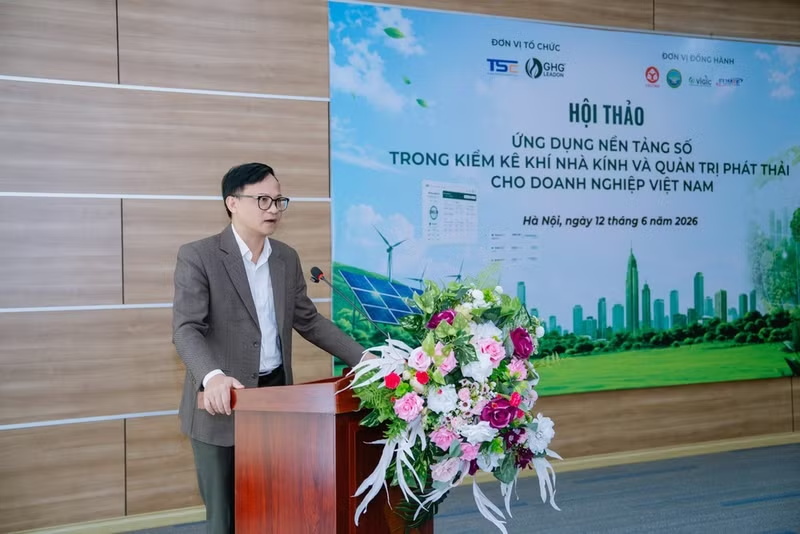
Speaking at the event, Pham Duc Nghiem, Deputy Director of the MST’s National Agency for Startups and Technology Entrepreneurship, noted that in recent years the Party and State have issued numerous important policies to promote science and technology, innovation, and digital transformation, placing enterprises at the centre of the national innovation ecosystem.
He emphasised that alongside digital transformation, the trend towards green growth and sustainable development is opening new opportunities for the business community. The application of digital technology not only helps enterprises strengthen governance capacity but also facilitates access to green investment resources, new markets, and deeper participation in global value chains.
Looking ahead, he stressed, digital platforms and technological tools will continue to support the business community in enhancing governance capacity, promoting innovation, accessing green development resources, and expanding opportunities to enter international markets.
For his part, Luong Quang Huy, Head of the Greenhouse Gas Emission Management and Ozone Layer Protection Division at the Department of Climate Change, under the Ministry of Agriculture and Environment, reported that Viet Nam has been gradually completing the legal framework for greenhouse gas emissions management since the 2020 Law on Environmental Protection came into effect.
This is evidenced by the fact that in 2022, 1,912 facilities were required to conduct greenhouse gas inventories, a figure that had risen to 2,166 by 2024. At the same time, Viet Nam is implementing a roadmap to develop and pilot a domestic carbon market for major emitting sectors such as thermal power, steel, and cement.
At the workshop, participating enterprises discussed practical issues such as defining the scope of inventories, data collection methods, selection of emission factors, report standardisation, and aligning internal data with the requirements of regulators and international partners. Small and medium-sized enterprises requested clearer, more practicable guidance, as they lack dedicated environmental units.
They agreed that effective implementation of greenhouse gas inventories requires the coordinated combination of three elements: a clear legal framework, appropriate technological tools, and a sufficiently capable workforce. Digital platforms, they pointed out, act as a bridge, helping enterprises simultaneously meet domestic regulatory requirements, international standards, and operational needs.





![[Video] Resolution No. 10 repositions FDI in Viet Nam's new development strategy](https://en-cdn.nhandan.vn/images/5992a12dd6e78b9bfb434962ff1830731c3ef6c1538d722fbb2593b0fa31ecfea73ea406e335bb4f889623e75863a3fa5de1ba084f5b1db0b5788c84a44f1d4c/anh-dai-dien.jpg.avif)