It also represents a strategic solution enabling Viet Nam to proactively build a financial ecosystem capable of attracting high-quality global capital to directly support the development of the country’s economy.
Shifting from attracting capital to building an ecosystem
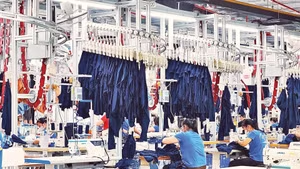
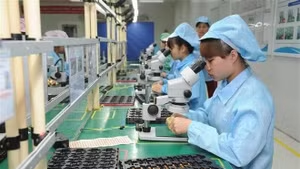
For many years, Viet Nam has been among the leading destinations for foreign direct investment (FDI) and has become deeply integrated into global manufacturing supply chains. However, domestic enterprises have continued to conduct most of their international fundraising, financial structuring and cash-flow management through regional financial centres such as Singapore and Hong Kong (China).
Although the economy has developed considerable manufacturing strengths, it has yet to participate in the highest value-added segment of international capital services.
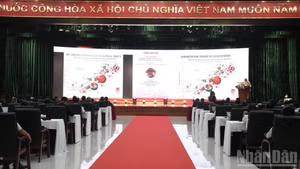
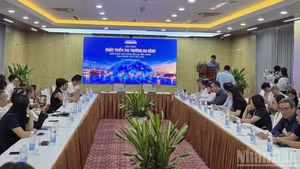
Addressing the national conference on implementing the Politburo's resolution on developing the foreign-invested sector, Ho Chi Minh City Chairman Nguyen Van Duoc frankly acknowledged that the city's traditional growth drivers — labour-intensive industries, land resources, and conventional tax incentives — had reached their limits. As countries increasingly compete on institutional quality, the business environment, and innovation capacity, Ho Chi Minh City will struggle to attract the next wave of strategic investment unless it creates new space for development.
“Therefore, the city has identified a fundamental and breakthrough transformation: shifting decisively from the mindset of attracting projects to building an ecosystem and fostering innovation in order to attract the next generation of investment capital,” Duoc emphasised.
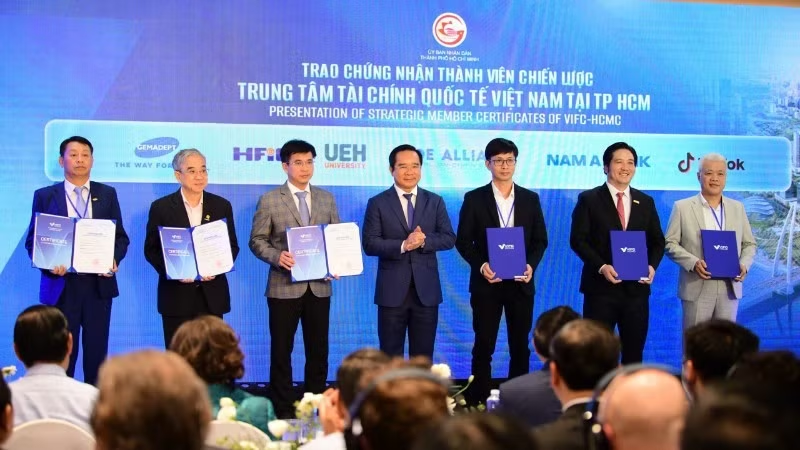
The launch of VIFC-HCMC in February 2026 marked an important step towards elevating Viet Nam's economic standing. The new framework is underpinned by National Assembly Resolution 222/2025/QH15 on the International Financial Centre in Viet Nam.
The resolution establishes a special policy framework allowing the application of exceptional mechanisms covering foreign exchange, taxation, and investment. It also provides for flexible regulatory sandboxes for financial technology (fintech) and an independent international arbitration system to protect investors.
Unlocking financial flows for the economy
What distinguishes VIFC-HCMC from many financial centres around the world is its unique development model. Rather than relying on speculative asset trading or short-term capital flows, it is designed as a multi-layered structure directly connecting global capital with the development needs of the real economy.
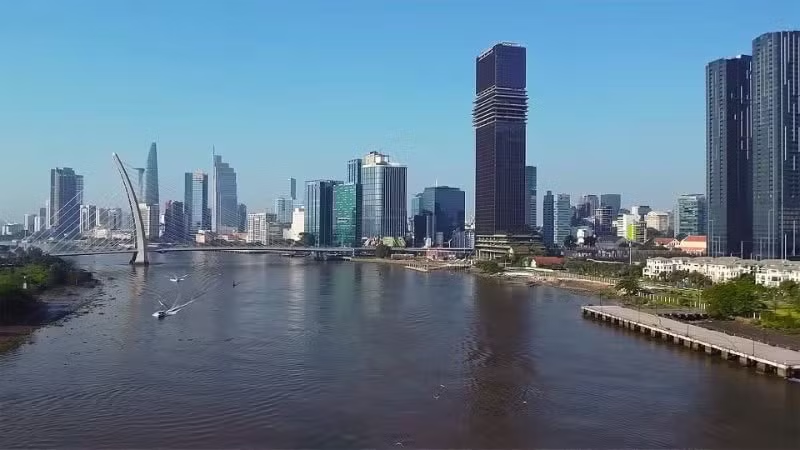
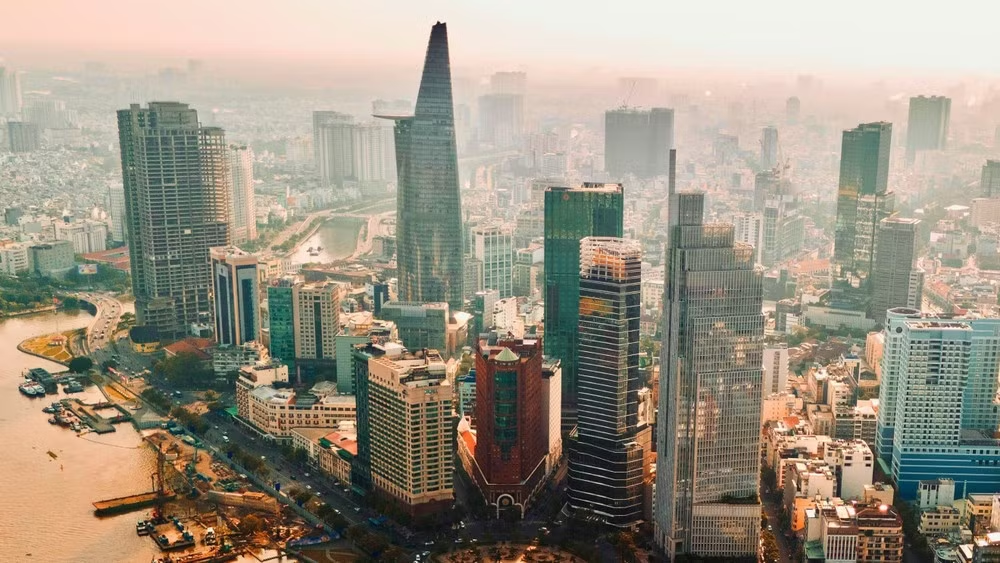
The ecosystem in the Thu Thiem New Urban Area is being built around four strategic pillars: international capital markets; trade finance services; digital banking and fintech; and specialised markets including carbon credits, green finance, and a centralised gold exchange.
The country’s financing requirements for the next stage of development are enormous. During the 2026-2035 period, Viet Nam is expected to require between 1.5 and 1.6 trillion USD in total social investment to achieve its sustainable development objectives, while the state budget is projected to meet only around 20% of that demand.
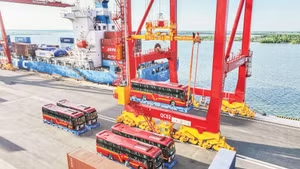
In Ho Chi Minh City alone, total social investment demand for the 2026-2030 period is estimated at more than 3.2 quadrillion VND (121.6 billion USD) to implement strategic mega infrastructure projects, including metro lines, ring roads, seaports, logistics facilities, and digital transformation initiatives.
Emphasising the importance of the International Financial Centre in mobilising investment, Chairman Nguyen Van Duoc affirmed that VIFC-HCMC would serve as the country’s strategic gateway for attracting capital to address this challenge comprehensively.
The centre will host the headquarters of global investment funds, investment banks, asset management companies, and financial technology centres – institutions capable of coordinating and directing long-term investment into strategic infrastructure projects in Viet Nam and Ho Chi Minh City.
A convergence of intangible value and investor confidence
International experts believe that Viet Nam has a valuable opportunity to establish its position on Asia’s financial map within the next two to three years.
Professor Andreas Stoffers of the FOM University of Applied Sciences in Germany observed that global financial competition has fundamentally changed. Success is no longer measured by the scale of impressive skyscrapers but increasingly by capabilities in real-time data processing, artificial intelligence, blockchain technology, and green finance. As a late entrant, Ho Chi Minh City enjoys the advantage of adapting rapidly to this new-generation financial model.
However, Professor Stoffers also cautioned that a sustainable financial centre must be built on a foundation of trust, a reliable and predictable legal system, and effective links with the real economy.
Sharing this view, Richard D. McClellan, Chief Executive Officer of VIFC-HCMC, said that the factor international investors value most is not simply tax incentives, but effective implementation and operational flexibility, in other words, a mechanism that enables capital to enter efficiently, operate smoothly, and exit safely when required.
Chairman Nguyen Van Duoc also highlighted the importance of acquiring intangible value through the VIFC-HCMC ecosystem. This includes cutting-edge financial technology, advanced governance aligned with international transparency standards, cross-border digital data systems, and the global knowledge networks of international experts.
These, he stressed, are the truly vital resources that will strengthen Viet Nam's competitiveness and elevate its economic position to higher levels of the global value chain.
With strong commitment from the Ho Chi Minh City authorities, implementation of the VIFC-HCMC project is accelerating on multiple fronts, from the development of a 2 billion USD data infrastructure project led by the G42 consortium to international-standard talent development programmes.
As it works towards bringing the centre into full operation, Ho Chi Minh City is striving to create a new development space that will contribute to the sustainable growth of the national economy.