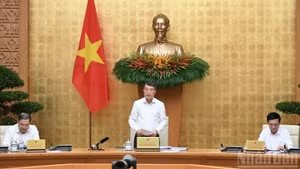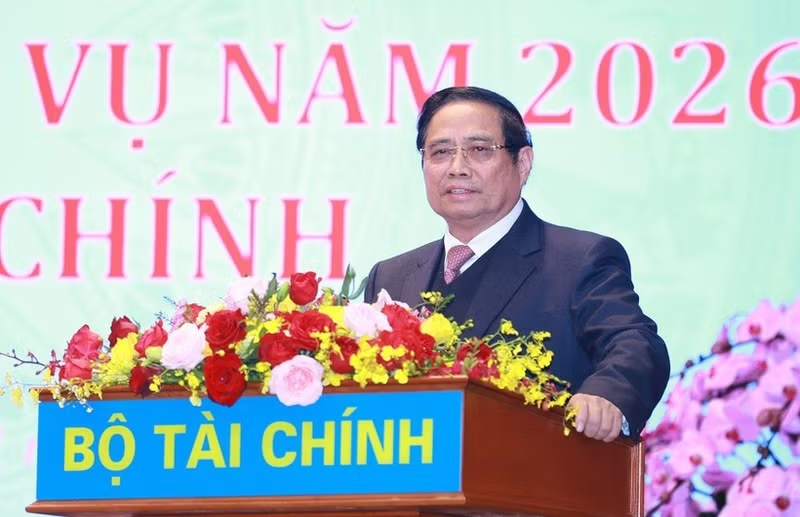
The Government leader made the request while attending a Ha Noi conference reviewing the sector’s financial, budgetary, investment and socio-economic development efforts in 2025 and outlining tasks for 2026. Addressing the event, PM Chinh affirmed that among the country’s overall achievements in the past year, the finance sector made particularly important contributions with many notable results.
He also pointed out a number of challenges the sector must overcome, including the disbursement of public investment capital, development of the private economy, restructuring of State-owned enterprises, and pressure in macroeconomic management.
The leader stressed the need to turn institutions from a “bottleneck” into a national competitive advantage, and to shift from a “management” mindset to one of “creating and nurturing a development ecosystem.”
He urged the sector to build policy mechanisms that enable household businesses to grow into enterprises, small businesses into large ones, and large enterprises into even bigger, multinational corporations. It was also tasked with accelerating the disbursement of public investment and strategic infrastructure capital, focusing resources on mega-projects such as the North–South high-speed railway, the Lao Cai–Ha Noi–Hai Phong railway, and inter-regional expressway systems, under the principle of “capital waiting for projects, not projects waiting for capital.”
PM Chinh urged the ministry and the wider finance sector to play a key role in ensuring the smooth operation of the two-tier local government model, boost private-sector growth, and enhance the performance of state-owned enterprises. He emphasised the need to lead in digital transformation and innovation, push forward with international financial integration, and move quickly on launching a digital asset exchange and a national one-stop investment portal.
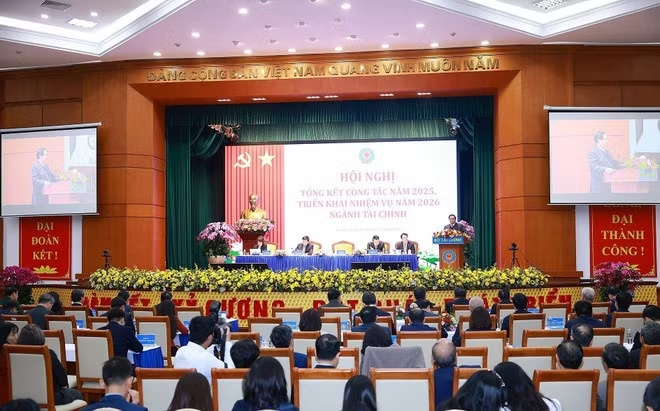
As heard at the conference, in 2025, the ministry was reorganised under a new model through the merger of the Ministry of Finance and the Ministry of Planning and Investment, the incorporation of Viet Nam Social Security, and the transfer of functions and tasks from the Commission for Management of State Capital at Enterprises and the National Financial Supervisory Commission. This restructuring reduced around 3,600 internal units, equivalent to 37.7%, while significantly improving the quality of State management.
The finance sector took the lead in institutional development by advising the Politburo on the issuance of key strategic resolutions, including Resolutions No. 57-NQ/TW, 59-NQ/TW, 66-NQ/TW and 68-NQ/TW. The ministry also chaired the submission of 15 draft laws and resolutions to the National Assembly.
The sector contributed to Viet Nam’s stock market being officially upgraded to a secondary emerging market. Notably, it also played a key role in implementing plans for an international financial centre in Viet Nam, developing free trade zones, and piloting a sandbox for digital asset markets, laying an important foundation for Viet Nam to keep pace with global financial and trade trends.
The ministry advised competent authorities to issue multiple resolutions that helped boost state budget expenditure to 2.4 quadrillion VND (91 million USD). Public investment disbursement saw a marked breakthrough, with the first 11 months of 2025 recording an increase of around 155 trillion VND compared to the same period in 2024, contributing to the near-1 quadrillion VND public investment disbursement target – the highest level ever achieved.
The ministry also proactively and promptly advised and implemented comprehensive fiscal and budgetary measures, allocating about 6.8 trillion VND to support provinces and cities in disaster prevention and response, recovery from natural disasters and epidemics, restoration of production, stabilisation of people’s livelihoods, and gradual socio-economic recovery.

![[Infographic] Key points from General Secretary and President To Lam’s opening remarks at the 14th PCC’S 4th plenum](https://en-cdn.nhandan.vn/images/j0QNt7m_5iy1OXpnUKiwG61aYhTv_B140GWhfriF26JwZbNNJ8LWetfvXUhz4Az6/1-8220.jpg.avif)