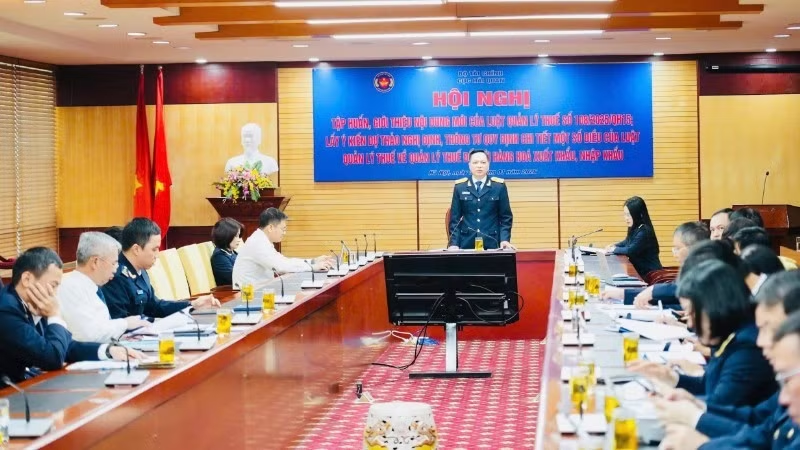
At the conference, representatives of the Customs Tax Operations Division under the Viet Nam Customs presented to officials and civil servants from units under the customs authority, regional customs sub-departments, and the business community the new contents and major amendments and additions in the Law on Tax Administration No. 108/2025/QH15.
The Law on Tax Administration No. 38/2019/QH14, effective from July 1, 2020, after more than five years of implementation, has made an important contribution to modernising tax administration, reforming administrative procedures, strengthening discipline and order in state budget revenue collection, and facilitating taxpayers’ compliance in accordance with regulations.
However, amid rapid socio-economic development and the emergence of many new economic models — such as digital assets, fintech and e-commerce — alongside a strong digital transformation, there is a need for a comprehensive revision of the Law on Tax Administration to meet the country’s new development requirements.
In 2025, Viet Nam Customs, in coordination with the Tax Department, submitted to the National Assembly of Viet Nam for promulgation the Law on Tax Administration No. 108/2025/QH15, which will take effect from July 1, 2026. Separately, the provisions on tax declaration and tax calculation for business households and individual business operators in Article 13, and the provisions on the use of electronic invoices in Article 26, took effect earlier from January 1, 2026.
The Law comprises nine chapters and 53 articles, designed as a framework law that devolves greater authority to the Government and the Ministry of Finance while still ensuring the full set of core contents on tax administration. One notable point is the shift from function-based tax administration to taxpayer-based administration combined with functions; and from a “management” mindset to a “service” mindset, placing taxpayers at the centre.
At the conference, Viet Nam Customs focused on gathering feedback on a number of key issues in the draft Decree and Circular, such as: determining the scope of application; supplementary tax declarations; cases where customs authorities assess and notify taxes; declaration and payment on behalf of others; tax payment deadlines; cases where late-payment interest is not charged; and tax refunds and non-refunds.













![[Infographic] GRDP growth scenarios for 34 provinces and cities in fourth quarter of 2026](https://en-cdn.nhandan.vn/images/nyM650OGFWrOVWc-xajqN-rTZ68Rlmc1fiGJOhBRYHFSa4DhrHNDxEFdnz313Vk5dNJuxdkHglPA3rLeaPeiaUheNuCI723k2lNssd-YLJuKR58epWq7s21lV5WjM-HR2-Qpbi4MwAzqt9wRjL4WjGkfEz7RO9qhcwg8o8LQFK8/grdp-growth-scenarios-for-34-provinces-and-cities-in-q42026-anh-dai-dien.jpg.avif)