Assoc. Prof., Dr. Tran Thanh Nam, Rector of the University of Education under Viet Nam National University, Ha Noi, said that social network can have positive impacts when it is used in a healthy manner. However, excessive use and dependence on social network can also have serious consequences.
Frequent exposure to negative, harmful, and age-inappropriate information online can lead to stress, anxiety, depression, poorer sleep quality, and a lower sense of happiness.
“Children are growing up in two worlds: the real world and the digital world. It is our responsibility to make both worlds safe. There is no single-sector solution to the mental health of children and adolescents in the digital age. Education, psychology, healthcare, technology, and policy must come together at the same table,” Assoc. Prof., Dr. Tran Thanh Nam stressed.
According to the analysis of Nguyen Thi Nhung, Deputy Head of the Department of Students and Pupils under the Ministry of Education and Training, the rapid development of digital technology and social network has profoundly affected the habits and lives of pupils and students, bringing with it concerning negative impacts on mental health, such as reduced ability to concentrate on learning, sleep disorders, reduced physical activity, eating disorders, anxiety, depression, and exposure to violence and online scams. These issues affect the physical and mental development of pupils and students, as well as their social relationships.
A report by the World Health Organisation shows that high school pupils have a significantly higher rate of feeling lonely than secondary school pupils.
Specifically, 3.68% of secondary school pupils always feel lonely and 5.92% frequently feel lonely, while the corresponding figures among high school pupils are 6.16% and 10.14%, respectively; 4.94% of pupils frequently feel anxious.
However, school-based mental health support currently faces many difficulties because some education managers, teachers, parents, and pupils have insufficient awareness of the issue; dedicated school medical staff account for only 50.7% of the total, with only about 30% of them possessing medical qualifications.
The fear of being “labelled” as having a mental health problem also discourages many pupils from seeking help.
Notably, the fear of being “labelled” as having a mental health problem also discourages many pupils from seeking help.
This reality calls for innovation in communication, health education, and mental health care; equipping pupils with life skills and skills to cope with violence, school bullying, and cyberbullying; and building school models with health-promoting and friendly school healthcare services.
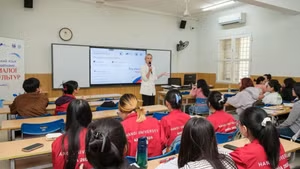
Recently, numerous experts and scientists attending a seminar titled “Social network and the mental health of children and adolescents: An urgent issue needing action” proposed a number of solutions to build a safe and healthy digital environment for children and adolescents, raise awareness, and strengthen the capacity to protect mental health in the context of digital transformation, thereby contributing to the implementation of policies to protect and support children’s development in the online environment.
Duong Ngo Minh Nam, Deputy Head of the Department of Science, Education, Culture, and Social Affairs under the Government Office, said that protecting children’s mental health and rights when they participate in social netwokr requires coordination among families, schools, regulatory agencies, technology businesses, and children themselves.
The legal system for protecting children in cyberspace is gradually being improved, with clear provisions on the responsibilities of families, the state, and technology businesses in protecting private information as well as preventing and removing harmful content and content that exploits or harms children.
Le Anh Lan, an education expert at UNICEF Viet Nam, said that protecting children’s mental health on social network does not mean banning it or separating them from the digital world.
Policies can only succeed when we respect children’s real-life experiences and put their own voices at the centre. Many countries have introduced policies to protect children and adolescents in the online environment.
In Viet Nam, the Prime Minister issued Decision No. 468/QD-TTg to approve the programme on “Protecting and supporting children’s development in cyberspace for the 2026-2030 period” on March 23, 2026.
The programme places the protection of and support for children in the online environment in a long-term action framework. On June 1, 2026, the Prime Minister issued Decision No. 973/QD-TTg to approve the school health programme for the 2026-2035 period, providing an additional policy basis for promoting the health and comprehensive development of learners.
The Ministry of Culture, Sports, and Tourism has also drafted and published a draft decree amending and supplementing a number of articles of Government Decree No. 147/2024/ND-CP (dated November 9, 2024) on the management, provision, and use of internet services and online information. The draft proposes that children under 16 should not be allowed to open social network accounts themselves; instead, parents would open accounts on their behalf and manage their content, usage times, and accounts, with children’s accounts only allowed to view content and not to post or leave comments.
The Law on Disease Prevention and Decree No. 165/2026/ND-CP, detailing and guiding the implementation of several articles of the Law on Disease Prevention, also clearly state that counselling, communication, and health education (including communication and mental health education) are identified as key tasks in disease prevention at educational institutions.
The Ministry of Education and Training is also implementing the mental health education plan for children and pupils for the 2022-2025 period, with key tasks of communication; raising awareness; strengthening the capacity of education managers, teachers, school healthcare staff, and parents regarding mental health; and strengthening the management and comprehensive healthcare of pupils at schools, towards conducting periodic health assessments combined with screening activities to soon detect pupils with mental health problems at an early stage for counselling, intervention support, and higher-level referral when necessary, as well as preventing risk factors for mental disorders.
At the same time, training and improving the capabilities and skills of staff and teachers responsible for psychological counselling and school healthcare at educational institutions should be intensified, building communication materials, guidance on mental health care, and screening assessments are also being developed to help teachers and school healthcare staff detect pupils showing signs of mental health disorders.