Strengthening enforcement of intellectual property rights
The digital environment continues to expand, increasing opportunities for creative works in various fields to reach the public. However, alongside these new opportunities, the environment also poses challenges to the protection of copyright and related rights.
Some statistics released in 2026 show that enforcement of intellectual property rights is being strengthened. According to information from the Ministry of Public Security at the Government's regular press conference in May 2026, after nearly one month of a peak campaign launched under Prime Minister's Official Dispatch No. 38/CD-TTg dated May 5, 2026, the Public Security forces coordinated with telecommunications service providers to block 194 websites infringing intellectual property rights. These included eight websites streaming films, 159 websites illegally livestreaming football matches, and 27 websites selling goods in violation of industrial property rights.
During the same period, Public Security forces nationwide initiated legal proceedings in 56 cases involving 98 defendants for offences involving infringement of copyright and related rights, industrial property rights, and the production and trading of counterfeit goods; approximately 216 individuals were fined a total of more than 850 million VND.
These are indications that the need to strengthen enforcement of intellectual property rights in the digital environment is becoming increasingly evident. In May 2026, the Copyright Office and the Department of Cybersecurity and Hi-tech Crime Prevention and Control (A05) under the Ministry of Public Security signed a coordination programme to strengthen the management and enforcement of laws on copyright and related rights in the digital environment for 2026–2029.
The coordination focuses on information sharing, inspection and handling of infringements, enhancing professional capacity, and strengthening cooperation in protecting copyright and related rights in the digital environment. This shows that copyright protection is gradually being placed within a broader coordination system involving specialised cybersecurity forces, service providers, and digital platforms.
A notable change in 2026 was the Government's issuance of Decree No. 134/2026/ND-CP dated April 6, 2026, amending and supplementing a number of articles of Decree No. 17/2023/ND-CP detailing a number of articles and measures for implementing the Law on Intellectual Property concerning copyright and related rights. The decree took effect on April 9, 2026.
The new provisions further clarify mechanisms for protecting copyright and related rights in the digital environment, including mechanisms for notifying and removing infringing content. For real-time live television programmes, the regulations allow removal or blocking measures to be applied immediately upon receipt of a valid request; for other cases, specific processing deadlines are prescribed.
Decree No. 134/2026/ND-CP also raises the ceiling for compensation for material damage in cases where the actual damage cannot be determined or other grounds for compensation are inappropriate, from a maximum of 500 million VND to a maximum of 1 billion VND. The adjustment further strengthens the legal basis for protecting copyright and related rights as the exploitation and distribution of content increasingly expand in the digital environment.
However, a distinctive feature of the digital environment is that a piece of content can be distributed across multiple platforms, servers, and addresses. After content has been blocked or removed, it may still reappear. Therefore, alongside procedures for handling infringements, it is necessary to strengthen the capacity to detect, verify, trace, and preserve electronic evidence.
In practice, strengthening copyright enforcement in the digital environment cannot rely solely on measures taken after infringements occur. It also requires the development of digital infrastructure, governance mechanisms, and enforcement capacity suited to the development of the cultural industries.
Lawyer Nguyen Hung Quang, an expert who advised on the development of regulations on the cultural industries in the 2024 Capital Law, said one of the fundamental weaknesses in the development of the platform economy today is copyright in the digital environment, including the quality of legal regulations, the enforcement capacity of competent authorities, and technical support mechanisms.
According to him, these limitations make it difficult for Vietnamese platforms to organise business activities and protect property rights in the digital environment. Therefore, it is necessary to improve the legal framework and mechanisms for ensuring copyright enforcement in line with market realities, while developing data platforms and digital infrastructure as part of the economic infrastructure for the entire cultural-industry value chain.
The rapid development of new technologies, including artificial intelligence, also raises new issues concerning the identification of the origin, rights holders, and scope of lawful use of content. Therefore, legislation and enforcement methods need to be regularly updated, while ensuring a balance between protecting the rights of creators and the right to access and use works in cases permitted by law.
Effectively harnessing intellectual property assets
From the perspective of developing the cultural industries, copyright protection is not only intended to prevent unauthorised copying. More importantly, it must ensure that creative achievements can become assets, be lawfully exploited, and generate economic value.
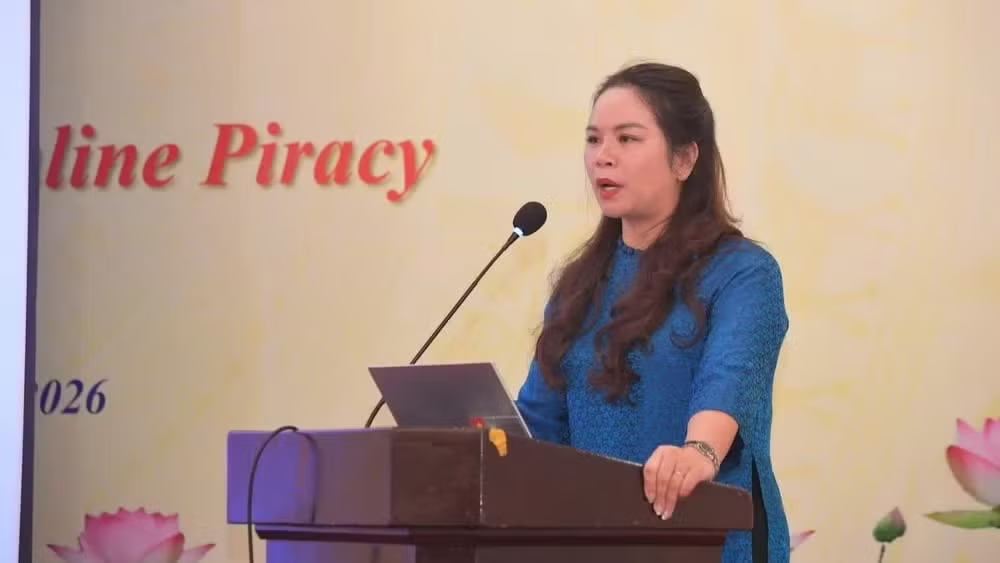
If rights are not clearly established, exploitation is not transparent, or rights are not effectively protected, the value chain of creative products will struggle to develop fully. From the perspective of the specialised management agency, Tran Hoang, Head of the Copyright Office, emphasised that in the new era, copyright has become an important component of the creative economy's infrastructure.
Viet Nam needs to continue improving its legal framework, strengthening enforcement capacity, enhancing international cooperation, and gradually establishing standards suited to the development of artificial intelligence.
New challenges lie not only in the speed at which content is disseminated but also in the way infringements are organised. According to the Copyright Office, some infringement models in the digital environment have developed into “closed infringement ecosystems” involving multiple layers of operation, commercial profit-making objectives, and technological support, making it impossible to address them merely by removing individual pieces of content or penalising individual cases.
The office said it is necessary to strengthen coordination among management agencies, enforcement forces, tax authorities, and technology platforms, while researching the application of AI, real-time content recognition, digital watermarking, and data-sharing mechanisms to improve the effectiveness of rights protection.
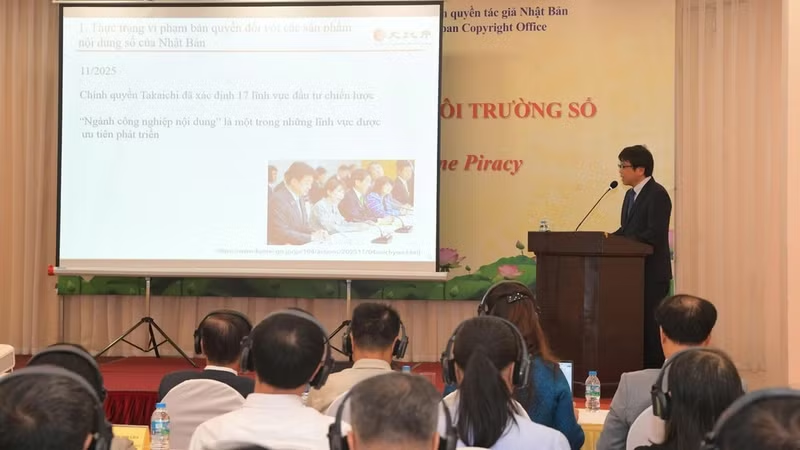
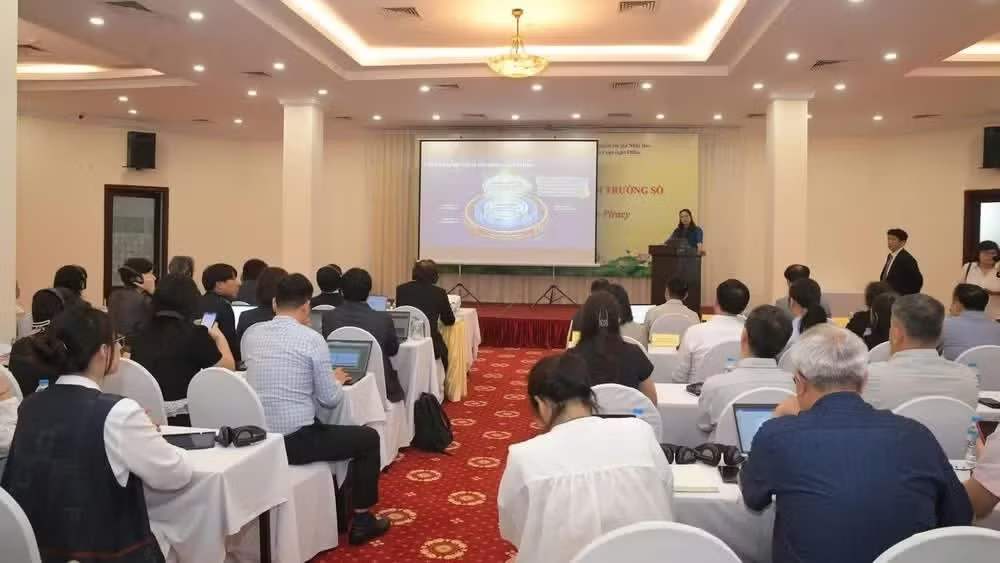
At the Workshop on Enhancing Copyright Enforcement Effectiveness in the Digital Era held in Ha Noi in July 2026, Kawakami Toshihiro, Head of the Japanese Copyright Office, noted that copyright infringement remained a concern requiring stronger international cooperation, as the cross-border nature of the Internet makes it difficult for any one country to address the issue effectively through unilateral action.
An important aspect of the development of the Law on the Development of the Cultural Industries is its approach to intellectual property assets. The draft law is being developed not only to protect rights but also to facilitate the identification, management, valuation, and exploitation of intellectual property assets.
Proposals include intellectual property asset identification codes, digital intellectual property asset records, mechanisms for valuing intellectual property assets, research into using intellectual property assets as collateral, and research into an exchange for intellectual property assets and cultural products. These remain under development as policies are formulated and refined, and therefore their feasibility needs to be further assessed before they are institutionalised.
If appropriately studied and implemented, these tools could help address a fundamental issue in the cultural market: how to clearly determine who owns a creative asset, the scope within which it may be exploited, its value, and how the right to use it can be transferred. Standardised, connected and updated rights data could reduce transaction costs while enabling rights holders to take a more proactive approach to exploiting their intellectual property assets. This marks a shift from a mindset focused solely on protecting rights to one focused on managing and developing the value of those rights.
Therefore, alongside strictly handling infringements, it is necessary to make the lawful use of works more convenient. Databases of works and rights holders need to be gradually improved; information on the scope of authorisation, licensing methods, and payment obligations needs to be transparent; and collective management organisations for copyright and related rights need to continue strengthening their governance capacity and application of technology.
Only when rights holders have tools to monitor and protect their assets can copyright fully realise its economic value. At the same time, public awareness of respecting copyright needs to continue to be raised. This is particularly important amid the strong push for digital transformation and the development of the digital economy and cultural industries.