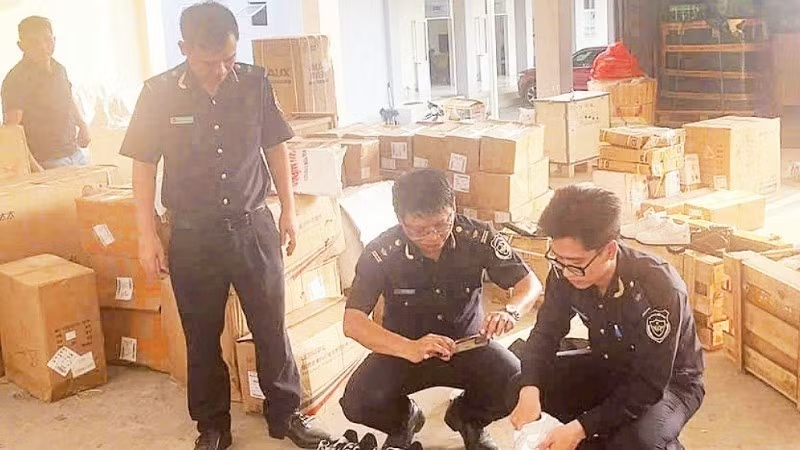
Immediately after the Prime Minister issued Official Dispatch No. 38/CD-TTg on May 5, 2026, on focusing on decisive measures to combat, prevent, and deal with intellectual property rights infringement, the General Department of Viet Nam Customs promulgated a plan to materialise the task.
After nearly one month of the intensive enforcement campaign, from May 7 to 29, the General Department of Viet Nam Customs unovered and processed 12 violations.
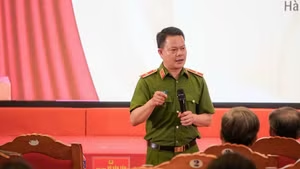
Dang Van Duc, Deputy Director of the Anti-Smuggling Investigation Department under the General Department of Viet Nam Customs, noted that the infringing goods were mainly high-value commercial products with well-known brands that are easy to sell and counterfeit. These included clothing, footwear, handbags, watches, fashion accessories, mobile phone accessories, cosmetics, healthcare products, door locks, children's toys, components, labels, and packaging.
For cosmetics, dietary supplements, and healthcare products, the authorities found that the risks extend beyond economic losses and can directly imperil consumers' health.
Most violations involved goods in transit and imported goods for commercial purposes, with transit goods accounting for the largest proportion. The violations were concentrated along land border gates such as Huu Nghi, Cha Lo, Lao Bao, and Hoa Lu, as well as major seaports including Sai Gon Port Area 1.
Many current intellectual property infringement cases involve well-organised operations, from placing orders and consolidating goods to customs declarations made through hired legal entities, followed by domestic distribution or onward transport to third countries.
The offenders have exploited transit procedures, cross-border e-commerce, and trade facilitation policies to move goods quickly and reduce the likelihood of physical inspections. Their methods include falsely declaring or incompletely declaring trademarks, product names, and Harmonised System (HS) codes; concealing counterfeit goods among genuine products; splitting shipments into smaller consignments; transporting goods through many routes to erase traces; and importing goods without labels or with labels removed for later processing.
A striking characteristic is that many cases involve not only suspected trademark counterfeiting but also indications of origin fraud, incorrect labelling, false product declarations, or goods that fail to satisfy the prerequisites for export, import, or transit.
In a recent case, the Anti-Smuggling Investigation Sub-Department and Huu Nghi International Border Gate Customs collaborated to transfer case dossiers to the Investigation Police Agency of Lang Son Province for further investigation and processing in accordance with the law. The case implicated transit shipments suspected of infringing intellectual property rights linked to Son Ha Transport and Services Joint Stock Company, Khai Long Trans-Asia Investment Company Limited, and Lang Son Import-Export Trading and Services Company Limited.
The seized goods comprised 200 steel bearings displaying the Koyo trademark and labelled "made in Japan"; 2,175 mobile phones and accessories bearing the iPhone and Samsung trademarks; more than 9,000 cosmetic products under the Jula's Herb Carrot Aging and Eucerin brands; and more than 20,000 pairs of shoes, sandals, handbags, watches, and belts bearing well-known trademarks such as Rolex, Hermes, Chanel, Nike, Adidas, and Puma.
So far, the Investigation Police Agency has promulgated decisions to initiate criminal proceedings and prosecute suspects pertaining to acts of industrial property rights infringement involving Son Ha Transport and Services Joint Stock Company.
Facing the constantly evolving nature of transnational crime, alongside traditional enforcement measures, the customs sector needs to pivot from a reactive approach to a proactive one, and from conventional controls to management based on data, technology, digital transformation, and international cooperation.
Nguyen Van Tho, Director General of General Department of Viet Nam Customs, announced that during the second half of 2026, the customs sector will prioritise drafting amendments and supplements to the 2014 Customs Law, as well as related legal documents concerning digital customs, cross-border e-commerce, specialised inspections, smart border gates, and modern customs management.
At the same time, the sector will expedite the development of a modern, smart customs system based on digital data and the application of artificial intelligence and big data analytics. It will also implement several major projects, including the information technology system for digital customs, the expansion of the national single window portal, and phase 3 of the ASEAN single window connectivity project.
At the 147th/148th Sessions of the World Customs Organisation (WCO) Council, held in Belgium in late June, WCO Secretary General Ian Saunders emphasised that, amid increasingly complex non-traditional security threats, transnational crime and illicit trade, strengthening international cooperation has become essential for improving border management effectiveness.
Accordingly, information sharing, enhanced law enforcement cooperation, and stronger partnerships between customs administrations and international organisations have been identified as key factors in ensuring the security of global supply chains while facilitating legitimate trade.
The WCO Secretary General called on members to continue promoting multilateral cooperation, strengthen information sharing and the appication of technology and innovation, and reinforce enforcement capacity to fortify resilience against constantly evolving global challenges.
Speaking during the conference discussions, Nguyen Van Tho, Director General of General Department of Viet Nam Customs, reaffirmed Viet Nam's strong support for the WCO Strategic Plan for 2025–2028 period, describing it as a key roadmap for enhancing the WCO's operational effectiveness in a new stage of development.
Viet Nam Customs also reaffirmed its commitment to working alongside WCO members in implementing strategic priorities, particularly in promoting digital transformation, building a data-driven smart customs model, and strengthening enforcement capacity amid the global trade and border management being affected by many uncertainties.
Director General Nguyen Van Tho emphasised the need to narrow the gap in digital transformation readiness among WCO members to ensure that customs modernisation process is inclusive, coordinated, and sustainable.
With a proactive and responsible spirit, Viet Nam Customs remains steadfast in making substantive contributions to WCO initiatives, particularly in the areas of data, e-commerce, and the application of emerging technologies, with the goal of building a modern, adaptive, and globally connected customs system.