Efforts to disburse funding for strategic infrastructure
Under Decision No. 948/QD-TTg dated May 17, 2025 of the Prime Minister, as amended and supplemented by Decision No. 1679/QD-TTg, approving the master plan for preparing for and organising APEC 2027, An Giang Province has been assigned to implement 21 key projects.
The project portfolio is divided into two main groups: 11 public investment projects and 10 business investment and public-private partnership (PPP) projects.
As of September 3, the total State budget allocated to public investment projects serving APEC in 2026 had reached nearly 13.8 trillion VND. Actual disbursement had reached more than 6.46 trillion VND, equivalent to 46.83% of the annual plan.
However, according to the An Giang Provincial Department of Finance, there are currently clear differences in progress among the three groups of projects. The first group, comprising seven projects maintaining a good construction pace, includes the expansion of Phu Quoc International Airport, the APEC Summit Centre, the Nui Ong Quan mixed-use ecotourism urban area, Bai Dat Do urban area, the An Thoi resettlement area, the Ho Suoi Lon resettlement area, and the undergrounding of technical infrastructure in Duong Dong.
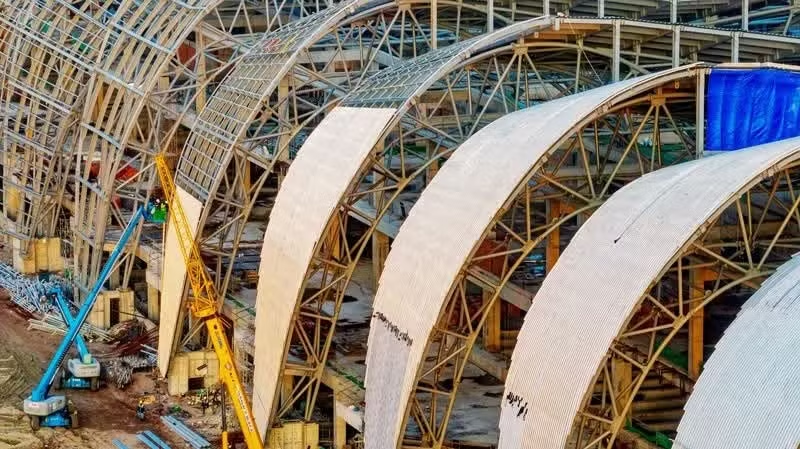
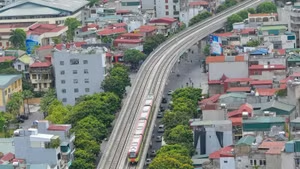
The second group comprises 10 projects that are behind schedule or whose construction volume is not commensurate with the plan. These include APEC Boulevard, Urban Railway Line 1, DT.975 Road, the Intelligent Monitoring and Operations Centre, the Ham Ninh and Cua Can resettlement areas, and Duong Dong 2 Water Plant.
Most alarming is that the Duong Dong 2 Reservoir and Cua Can Reservoir projects are at least three months behind schedule. While the Duong Dong 2 Reservoir project has achieved a high disbursement rate, its actual construction volume remains very low.
The group of seven projects with low progress and low disbursement or projects that do not yet meet the conditions for implementation, focuses on environmental treatment and technical infrastructure in An Thoi and Duong Dong. These include the Bai Bon waste treatment area, Bai Bon waste-to-energy plant, An Thoi solid waste treatment plant, centralised wastewater treatment plants in An Thoi and Duong Dong, Cua Can Reservoir water plant, and the undergrounding of infrastructure in An Thoi.
According to the An Giang Provincial Department of Finance, delays in some projects are attributable to complicated difficulties involving site clearance, materials, and technical infrastructure.
Specifically, although 42.5ha out of the 49.55ha approved area for the Phu Quoc International Airport expansion project has been handed over, a further 19.45ha still lacks an approved plan due to complicated land origins, disputes, and overlapping boundaries.
The Cua Can Reservoir project still faces difficulties involving 0.98ha; the Ham Ninh resettlement area still has 7.17ha involving 11 households; and the Cua Can resettlement area faces difficulties involving approximately 2.5ha. The An Thoi solid waste treatment plant is encountering difficulties in determining land origins, while land cannot yet be allocated for the Duong Dong wastewater treatment plant due to a lack of compensation funding.
In addition, according to the Department of Finance, most key projects, including the Duong Dong 2 Reservoir, Cua Can Reservoir, Ham Ninh resettlement area, and Bai Dat Do urban area, face severe shortages of rock, fill soil, sand for ground filling, and disposal sites for excavated soil. Meanwhile, the DT.975 Road, APEC Boulevard, Duong Dong and An Thoi infrastructure undergrounding projects are affected by electricity poles, water pipes, and telecommunications cables that have not been relocated in a coordinated manner at intersections.
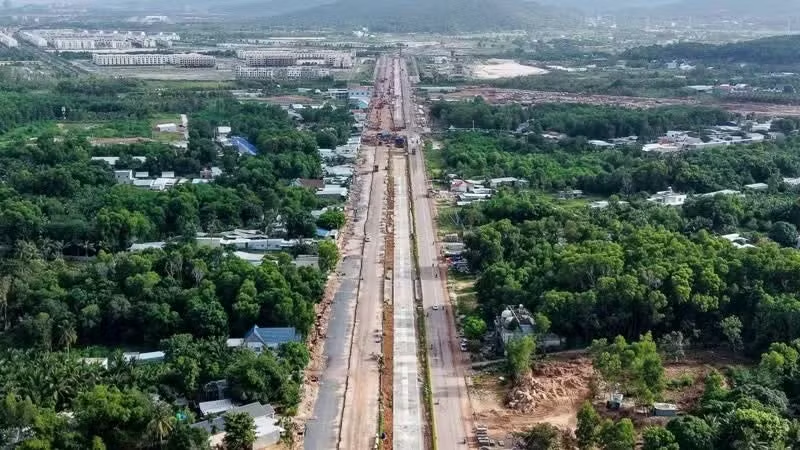
According to leaders of the An Giang Provincial Department of Finance, Urban Railway Line 1 faces difficulties due to new technology, complex technical standards, and a shortage of highly skilled personnel. Meanwhile, prolonged rainstorms and high waves have seriously hindered the construction of embankments and land filling, as well as the construction of the APEC Summit Centre within a confined site.
Tightening progress control, determined to meet deadlines
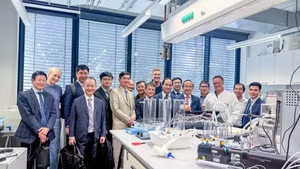
To monitor the situation, recently, Party Central Committee member and Chairman of the An Giang Provincial People’s Committee Ho Van Mung personally led a working delegation to inspect a number of key projects, including DT.975 Road, Urban Railway Line 1, the APEC Summit Centre, APEC Boulevard, and the An Thoi wastewater treatment plant.
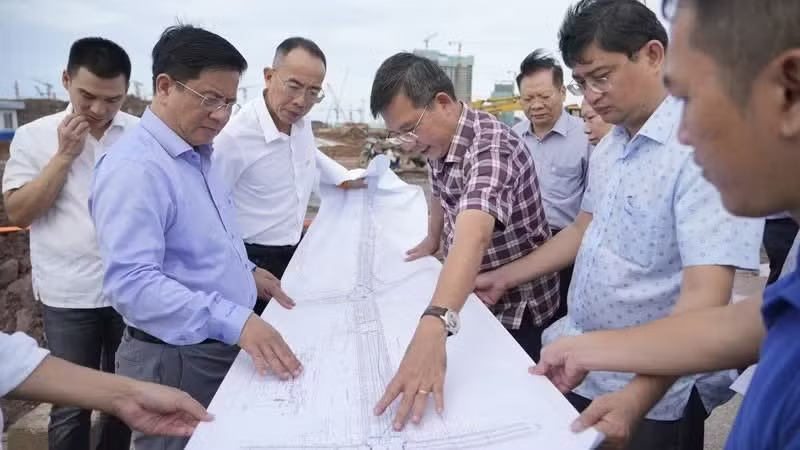
At each project, the An Giang Provincial People’s Committee Chairman directly heard reports from investors and contractors on construction volumes and emerging difficulties. Issues falling within the authorities’ remit were resolved immediately at the site, while matters beyond their remit were assigned to relevant agencies to clearly determine responsibilities and resolve them thoroughly, preventing difficulties from dragging on.
He requested investors and contractors to strictly comply with regulations on construction investment and absolutely refrain from violating the rules. The overall aim is to accelerate progress and ensure that deadlines serving the conference are met. The inspection was intended to tighten the accountability of project leaders, ensure continuous monitoring of each project, and accurately assess the contractors’ actual capacity to mobilise personnel and equipment.
Earlier, the Department of Finance had proposed that the An Giang Provincial People’s Committee issue a series of decisive measures, assigning specific tasks to each department, sector, and locality.
Accordingly, the Phu Quoc Special Zone People’s Committee is required to mobilise maximum resources to completely resolve site clearance issues and accelerate land allocation and leasing. It must resolutely apply coercive measures in accordance with regulations against cases of deliberate delay, giving top priority to the Duong Dong 2 Reservoir, Cua Can Reservoir, Ham Ninh–Cua Can resettlement areas, An Thoi waste treatment plant, and Duong Dong 2 Water Plant projects.
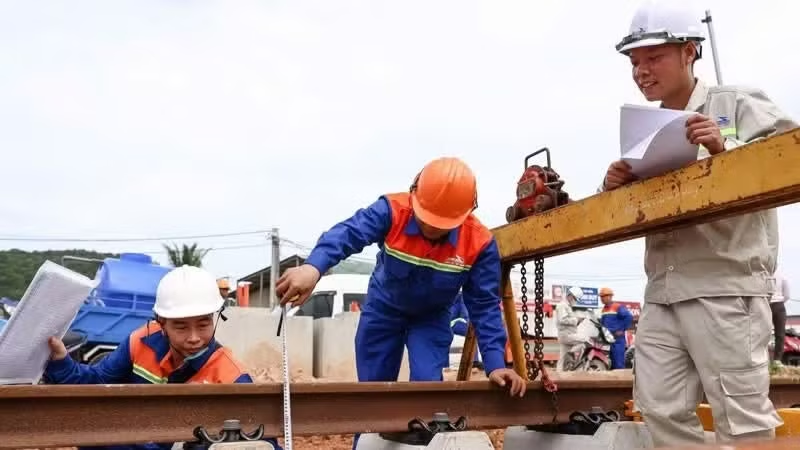
The Department of Agriculture and Environment will take the lead in urgently resolving procedures for converting forest land, clarifying land origins, planning disposal sites, and licensing sources of filling materials. Clear deadlines must be set for completion of each dossier to prevent prolonged delays from affecting overall progress.
The Department of Construction will act as the focal point for resolving difficulties involving the relocation of technical infrastructure, and take the lead in coordinating with investors to establish detailed weekly “catch-up schedules” for projects at risk of delay. For Urban Railway Line 1, the department will urgently work with the Ministry of Construction to agree on the applicable technical standards and add specialised personnel.
The Phu Quoc Economic Zone Management Board, for its part, needs to urge and tighten the obligations of investors in PPP and business investment projects. If investors fail to ensure sufficient financial capacity, personnel, or equipment, resulting in delays, they will be held accountable or project revocation in accordance with regulations.
Investors and contractors are required to prepare and update detailed schedules down to individual items and calculate the remaining workload in order to mobilise additional resources. They must submit regular progress reports to the Provincial People’s Committee and Department of Finance so that situations arising beyond their authority can be addressed promptly.