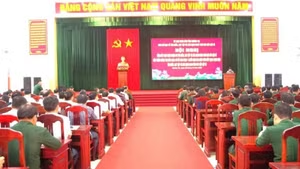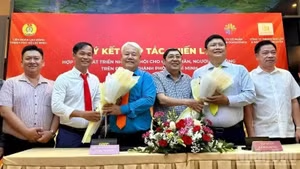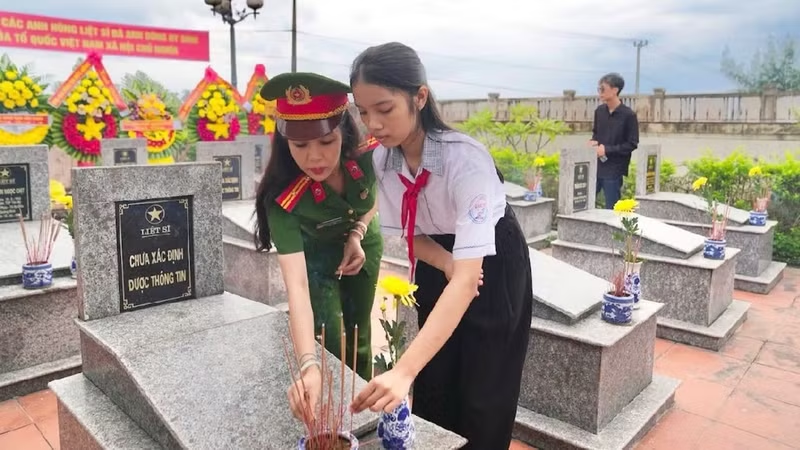
The People’s Public Security forces have drawn on their strengths in population data, digital infrastructure, and science and technology to search for and identify fallen soldiers.
Following directions from the Government and the Ministry of Public Security, the Police Department for Administrative Management of Social Order (C06) has taken the lead in advising on and organising the review and standardisation of information on fallen soldiers and their relatives; collecting DNA samples; developing and managing the DNA database of relatives of fallen soldiers; and coordinating with forensic agencies to compare samples and identify the remains of fallen soldiers.
For more than a year, the administrative management police force in general, and C06 in particular, have made persistent efforts to establish connections, conduct searches, and collect DNA samples from relatives of fallen soldiers whose identities have yet to be determined.
Based on information gathered at the grassroots level, biological samples from relatives undergo forensic analysis and comparison.
When a relative’s DNA is matched with data from the remains of a fallen soldier, an identity is confirmed and an unnamed grave is given back its name. For the family, it provides an answer after decades of waiting.
This is the value of applying population data, biological data, and DNA forensic technology to the work of honouring the fallen.
The case of fallen soldier Nguyen Quoc Hoi, from Quang Phuc Commune, Quang Trach District, the former Quang Binh Province (now part of Bac Gianh Ward, Quang Tri Province), is a typical example.
After lying on the battlefield for 54 years, the fallen soldier was identified and returned to his family. In May 2025, the former Quang Binh Provincial Police (now the Quang Tri Provincial Police) coordinated with C06 to collect DNA samples from relatives of fallen soldiers whose remains had yet to be identified.
More than a month later, comparison results showed that a relative’s DNA sample matched remains in an unidentified grave at the Duc Co Martyrs’ Cemetery in Gia Lai Province.
From a nameless grave, the identity of Nguyen Quoc Hoi was established. In July 2025, the Ministry of Public Security coordinated with the Ministry of Home Affairs to complete dossiers recognising the identities of 16 fallen soldiers, including Nguyen Quoc Hoi.
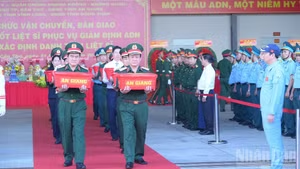
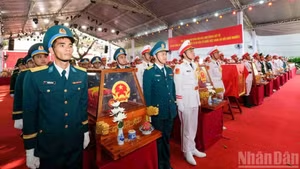
On September 1, 2026, Bac Gianh Ward, Quang Tri Province, held a solemn memorial service, funeral, and burial ceremony for the remains of fallen soldier Nguyen Quoc Hoi at Quang Phuc Martyrs’ Cemetery.
In response to the 500-day campaign to accelerate the searching, collection, and identification of fallen soldiers’ remains, the Ministry of Public Security launched a 30-day plan across 30 localities, mobilising more than 20,000 officers to collect DNA samples from relatives of fallen soldiers nationwide.
Using the national population database together with the DNA database of relatives of fallen soldiers has created a unified foundation for reviewing, verifying, and comparing information.
Colonel Tran Hong Phu, Deputy Director of C06, said many fallen soldiers had died decades ago and their records were incomplete. Many direct relatives were also no longer alive, making verification of the maternal line for sample collection particularly demanding and requiring a high degree of caution.
Nevertheless, under the close direction of Ministry of Public Security leaders, with coordination among ministries, agencies, and localities and the support of families, the campaign has achieved a number of concrete results.
In the 100 days since its launch, the force had collected more than 265,000 DNA samples from relatives of fallen soldiers, completed analysis of more than 71,000 samples, and uploaded nearly 67,000 results to the database.
To date, the Ministry of Public Security has received 224 DNA analysis results from samples taken from the remains of fallen soldiers, conducted comparisons, and coordinated the completion of identification dossiers for 33 cases.
Moving forward, the Ministry of Public Security will continue to coordinate the review and collection of DNA samples from the remaining relatives, complete the DNA database of relatives of fallen soldiers, and step up data comparison, meeting the long-held hopes of families of fallen soldiers across the country.