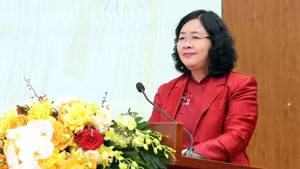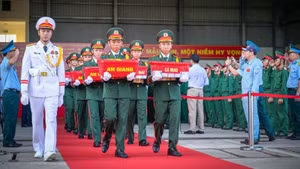
Identifying the remains of Viet Nam's war martyrs is an incredibly challenging task that demands perseverance, resources, and the united efforts of the entire political system, according to Secretary of the Party Central Committee and Deputy Prime Minister Pham Thi Thanh Tra.
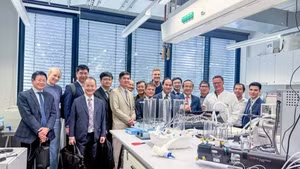
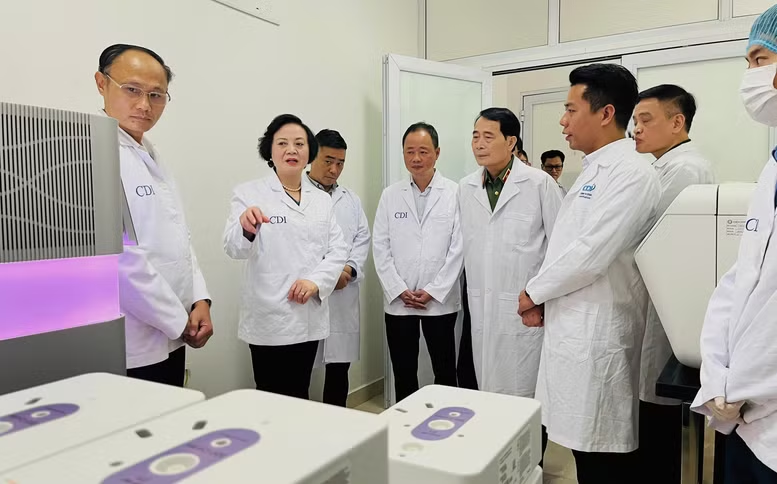
Tra, who is head of the National Steering Committee for the Search, Collection and Identification of Martyrs’ Remains (Steering Committee 515), inspected the practical implementation of DNA identification technology at the Centre for DNA Identification under the Institute of Biology of the Viet Nam Academy of Science and Technology, and the Military Institute of Forensic Medicine under the Military Medical Department of the Ministry of National Defence on September 14.
The inspection focused on the deployment of DNA testing technology to improve the effectiveness of identifying remains.
Mastering new technologies, expanding DNA testing capacity
At the Centre for DNA Identification, Tra acknowledged the efforts of officials and scientists at the Institute of Biology in mastering new technologies, while asking the units to continue addressing challenges related to human resources, data and implementation arrangements to meet growing demands.
According to a report by the Institute of Biology, the DNA Testing Centre has mastered two groups of technologies: conventional mitochondrial DNA testing and next-generation sequencing combined with single nucleotide polymorphism analysis (NGS-SNP).
To date, the centre has received and stored 37,610 samples of martyrs’ remains from eight provinces and cities under assignments by Steering Committee 515. These include localities with particularly large numbers of samples, such as Tay Ninh with 15,674, Ho Chi Minh City with 7,113, Dong Nai with 4,618, Hue with 3,918 and Dong Thap with 3,216.
Since April, 10 sets of remains of fallen soldiers have been identified through DNA testing and returned to their families, in coordination with the Ministry of Public Security. This is a notable achievement, as the units have been testing new technologies while simultaneously applying them in practice.
Alongside the initial results, the Deputy PM highlighted three issues requiring focused attention: human resources, technology and data.
The official asked the Institute of Biology to urgently prepare for new technology and organise training for personnel who will operate it as soon as possible.
Reporting to the Deputy PM, President of the Viet Nam Academy of Science and Technology Prof. Dr Tran Hong Thai said the Centre for DNA Identification currently has a core team of specialised personnel, while the academy has more than 200 biological science staff who can be mobilised when necessary. To meet the requirements of large-scale implementation, the top priority is to build an interconnected and synchronised DNA database to ensure rapid and accurate comparisons.
Removing bottlenecks in human resources, data to improve matching efficiency
According to a report by the Military Medical Department, during 2013-2025, the Military Institute of Forensic Medicine received nearly 5,000 samples of martyrs’ remains and tested nearly 2,000 of them, along with more than 1,800 samples from relatives, identifying 558 martyrs.
By September 11, 2026, during the 500-day campaign, the institute had collected 35,776 samples of martyrs’ remains from 16 out of 17 provinces and cities.
Regarding DNA testing, from March 15 to September 11, the institute extracted DNA from 243 samples of martyrs’ remains, obtaining 48 mitochondrial DNA sequences.
Its facilities have also been renovated and upgraded, with additional equipment installed and testing procedures optimised, raising the capacity of its DNA testing line from 400 to 800 samples per year.
Improvements have also been seen in human resources training, preservation and storage capacity.
Tra commended efforts by the department and the institute in identifying the remains of martyrs.
She called for continued reviews of practical experience and further standardisation of the procedures to develop common regulations, ensuring consistent, rigorous and professional implementation.
According to the Deputy PM, identifying the remains of war martyrs is not merely the fulfilment of a political task but also work carried out with a deep sense of responsibility and from the heart.
Alongside the achievements, however, she said the identification still faces several bottlenecks that need to be addressed. The first is human resources for DNA identification, which she described as one of the biggest challenges facing DNA-based identification of martyrs’ remains.
The second bottleneck is the data system. The Deputy PM called for a synchronised system capable of matching and comparing data with existing sources, avoiding a situation in which individual units develop separate systems that cannot be connected, synchronised or jointly exploited.
She also asked relevant agencies to study and finalise regulations, technical standards and cost norms for the collection, preservation, storage and identification of martyrs’ remains.