New signals from admissions season
In early June, Nguyen Trung Anh, a Year 12 student at Phan Huy Chu High School in Ha Noi, finalised his university preferences. Surprisingly, he bypassed economics, finance, or business administration, fields that have remained popular for many years, deciding instead to apply for electrical engineering.
“At first, I also considered economics-related programmes. But after learning about workforce demand in the clean energy sector, employment prospects, and the industry's future growth potential, I realised this was a more suitable choice,” Trung Anh said.
This year's admissions season has seen many upper secondary schools in Ha Noi, Ho Chi Minh City, and Da Nang report a surge in student interest in STEM fields (science, technology, engineering, and mathematics). At university admissions and career guidance fairs, booths showcasing artificial intelligence (AI), data science, cyber security, robotics, energy, and semiconductor technologies have consistently attracted large numbers of students and parents.
According to the Ministry of Education and Training, while more than 177,000 students enrolled in STEM programmes nationwide in 2022, the figure has risen to nearly 200,000 by 2024. STEM enrolment continues to grow rapidly, with a target of reaching around 1 million learners by 2030.
In addition to labour market demand, new State policies supporting basic sciences, key engineering disciplines, and strategic technologies are having a noticeable impact on students' academic choice. The Government recently issued Decree No. 179/2026/ND-CP on scholarship policies for students pursuing these fields.
Under the decree, university students enrolled in priority disciplines will receive monthly stipends ranging from 3.7 million VND to 5.5 million VND per month. Master's and doctoral students may receive up to 8.4 million VND per month.
Nguyen Tien Thao, Head of the Department of Higher Education under the Ministry of Education and Training, said the policy aims not only to support educational expenses but also to create strong incentives to attract and retain talented students in fields strategically vital to national development.
According to Thao, the key objective is to direct human resource development towards foundational disciplines and strategic technologies instead of spreading resources too broadly, as in the past.
Preparations in university lecture halls
Universities began preparing for this year's admissions season several months ago. One of the most visible developments is the proliferation of new academic programmes related to strategic technology fields.
Nationwide, universities are expanding training in strategic technologies. Ha Noi University of Science and Technology and the University of Engineering and Technology (Viet Nam National University, Ha Noi) are focusing on AI, data science, and integrated circuit design. Viet Nam National University, Ho Chi Minh City is strengthening semiconductor workforce training. The University of Science and Technology (Da Nang University) is developing programmes in automation, microelectronics, and smart manufacturing, while Can Tho University is expanding digital technology and smart agriculture programmes.
Private higher education institutions are matching public universities by investing heavily in high-technology disciplines. FPT University continues to expand programmes in AI, big data, and cyber security. Phenikaa University focuses on robotics, biomedical technology, autonomous vehicles, and AI. VinUniversity is developing internationally benchmarked programmes in computer science, electrical engineering, and data science.
One of the most notable changes in Vietnamese higher education in recent years has been the shift from theory-heavy instruction to training closely linked with research and applied practice.
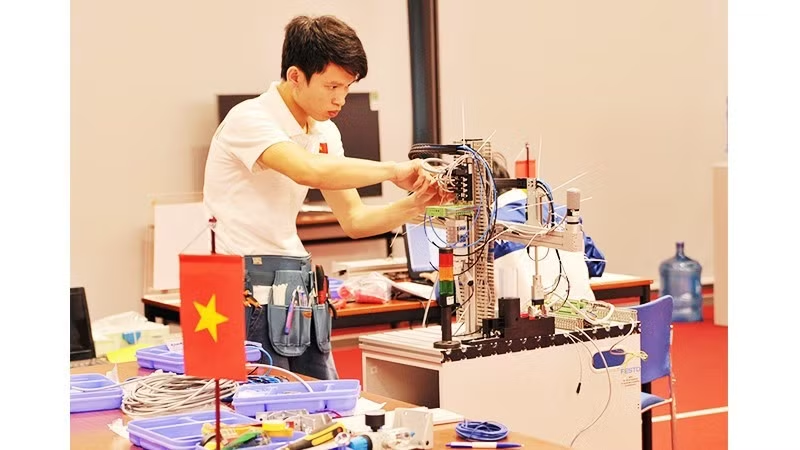
Many universities have invested hundreds of billions of VND in modern research centres and laboratories. At Ha Noi University of Science and Technology, students can access research facilities specialising in robotics, microelectronics, AI, and automation. At Viet Nam National University, Ha Noi, numerous laboratories focusing on nanotechnology, advanced materials, data science, and advanced electronics have been developed to international standards. Viet Nam National University, Ho Chi Minh City is also building semiconductor and integrated circuit research centres to support both education and research.
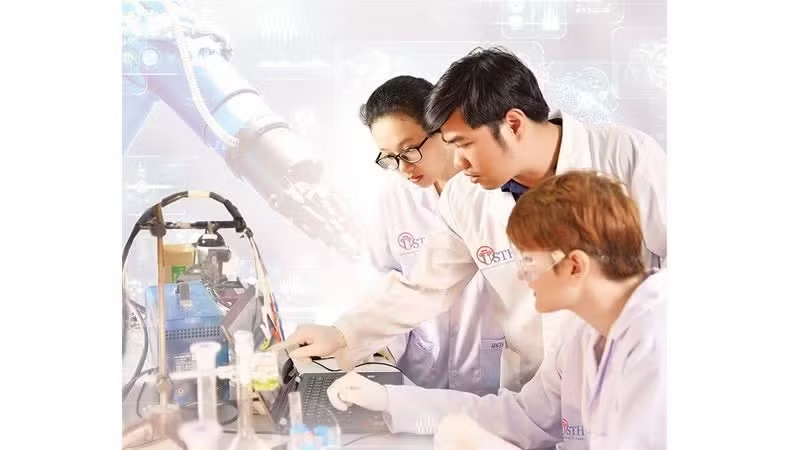
Meanwhile, the University of Science and Technology of Ha Noi (USTH) has developed laboratories dedicated to space technology, materials science, biotechnology, and energy. USTH has attracted students through an appealing scholarship policy. Prof Dr Dinh Thi Mai Thanh, Rector of USTH, said students in space technology, semiconductor integrated circuit design, mathematics, chemistry, and basic science programmes may receive scholarships covering up to 100% of tuition fees. Scholarships covering 75%, 50%, and 25% of tuition costs are also available, contingent on academic performance.
Simultaneously, many universities are strengthening partnerships with major technology companies. In addition to recruitment activities, many businesses now work with universities to develop curricula, sponsor laboratories, and offer internship opportunities. Their growing involvement is expected to help narrow the gap between academic training and labour market demands.
According to experts, investment in facilities is intended both to elevate educational quality and to provide students with direct exposure to core technologies. This is particularly important because most strategic technology fields require modern research and practical training environments, as well as highly qualified academic staff.
As the 2026 upper secondary school graduation examination approaches, Nguyen Tien Thao offered guidance to students: “Year 12 students should review their strengths in natural science subjects. If you have been hesitant, now is the time to make a decision about your future path. Scholarships for basic sciences, key engineering disciplines, and strategic technologies are not merely financial support; they provide an opportunity to enter sectors that will be vital to the country over the next 10 to 20 years. Let that be your greatest motivation when choosing your field of study. Choosing the right discipline at this moment is choosing your place in the future.”
From human resource development to fostering innovation
Alongside the introduction of new programmes and investment in facilities, another clear trend emerging across universities is the transition towards innovation-driven models.
At a recent national scientific conference on the development of innovation-oriented universities in line with Politburo Resolution No. 71-NQ/TW, many experts noted that the role of universities today differs significantly from the past. Whereas universities traditionally focused on teaching and scientific research, they are now expected to become centres of innovation that generate new knowledge, technologies, and development models.
Lieutenant General Prof Dr Le Minh Thai, Director of the Military Technical Academy, said that amid the rapid advance of the Fourth Industrial Revolution, universities are no longer merely places for transmitting knowledge; rather, they have become centres of innovation where new ideas, technologies, and solutions to national development challenges are created.
According to him, innovation should not remain an abstract academic concept but must be translated into development strategies, organisational mechanisms, and practical activities within each educational institution.
In recent years, the Military Technical Academy has gradually built an innovation ecosystem by closely integrating education, scientific research, technology development, and digital transformation. This is also the direction many engineering universities are pursuing to create environments in which students can simultaneously study, conduct research, innovate, and solve real-world problems.
Vu Thanh Mai, Deputy Head of the Party Central Committee’s Commission for Information, Education, and Mass Mobilisation, said that in a context where science and technology, innovation, and digital transformation are profoundly reshaping every aspect of society, the key resource determining national development is no longer natural resources or low-skilled labour, but knowledge, technology, and the quality of human resources.