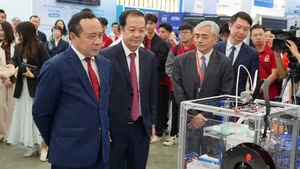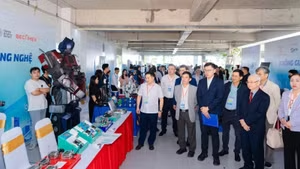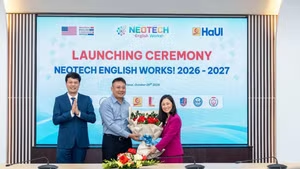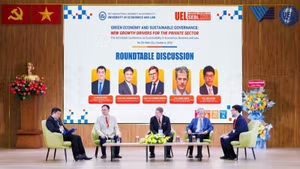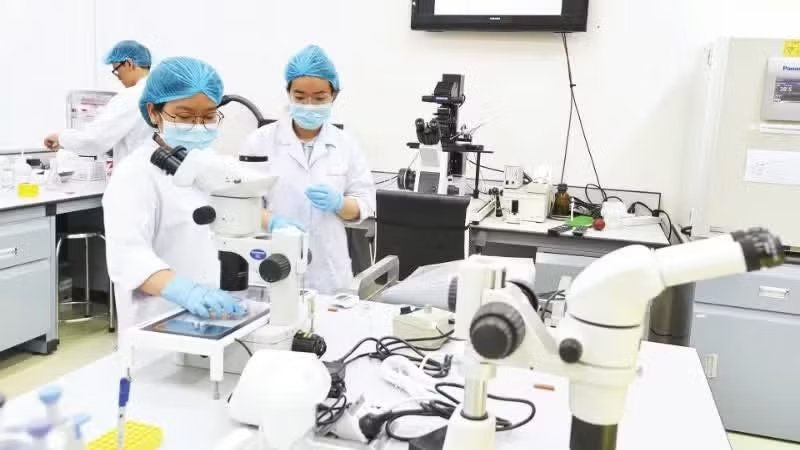
The “three-way partnership” model is precisely the operating framework that brings these resources together: the State builds the institutional framework, universities provide knowledge, and businesses organise implementation and commercialisation.
Politburo Resolution No. 57-NQ/TW identifies science and technology, innovation and digital transformation as key drivers of national development in the new period.
Politburo Resolution No. 68-NQ/TW likewise emphasises the need to create conditions for the private economic sector to truly become an important driver of the economy, with deeper participation in foundational industries, high technology and global value chains.
The two resolutions are closely complementary. The private sector has moved from merely responding and participating to accompanying and taking the lead, shifting from a short-term approach to long-term investment grounded in science and technology.
At a time when Viet Nam is striving to move up the global value chain, increasingly demanding requirements are being placed on private economic groups, especially enterprises with technological capabilities. Without the initiative and active participation of this sector, it will be very difficult to build an innovation ecosystem.
Tran Kim Chung, Chairman of CT Group, said that while the “three-way partnership” model is not new in concept, it had not previously delivered real effectiveness. What is different now lies in the context and the way it is being implemented. If in the past only one or two actors took part in a fragmented manner, all three are now truly joining hands in a substantive way.
According to data from the Statistics Office, Viet Nam currently has a labour force of more than 53 million people. However, high-quality human resources remain a bottleneck, with the proportion of formally trained workers holding degrees or certificates reaching only around 29.2%-29.5% in 2025.
In science and technology, especially in high-tech fields such as semiconductors, artificial intelligence (AI) and big data, the labour market is under intense pressure because of workforce shortages. In Viet Nam’s semiconductor industry alone, current supply meets less than 20% of demand, while the market needs around 5,000 to 10,000 engineers each year. The Government has set a target of training 50,000 engineers by 2030, with a focus on chip design and production, packaging and testing stages.
According to the Ministry of Education and Training, in 2024 more than 218,000 students were enrolled in STEM disciplines, encompassing science, technology, engineering and mathematics, accounting for around 36% of total university admissions. This figure remains lower than in a number of countries in the region and around the world, including Singapore at 46%, Malaysia at 50%, Finland at 36% and Germany at 39%.
Given the practical shortfall in the supply of high-quality human resources, stronger links between universities and businesses are becoming increasingly urgent. Many major science and technology enterprises, in their role as economic trailblazers, have worked with universities to develop training programmes, provide practical learning environments and proactively absorb this talent after graduation.
Professor Nguyen Thi Thanh Mai, Director of Viet Nam National University, Ho Chi Minh City, said that the enterprise-commissioned training model is being expanded, helping to create a direct link between market demand and academic programmes. In 2025, the university cooperated with more than 100 local enterprises and generated over 270 billion VND in revenue from scientific activities and technology transfer. These cooperation programmes cover training, recruitment and human resource development. This presents an opportunity for universities to strengthen their role as core actors within the innovation ecosystem.
Sharing this view, and fully aware of its role as a key university in the Mekong Delta region, Le Van Lam, Vice Director of Can Tho University, said that working alongside businesses is both a responsibility and a driving force for improving the quality of training and scientific research, particularly in high-tech agriculture, the environment and digital transformation, thereby contributing to the sustainable development of the Mekong Delta.
Ho Sy Hung, Chairman of the Viet Nam Chamber of Commerce and Industry (VCCI), said that after one year of implementing Politburo Resolution No. 57-NQ/TW, the “three-way partnership” model has begun to take shape in practice, particularly within the private economic sector.
According to Hung, Vietnamese businesses are undergoing a strong transformation by linking research with production, commercialisation and participation in global value chains through high-tech products carrying the “made by Vietnam” brand.
Many enterprises have invested in core technology fields such as semiconductors, artificial intelligence (AI), unmanned aerial vehicles (UAVs), biotechnology and the green transition. The private economic sector has become a core force in implementing national strategies on science and technology, rather than merely being a “beneficiary” as in the past.
To enable private enterprises to invest more boldly in science and technology, more mechanisms need to be developed to encourage, protect and nurture innovation, while strengthening close cooperation among the “three pillars”: the State, businesses and science.
It is clear that the “three-way partnership” model is moving beyond the experimental stage towards substantive operation. When the State shifts from management to facilitation, universities reform their training programmes in line with practical needs, and businesses organise implementation and place orders based on real demand, Viet Nam can fully position itself to master technology, participate more deeply in global value chains and achieve breakthroughs on the world technology map.