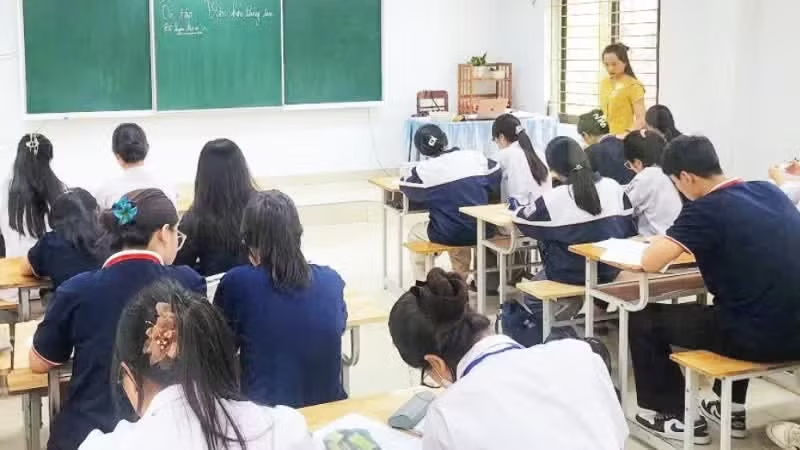
Ready for the examination
This year, Ha Noi has 129,173 registered candidates, accounting for one-tenth of the national total. According to Nguyen Quang Tuan, Deputy Director of the Ha Noi Department of Education and Training, the city has intensified inspections of facilities at examination venues. Coordination among the police, healthcare services and power suppliers has been strengthened to ensure the examination is conducted safely and smoothly.
The Ha Noi Youth Union and the Ha Noi Students’ Association have launched the “Exam season support” programme, deploying nearly 9,800 volunteers at 222 examination venues. To date, all 126 communes and wards have completed their preparations.
Nguyen Van Dung, Head of the Culture and Social Affairs Division of Hoai Duc Commune, said local authorities would continue conducting final checks, strengthen security measures, manage traffic flows, maintain public order and stand ready to address any unexpected situations.
Ho Chi Minh City has the largest number of candidates sitting the 2026 high school graduation examination, with nearly 143,000 registrations. Nguyen Van Hieu, Director of the city’s Department of Education and Training, said training sessions had been organised for invigilators, teachers and examination personnel at all examination venues. The examination steering committee has worked closely with relevant agencies, particularly the city police, to train security personnel in detecting and preventing examination fraud involving high-tech devices.
In mountainous provinces, where terrain is rugged and travel remains difficult, preparations must take into account a range of unique circumstances, with special attention given to candidates in remote and isolated areas.
This year, Lai Chau Province has 4,672 registered candidates, with 23 official examination venues and 23 backup venues. The venue furthest from the provincial centre is located at Ka Lang Ethnic Boarding High School in the border commune of Thu Lum, approximately 220 km away.
The examination period coincides with the peak rainy season in Lai Chau. The provincial examination steering committee has instructed relevant agencies and local authorities to prepare contingency plans for adverse weather and natural disasters.
According to Vu Tien Hoa, Deputy Director of the Lai Chau Department of Education and Training and Deputy Head of the provincial examination steering committee, examination papers will be delivered two days in advance to venues located far from the provincial centre and in areas vulnerable to natural disasters.
Following the examination, commune authorities will coordinate with relevant agencies to safeguard and transport completed examination scripts. In the event of natural disasters, additional support forces will be deployed. Some local authorities have also mobilised resources to provide free accommodation and meals for independent candidates facing financial hardship.
This year, Nghe An Province has more than 42,000 candidates registered for the examination, an increase of more than 2,000 compared with 2025.
Lo Thi Lan, Secretary of the Youth Union in Tuong Duong Commune, said that 80 youth volunteers are ready to support candidates sitting the examination at Tuong Duong 1 High School.
Most candidates at this venue belong to ethnic minority communities, with many living more than 100 km away and therefore arriving several days before the examination. Volunteer teams have contacted providers of low-cost and free accommodation to assist candidates and their parents travelling from distant areas. Lan has also made several rooms owned by her family available free of charge.
Helping candidates feel at ease
Nguyen Chi Thuc, Vice Principal of Tuyen Quang Provincial Ethnic Boarding High School, said students have received continuous support from teachers and school staff in the days leading up to the examination. Teachers have been helping students review key knowledge and answer any remaining questions.
In a boarding school environment, teachers serve not only as educators but also as parental figures, caring for students’ daily needs. As a result, students feel secure, enabling them to focus fully on revision and enter the examination with confidence.
At Tien Phong High School in Ha Noi, Principal Nguyen Quoc Nam said the school had proactively implemented a structured revision plan to ensure students acquired the necessary knowledge and skills. Academic activities have focused on maximising performance by closely following sample examination papers, conducting regular practice tests and organising mock examinations to help students improve examination techniques, manage time effectively and reduce psychological pressure. The school has also regularly shared learning outcomes and mock examination results with parents to keep them informed of their children's academic progress.
At Luong Tai High School in Bac Ninh Province, Vice Principal Pham Thi Thu Thuy said the school had effectively implemented revision programmes and thoroughly communicated examination regulations to students.
Examination venues must clearly define personnel, tasks, responsibilities, timelines, authority and expected outcomes. Procedures must be followed fully and accurately, duties performed in accordance with assigned roles, and situations handled strictly in line with official guidance. Examination venues should neither be complacent nor excessively stressed, and should avoid independently resolving issues outside established procedures. Strengthening responsibility, professional competence and technical expertise will contribute significantly to the success of the examination.
Nghiem Van Binh, Head of the Examination Management and Educational Quality Assurance Division under the Ha Noi Department of Education and Training
Nghiem Van Binh, Head of the Examination Management and Educational Quality Assurance Division under the Ha Noi Department of Education and Training, emphasised that examination venues must clearly define personnel, tasks, responsibilities, timelines, authority and expected outcomes. Procedures must be followed fully and accurately, duties performed in accordance with assigned roles, and situations handled strictly in line with official guidance. Examination venues should neither be complacent nor excessively stressed, and should avoid independently resolving issues outside established procedures. Strengthening responsibility, professional competence and technical expertise will contribute significantly to the success of the examination.
Emphasising the responsibility of examination venue heads
Huynh Van Chuong, Director General of the Quality Management Department under the Ministry of Education and Training, said heads of examination venues are responsible for overseeing all activities at their venues, including the storage and use of examination papers and completed scripts. Rooms not in use during examination sessions must be locked and sealed before each session.
Heads of venues are responsible for assigning duties to personnel and informing candidates about regulations concerning the protection of State secrets related to examination papers and acts that violate examination rules. Examination venues must coordinate with police forces to implement technical solutions and equipment aimed at preventing examination fraud when requested by examination councils or provincial steering committees.
Before each examination session, all personal communication devices belonging to examination personnel must be stored in the venue’s operations room and kept locked and sealed until the session concludes.
The allocation of invigilation and supervision duties must be determined by drawing lots, ensuring that no invigilator supervises the same examination room more than once during the examination period.
Examination venues must designate storage areas for candidates’ personal belongings and prohibited materials, located at least 25m from examination rooms. Invigilators are not permitted to leave examination rooms while candidates are completing their papers. Supervisors may oversee no more than three adjacent examination rooms on the same floor and within the same building.
Candidates are permitted to bring writing pens, rulers, pencils, erasers, set squares, graph-drawing instruments, geometry tools and non-programmable calculators without memory cards into examination rooms. Carbon paper, correction fluid, documents and communication devices are strictly prohibited.
For essay-based examinations, candidates may leave the examination room only after completing two-thirds of the allotted time and must submit their answer scripts, question papers and rough work before leaving the examination area. For multiple-choice examinations, candidates are not permitted to leave the examination room during the examination period or during the interval between subjects within an elective examination component.
If a candidate must temporarily leave the examination room, the invigilator must notify the examination supervisor for coordination. In cases requiring emergency medical treatment, candidates may leave only under the supervision of both police officers and examination supervisors until the examination session concludes, subject to approval by the head of the examination venue.