When flow of knowledge changes direction
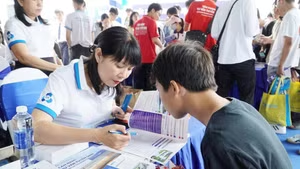
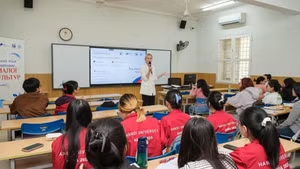
In the Social Marketing class at the Faculty of Marketing, National Economics University, topics relating to Viet Nam’s markets, consumers, and everyday life have featured more prominently since the arrival of international students. The course, which uses foreign textbooks and is taught in English, has also placed greater emphasis on discussion and group work. “I have introduced more case studies based on Vietnamese contexts, so that students can learn professional knowledge while gaining a better understanding of Vietnamese people, markets and the country’s context,” said Assoc Prof, Dr Hoang Phuong Dung, a lecturer at the Faculty of Marketing.
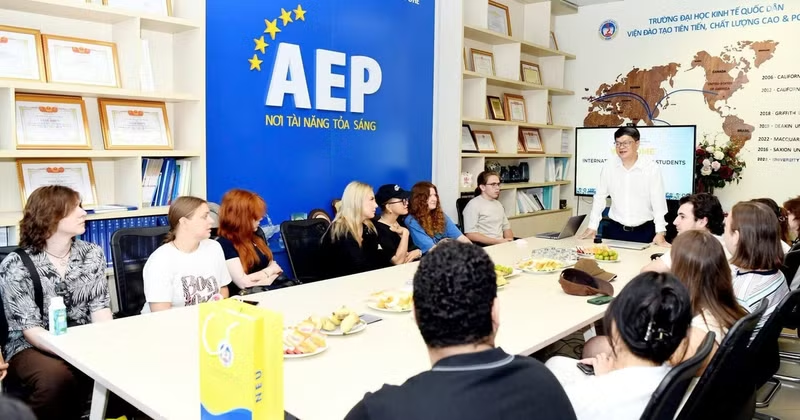
This is one of the changes that has taken place as 24 students from different countries spend a semester at the School of Advanced Education Programmes and POHE during the 2026–2027 academic year. Different experiences and perspectives enter the classroom with the students, while lecturers also adapt their content, language, and teaching methods to a multicultural learning environment. The exchange works in both directions: knowledge and experience from different countries are brought into the classroom, while stories about Vietnam, its people, and its markets become part of international students’ journey of discovery.
More than 200,000 Vietnamese people are currently studying abroad. In the opposite direction, Viet Nam receives around 22,000 international students each year, while nearly 30,000 international students take part in exchange, joint, and short-term study programmes. Although these numbers have increased in recent years, international students still account for only around 1% of the total student population in Viet Nam. The country has begun to attract international learners, but the flow of students remains predominantly outward, from Viet Nam to the rest of the world.
According to Dr Janet Ilieva, Founder and Chief Executive Officer of Education Insight, UK, international students are increasingly seeking study destinations in countries to the east and south. This trend opens a new direction: alongside sending students out into the world, Vietnamese universities can proactively develop programmes and academic environments attractive enough to draw international learners, experts, and partners to Viet Nam. For interest to develop into a long-term choice, each educational institution must find its own answer to a key question: What value can it offer that makes learners want to come, stay and return to Viet Nam?
Drawing students through institutional strengths
According to Professor May Tan-Mullins, President and Chief Executive Officer of the University of Reading Malaysia, it is difficult for any individual university to invest heavily in every field at the same time. What matters is finding a suitable direction, pursuing it consistently, and establishing a distinctive reputation both in academic circles and among international learners. For Vietnamese universities, such strengths may derive from culture and heritage; challenges relating to agriculture, the environment, and green development; or the realities of a rapidly transforming economy. When incorporated into academic programmes and practical experiences, these advantages can become compelling reasons for students to choose Viet Nam.
At the School of Advanced Education Programmes and POHE, the foundation for attracting international students has been built around English-taught programmes, international accreditation and links with businesses. All courses under the advanced programmes are taught in English, while a number of programmes managed by the school have been accredited under ACBSP and FIBAA standards. According to Dr Vu Van Ngoc, Director of the School of Advanced Education Programmes and POHE, whether studying finance, business, marketing, or management, students need to know how to harness data and use technology to support decision-making.
Learning is connected to practical experience through internships and projects with domestic and international businesses. For international students, timetables and lists of courses taught in English are published well in advance, allowing them to choose their courses proactively and make suitable preparations before coming to Viet Nam. According to Dr Vu Van Ngoc, this may seem like a small detail, but it makes it easier for students to enter a new environment.
English-taught programmes, international accreditation and internship opportunities with businesses are among the first things students can see when researching a university. Long-term appeal, however, also lies in the distinctive value an institution can offer. In the school’s programmes, international knowledge and standards are applied to issues relating to Viet Nam’s markets, culture, and everyday life. This combination creates additional options for international students while giving Vietnamese students opportunities to study in an environment that is more closely connected with the wider world.
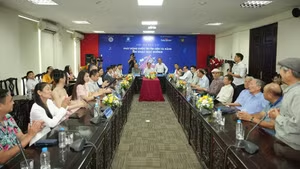
As part of the State visit by the high-ranking Vietnamese delegation to New Zealand, the Viet Nam–New Zealand Higher and Vocational Education Forum was held at Auckland University of Technology. Educational institutions, research institutes and businesses from both countries explored opportunities for cooperation in digital technology, biotechnology, high-tech agriculture, renewable energy, food technology, and green development. These are also areas in which Viet Nam needs additional human resources, technology and new training models.
According to Assoc Prof, Dr Nguyen Thu Thuy, Director General of the Department of International Cooperation under the Ministry of Education and Training, education diplomacy aims to attract international knowledge, technology, talent, and resources while promoting Viet Nam’s image and academic capabilities to the world.
“Viet Nam’s goal is to shift from being a recipient to a co-creator of knowledge, and from participating in the global arena to contributing to it,” Thuy stressed.
This transition needs to be reflected in concrete changes within individual educational institutions: a programme upgraded to higher standards, a research finding put into practice, a new skill developed, or an international student or lecturer choosing Viet Nam as a place to study and work. As such developments become increasingly widespread, the appeal of individual educational institutions will help strengthen the country’s overall capacity and position.