The network will provide learning and training opportunities for children of wounded and fallen People’s Public Security officers, children from families entitled to preferential policies, disadvantaged ethnic minority children, and children eligible for social protection, thereby contributing to the effective implementation of social welfare policies.
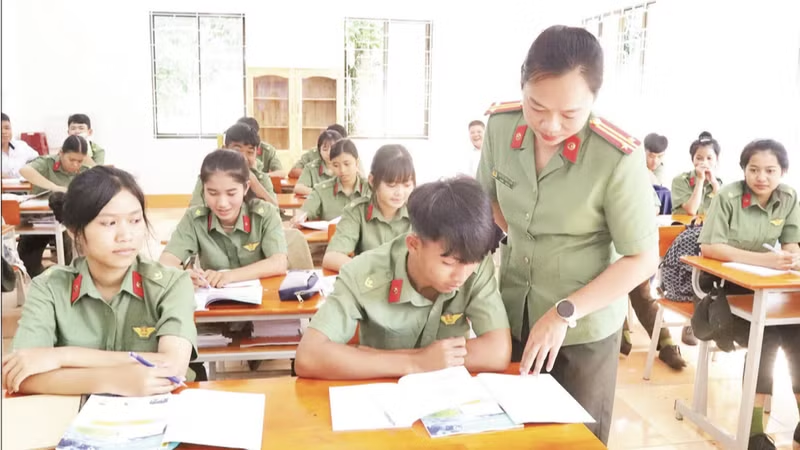
At the end of June 2026, People’s Public Security Cultural School I was established on the basis of the existing People’s Public Security Cultural School in Bach Quang Ward, Thai Nguyen Province, which was transferred in its entirety from the Training Department under the Ministry of Public Security to the management of the Thai Nguyen Provincial Police. Inheriting a 50-year tradition of establishment and development, the school quickly consolidated its organisation, prepared its facilities, and expanded enrolment. The 2026-2027 academic year is the first year the school has implemented a three-level education model, admitting 500 new students, including 90 fifth-graders, 150 sixth-graders, 150 tenth-graders, and 110 students who are children of Lao citizens, bringing the total number of students to nearly 1,200.
As the new academic year began, the school welcomed students, provided them with uniforms and arranged proper accommodation and meals. Phan Thi Minh Thu, daughter of fallen officer Phan Van Thanh (late head of the security and public order team in Xuan Ha 1 Hamlet, Thanh Cong Commune, Thai Nguyen Province, who died while bravely rescuing three young children at risk of drowning in October 2025) was admitted to Grade 5. For Minh Thu’s mother, having her daughter study at the school has given her greater peace of mind. Meanwhile, Mua Thi Kien Giang, a student in class 6A2, could not avoid missing her family during her first days away from home. However, the care and attention of her teachers have gradually helped her adapt to the new environment and resolve to study and train well.
People’s Public Security Cultural School I also continues to provide education for students from Laos and Cambodia. From 2021 to 2026, the school has provided education and training to more than 1,200 students and trainees from the two countries, with the upper-secondary graduation rate reaching nearly 99%, contributing to meeting the Ministry of Public Security’s external relations requirements and strengthening security cooperation with neighbouring countries. According to the school’s leadership, alongside renewing teaching and learning methods, the school places emphasis on political and ideological education, ethics, skills, and a sense of organisational discipline; building a formal, disciplined, and safe educational environment; and laying a foundation for students’ comprehensive development.
People’s Public Security Cultural School II, located in Tan Lap Ward, Dak Lak Province, began its first academic year with a distinctive appearance. Not only the staff and teachers but also the students wear the uniforms of the People’s Public Security forces. At school, the students are introduced to a daily routine governed by strict schedules and discipline.
Colonel Mai Huu Van, the school’s principal, said that the school was established on the basis of inheriting the facilities of the former People’s Public Security Cultural School III. With a 9.7-hectare campus and adequate facilities, classrooms, and boarding accommodation, the school has 34 classes with 1,020 students from Grades 5 to 10 in the 2026-2027 academic year, coming from four central provinces: Dak Lak, Gia Lai, Lam Dong, and Quang Ngai. Each student comes from a different background, but they all receive comprehensive care in terms of accommodation, meals, and healthcare, as well as in education in knowledge and skills. The school places emphasis on foreign languages, science and technology, digital competence, career orientation, discipline, and a sense of responsibility, while also paying close attention to each student, particularly those facing exceptionally difficult circumstances.
Y Gio M’Lo, a Grade 10 student from the M’nong ethnic group, comes from Drang Phok Hamlet in the border commune of Buon Don. His parents have passed away, and Y Gio and his four siblings support one another, making a living through farming. Concerned for her younger siblings, the eldest sister, Nguyen Thi Ngan M’Lo, had to leave school early to become the family’s mainstay. After completing Grade 9 at Buon Don Ethnic Minority Boarding School, Y Gio once thought that he would no longer have the opportunity to continue his education. Therefore, the day he received his admission decision to People’s Public Security Cultural School II was also the day his family gained new hope.
“Now that I have the opportunity to study and live here, I will do my best to train and study hard so that I can have a stable job and a better future, and repay my eldest sister, who had to give up her schooling halfway and sacrifice her dream of learning and going to school for me,” Y Gio M’Lo said.
Also at People’s Public Security Cultural School II, Ma Thi Ngoc Tien, a Grade 6 student from the Tay ethnic group, comes from the remote Krong A Commune and is in particularly difficult circumstances. There are seven siblings in her family; her parents died when they were young. Her older siblings must now work on the farm to make a living, while Tien, the youngest, used to cycle 5km to school every day on her own. She once thought that she would only be able to complete Grade 5 before having to leave school. An opportunity came when police officers visited the locality to recruit students. On the day Tien enrolled, all her siblings cried with joy. Wearing her new uniform, she felt great pride and determination to study hard.
In Can Tho, People’s Public Security Cultural School III has just held its opening ceremony for the 2026-2027 academic year. In its first academic year, the school welcomed 554 students across three levels of education from Can Tho City and the provinces of An Giang, Ca Mau, Dong Thap, and Vinh Long.
Thach Thi Thanh Truc, a Khmer ethnic minority student from Thanh Hoa Commune, Can Tho City, is among the students facing particularly difficult circumstances. Her mother died and her father left, so she lives with her elderly grandmother and was at risk of having to discontinue her education. With support from the local authorities and the school, she was admitted to Grade 6, giving her another opportunity to continue her education. “I am very happy to be able to continue going to school and to be cared for and educated at this new school. I will try my best to study well so that, when I grow up, I can become a useful member of society,” Truc said.
Major Huynh Phuoc Vui, Deputy Principal of People’s Public Security Cultural School III, stressed that the school not only imparts knowledge but is also positioned as a “Happy Home”. Students receive care ranging from their meals and sleep to character education and the development of independence. The discipline of the armed forces, combined with the love and care of teachers, will help them overcome adversity, gain equal access to education, and confidently look towards the future.
Before the opening ceremony, the school’s board of management personally visited 60 successful applicants, mainly children of Khmer ethnic minority people in Tai Van Commune and Khanh Hoa Ward (Can Tho City), to present them with admission notices. The school also organised teams to visit the homes of students facing difficulties, offering encouragement and support gifts.
The new academic year has begun. The People’s Public Security Cultural Schools are opening a new door for students who once faced the risk of having their education cut short. Here, they are not only taught academic knowledge and trained in discipline but are also cared for, loved, and encouraged to nurture their dreams. The establishment of the People’s Public Security Cultural School model demonstrates society’s responsibility towards disadvantaged children, helping create equal educational opportunities for those facing hardship so that they can acquire knowledge, resilience, and a solid foundation for confidently moving towards the future.
The network will provide learning and training opportunities for children of wounded and fallen People’s Public Security officers, children from families entitled to preferential policies, disadvantaged ethnic minority children, and children eligible for social protection, thereby contributing to the effective implementation of social welfare policies.
At the end of June 2026, People’s Public Security Cultural School I was established on the basis of the existing People’s Public Security Cultural School in Bach Quang Ward, Thai Nguyen Province, which was transferred in its entirety from the Training Department under the Ministry of Public Security to the management of the Thai Nguyen Provincial Police. Inheriting a 50-year tradition of establishment and development, the school quickly consolidated its organisation, prepared its facilities, and expanded enrolment. The 2026-2027 academic year is the first year the school has implemented a three-level education model, admitting 500 new students, including 90 fifth-graders, 150 sixth-graders, 150 tenth-graders, and 110 students who are children of Lao citizens, bringing the total number of students to nearly 1,200.
As the new academic year began, the school welcomed students, provided them with uniforms and arranged proper accommodation and meals. Phan Thi Minh Thu, daughter of fallen officer Phan Van Thanh (late head of the security and public order team in Xuan Ha 1 Hamlet, Thanh Cong Commune, Thai Nguyen Province, who died while bravely rescuing three young children at risk of drowning in October 2025) was admitted to Grade 5. For Minh Thu’s mother, having her daughter study at the school has given her greater peace of mind. Meanwhile, Mua Thi Kien Giang, a student in class 6A2, could not avoid missing her family during her first days away from home. However, the care and attention of her teachers have gradually helped her adapt to the new environment and resolve to study and train well.
People’s Public Security Cultural School I also continues to provide education for students from Laos and Cambodia. From 2021 to 2026, the school has provided education and training to more than 1,200 students and trainees from the two countries, with the upper-secondary graduation rate reaching nearly 99%, contributing to meeting the Ministry of Public Security’s external relations requirements and strengthening security cooperation with neighbouring countries. According to the school’s leadership, alongside renewing teaching and learning methods, the school places emphasis on political and ideological education, ethics, skills, and a sense of organisational discipline; building a formal, disciplined, and safe educational environment; and laying a foundation for students’ comprehensive development.
People’s Public Security Cultural School II, located in Tan Lap Ward, Dak Lak Province, began its first academic year with a distinctive appearance. Not only the staff and teachers but also the students wear the uniforms of the People’s Public Security forces. At school, the students are introduced to a daily routine governed by strict schedules and discipline.
Colonel Mai Huu Van, the school’s principal, said that the school was established on the basis of inheriting the facilities of the former People’s Public Security Cultural School III. With a 9.7-hectare campus and adequate facilities, classrooms, and boarding accommodation, the school has 34 classes with 1,020 students from Grades 5 to 10 in the 2026-2027 academic year, coming from four central provinces: Dak Lak, Gia Lai, Lam Dong, and Quang Ngai. Each student comes from a different background, but they all receive comprehensive care in terms of accommodation, meals, and healthcare, as well as in education in knowledge and skills. The school places emphasis on foreign languages, science and technology, digital competence, career orientation, discipline, and a sense of responsibility, while also paying close attention to each student, particularly those facing exceptionally difficult circumstances.
Y Gio M’Lo, a Grade 10 student from the M’nong ethnic group, comes from Drang Phok Hamlet in the border commune of Buon Don. His parents have passed away, and Y Gio and his four siblings support one another, making a living through farming. Concerned for her younger siblings, the eldest sister, Nguyen Thi Ngan M’Lo, had to leave school early to become the family’s mainstay. After completing Grade 9 at Buon Don Ethnic Minority Boarding School, Y Gio once thought that he would no longer have the opportunity to continue his education. Therefore, the day he received his admission decision to People’s Public Security Cultural School II was also the day his family gained new hope.
“Now that I have the opportunity to study and live here, I will do my best to train and study hard so that I can have a stable job and a better future, and repay my eldest sister, who had to give up her schooling halfway and sacrifice her dream of learning and going to school for me,” Y Gio M’Lo said.
Also at People’s Public Security Cultural School II, Ma Thi Ngoc Tien, a Grade 6 student from the Tay ethnic group, comes from the remote Krong A Commune and is in particularly difficult circumstances. There are seven siblings in her family; her parents died when they were young. Her older siblings must now work on the farm to make a living, while Tien, the youngest, used to cycle 5km to school every day on her own. She once thought that she would only be able to complete Grade 5 before having to leave school. An opportunity came when police officers visited the locality to recruit students. On the day Tien enrolled, all her siblings cried with joy. Wearing her new uniform, she felt great pride and determination to study hard.
In Can Tho, People’s Public Security Cultural School III has just held its opening ceremony for the 2026-2027 academic year. In its first academic year, the school welcomed 554 students across three levels of education from Can Tho City and the provinces of An Giang, Ca Mau, Dong Thap, and Vinh Long.
Thach Thi Thanh Truc, a Khmer ethnic minority student from Thanh Hoa Commune, Can Tho City, is among the students facing particularly difficult circumstances. Her mother died and her father left, so she lives with her elderly grandmother and was at risk of having to discontinue her education. With support from the local authorities and the school, she was admitted to Grade 6, giving her another opportunity to continue her education. “I am very happy to be able to continue going to school and to be cared for and educated at this new school. I will try my best to study well so that, when I grow up, I can become a useful member of society,” Truc said.
Major Huynh Phuoc Vui, Deputy Principal of People’s Public Security Cultural School III, stressed that the school not only imparts knowledge but is also positioned as a “Happy Home”. Students receive care ranging from their meals and sleep to character education and the development of independence. The discipline of the armed forces, combined with the love and care of teachers, will help them overcome adversity, gain equal access to education, and confidently look towards the future.
Before the opening ceremony, the school’s board of management personally visited 60 successful applicants, mainly children of Khmer ethnic minority people in Tai Van Commune and Khanh Hoa Ward (Can Tho City), to present them with admission notices. The school also organised teams to visit the homes of students facing difficulties, offering encouragement and support gifts.
The new academic year has begun. The People’s Public Security Cultural Schools are opening a new door for students who once faced the risk of having their education cut short. Here, they are not only taught academic knowledge and trained in discipline but are also cared for, loved, and encouraged to nurture their dreams. The establishment of the People’s Public Security Cultural School model demonstrates society’s responsibility towards disadvantaged children, helping create equal educational opportunities for those facing hardship so that they can acquire knowledge, resilience, and a solid foundation for confidently moving towards the future.