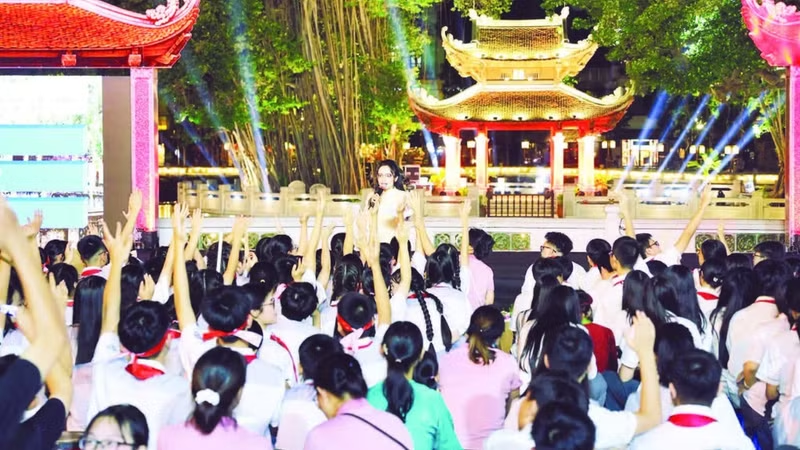
Entering the 2026-2027 academic year, artistic education activities and art movements in general education schools are being promoted by educational institutions in line with the sector’s orientation towards improving comprehensive quality, contributing to the concrete implementation of Resolution 80.
Learning to appreciate national culture
For a long time, nurturing a love for traditional arts has largely relied on museums, theatres, cultural centres, and clubs. Meanwhile, schools — where children spend the most time during the years when their personalities are being formed — have yet to give this content the commensurate place it deserves. Resolution No. 80-NQ/TW has set out new requirements for the education sector, under which arts education and heritage education must be viewed as components of comprehensive education.
In Hue, since late 2019, the education sector and the Hue Monuments Conservation Centre have signed a cooperation programme on “Hue Cultural Heritage Education” in schools, with heritage sites gradually becoming “open classrooms”. During the 2022-2025 period, the programme welcomed 1,790 groups, comprising 189,621 pupils and teachers; participating pupils accounted for approximately 66% of the city’s total pupil population. In March 2026, the two sides continued to sign a coordination programme for the 2026-2030 period.
In Ho Chi Minh City, heritage education has been implemented in two directions: bringing pupils to heritage sites and bringing heritage into the classroom. A report presented at the conference reviewing the cultural heritage education programme for pupils for the 2023-2026 period, held on September 25, showed that after four years, the programme had organised 44 activities, attracting more than 8,100 pupil attendances; in 2026, approximately 4,000 pupils participated through mobile exhibitions, exchanges with artisans, and the “Heritage Bus” journey.
Educational methods have gradually shifted from theoretical instruction to practical experience. At the same time, many schools have proactively invited artisans and artists to teach in classrooms. For example, at Bui Thi Xuan High School (Ben Thanh Ward), a pilot programme was launched in the 2026-2027 academic year for three Year 11 classes, involving more than 150 pupils. Each week, pupils have one lesson in the art of don ca tai tu, with periodic testing and assessment; the teachers are artisans and artists from the HCMC Theatre Association.
However, moving from several “bright spots” to the target of ensuring that 100% of pupils, trainees, and students in the national education system have access to and regularly and effectively participate in artistic activities and cultural heritage education is no small gap.
Most existing models still rely on the determination of individual schools, while funding sources remain unstable. The don ca tai tu club at Nguyen Thai Hoc Primary School (Ben Thanh Ward), launched in the 2020-2021 academic year, once had to suspend activities for a long period due to a lack of funding. It was not until the second semester of the 2025-2026 academic year that the class resumed.
According to musician and researcher Nguyen Quang Long, a member of the Executive Committee of the Viet Nam Musicians’ Association, it is necessary to clearly distinguish between the two levels set out in Resolution No. 80-NQ/TW: “access” and “participation”. If pupils merely attend a performance or listen to an introduction to heritage, this only constitutes access. With traditional arts, experience is the decisive factor.
He also pointed out a risk that needs to be avoided: turning arts and heritage into a subject or a new task, inadvertently creating additional pressure on pupils. The goal is not to turn every pupil into an artist but to enable them to appreciate and value national culture.
To achieve this, schools need a regular plan combining formal lessons with clubs, visits to heritage sites, and meetings with artisans; at the same time, effectiveness should not be assessed merely by the number of programmes or pupils attending but by whether the pupils truly understand, experience, and want to learn more. Only in this way can heritage education become part of school life.
Strengthening coordination
If “access” and “regular participation” are the two components of the goal, then artisans and artists are precisely the conditions for realising both. According to musician Nguyen Quang Long, this is a highly valuable resource, however, it needs to be organised and coordinated harmoniously.
Towards the set target, a question of public concern is whether the current pool of reputable and highly qualified artisans and artists is sufficient for the entire school system. In reality, experience at some schools in Ho Chi Minh City shows that there are still few tai tu musicians who can accompany schools over the long term, while teaching this art form requires perseverance and time.
He also pointed out something that is rarely mentioned: a talented artisan may not necessarily have a method suitable for young pupils; conversely, a teacher with solid pedagogical expertise may not necessarily be a practitioner with in-depth knowledge of the art form.
Therefore, he proposed combining the two groups rather than allowing artisans to completely replace teachers. Researchers, arts organisations, museums, and heritage sites can also participate, so that those who are skilled in the art and those who are skilled at teaching can complement each other.
Folk culture researcher Tran Phuoc Thuan, a member of the Executive Committee of the Viet Nam Association of Folk Arts and Literature, noted that when organising the teaching of traditional arts to pupils, forms of folk transmission should be encouraged, while there must also be support and guidance from specialised agencies to ensure that heritage is preserved properly.
Many forms of folk art live through the transmission of techniques and vocal styles, as well as the improvisation of performers within established musical frameworks. If they are brought into schools and turned into lessons to be memorised and graded as a knowledge subject, heritage may easily become “boxed in”, losing the very essence that creates its value. Conversely, if each place teaches it in a different way without knowledgeable people to assess it, pupils may absorb inaccurate information.
The realisation of the target set out in Resolution No. 80-NQ/TW requires perseverance and determination from the entire system. When clear mechanisms are in place, together with the initiative of schools and the commitment and dedication of artisans and artists, efforts to help heritage “take root” in schools will gradually gain success, allowing heritage to continue to live and have its value promoted among new generations.