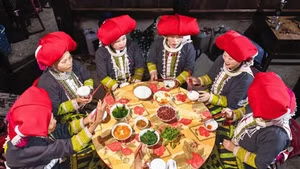
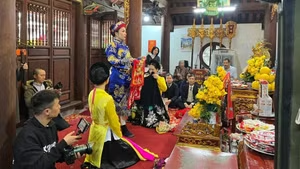
This is the first time a Party document has set specific quantitative targets for cultural brands and the cultural industries. With thousands of tangible and intangible heritage assets and a rich cultural life shaped by its 54 ethnic groups, Viet Nam has a strong foundation for achieving this goal. However, moving from having “cultural resources” to developing “cultural brands” will require strong determination and a systematic approach.
Building brands through culture
A national brand can be understood as the distinctive image, reputation and value that a country establishes in the eyes of the international community. According to Brand Finance, a London-based organisation that evaluates national brands, Viet Nam’s national brand ranking has steadily improved in recent years, driven by efforts to reform the investment environment and promote economic growth.
However, in terms of soft power, where culture plays a central role, Viet Nam’s position remains relatively modest. In the Global Soft Power Index released by Brand Finance in late January 2026, Viet Nam ranked 52nd out of 193 countries and ninth in Asia, still some distance behind the region’s leading countries.
Experts say what is lacking is not cultural material, but cultural products capable of creating a distinctive national identity. Looking at countries in the region makes this clear. Japan has not only preserved tea ceremony and kimono, but has also turned manga, anime and popular culture into sources of global influence. The Republic of Korea (RoK) has developed an ecosystem of cultural industries spanning music, film, fashion, cosmetics and tourism, creating the Hallyu (Korean Wave) as a systematic soft-power strategy.
In 2025, RoK’s exports of cultural content reached a record nearly 14.9 billion USD, while the total value of its cultural industry reached nearly 38 billion USD, making it the country’s fourth-largest export sector, after semiconductors, automobiles and petrochemicals.
In Europe, festivals in Edinburgh, the capital of Scotland, as well as Avignon and Lyon in France, have become “urban brands”, helping position national images on the global tourism and creative map. In these models, culture is not merely heritage to be preserved, but a resource retold in the language of the times.
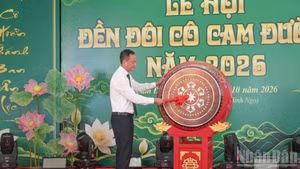
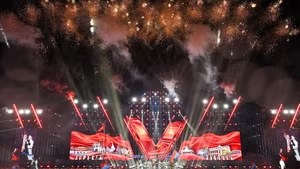
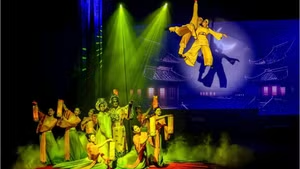
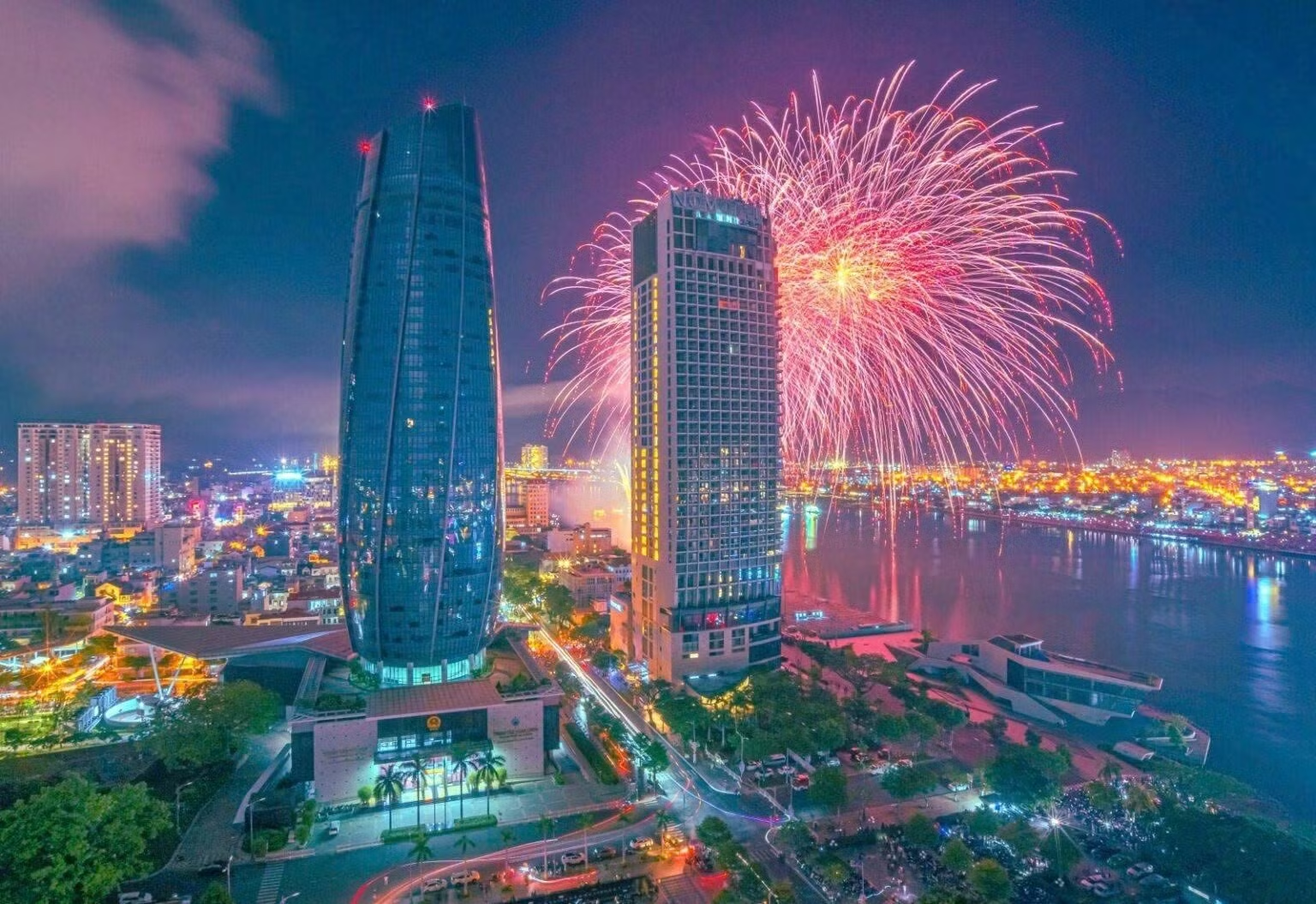
Domestically, there have been encouraging signs. The Hue Festival, the Da Nang International Fireworks Festival (DIFF), the Da Nang Asian Film Festival (DANAFF), and contemporary art events in Ha Noi and Ho Chi Minh City have begun to demonstrate the potential to connect heritage, tourism and the creative industries. However, to truly leverage their role as tools for brand building, such events need not only to achieve scale, but also to develop a distinctive identity and maintain continuity over many years.
Phan Minh Thu, Executive Director of Senplus JSC, said Viet Nam has no shortage of cultural resources or products, but remains limited in its ability to tell brand stories that can resonate with international audiences. Only when culture is “packaged” into experiences, products or services capable of reaching the market can it truly become an economic driver. Dr Truong Thuy Mai of the Faculty of Cultural Studies at Ha Noi University of Culture said an analysis of international experience shows that successful cities and countries all leverage cultural events as part of their destination-branding strategies.
Removing bottlenecks and building brands
From a creative perspective, Viet Nam is not short of capabilities. Deputy Minister of Culture, Sports and Tourism Nguyen Huy Dung said the value chain of the cultural industries remains fragmented at many stages, including between creativity and intellectual property, capital and production, and production and distribution and reinvestment.
He cited two figures that warrant consideration: around 80% of investment capital in Vietnamese game startups currently “flows” to Singapore, where the legal framework and investment ecosystem are more favourable; while more than 60% of domestic animation studios mainly provide outsourcing services for foreign projects rather than owning their own intellectual property. Viet Nam has creative capacity and a market, but the added value and property rights are not staying with those who create them. This is a paradox that needs to be addressed.
Today, awareness is rapidly being translated into institutional action. Following the issuance of Resolution No. 80-NQ/TW, the National Assembly adopted Resolution No. 28/2026/QH16, which provides a number of mechanisms and policies for developing Vietnamese culture and designates the Ministry of Culture, Sports and Tourism as the focal agency responsible for state management of the cultural industries before the Government.
Another step that many experts are looking forward to is the draft Law on the Development of Cultural Industries, which is expected to be submitted to the National Assembly for passage under an expedited procedure at the second session of the 16th National Assembly in October. The draft law aims to achieve three major objectives: establishing the position of the cultural industries within Viet Nam’s economic structure; connecting value chains to increase economic value, exports and strategic investment; and promoting Vietnamese cultural identity, the Viet Nam brand and Vietnamese soft power internationally.
Enacting the law is necessary, but many other factors will be needed to turn the targets into reality. Tran Hoang, Director of the Copyright Office under the Ministry of Culture, Sports and Tourism, said the gap between Viet Nam and leading countries is not due to a lack of cultural material to tell stories about, but because those countries have spent decades turning popular culture into an organised industry, backed by long-term investment and coordinated agencies covering the entire process from content incubation to international market promotion. The key issue now, he said, is to identify products with potential and distinctive identities that are capable of becoming international brands.
According to Phan Minh Thu, effective cultural branding requires several pillars: institutions and policies with specific support measures and a clear legal framework; a clearly defined identity and shared vision, avoiding a situation in which each locality tells a fragmented brand story of its own; and community strength, through which collective values are continuously nurtured, preserving memories while creating new cultural value.
The Government has approved the strategy for communicating and promoting Viet Nam’s image abroad for 2026-2030, with a vision to 2045, aiming to place Viet Nam among ASEAN’s top three countries and the world’s top 30 in the Global Soft Power Index. Therefore, ministries, sectors and localities need to move from ad hoc promotion towards systematic brand building based on long-term strategies.
With the policy framework gradually being completed, the political determination is already in place. What remains is implementation: choosing the right products, building the right markets and telling the right stories. The results will depend on how ministries, sectors, businesses and cultural practitioners work together in the years ahead.