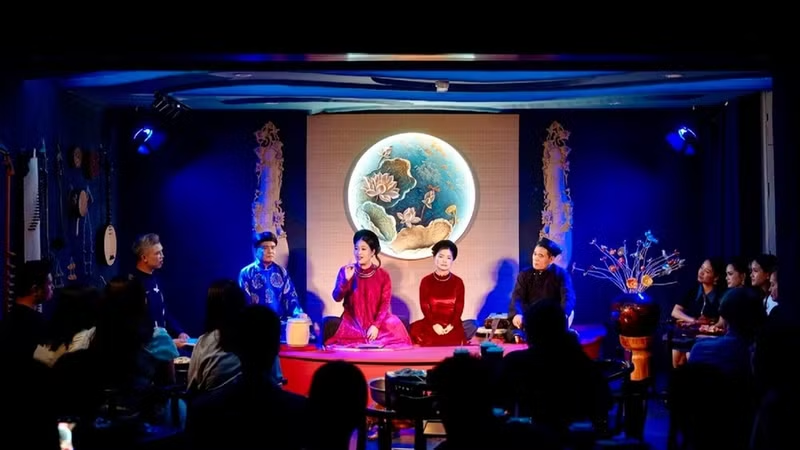
Recently, CADAO Collective, a dedicated space for enjoying traditional arts, was launched at 66 To Ngoc Van Street, Ha Noi. True to its innovative spirit, the space introduces audiences to the traditional values of puppetry, xam singing, and ca tru through an interplay with contemporary art.
Visitors can encounter a vibrant blend of water puppetry, shadow puppetry, and modern projection technology against a backdrop of folk melodies interwoven with new musical compositions.
They can also immerse themselves in the intimate, highly interactive performance space of xam singing and ca tru, and engage directly with artisans. Notably, the arts space is seamlessly connected with a local culinary experience.
“Tran Nhan Tong” – a collaborative production between the Viet Nam Circus Federation and the Viet Nam National Traditional Theatre – has also demonstrated the immense potential of renewing artistic language to attract visitors.
The historical-themed performance is presented through an engaging fusion that combines the narrative and lyrical elements of cai luong with the movement techniques and highly visual physical language of the circus.
Having started as a commissioned production, the show has gone on to stage dozens of ticketed performances, ultimately becoming an artistic product with a life of its own for the organisation.
Also aimed at serving tourists, “The Charm of Ha Thanh Cheo” by the Ha Noi Cheo Theatre distils the spirit of traditional cheo through a modern staging approach, and the “Sounds of the Vietnamese Soul” programme series by the Ha Noi Cai Luong Theatre seeks to bring traditional arts into open spaces. Meanwhile, “Long Thanh Emotions” by the Viet Nam Puppetry Theatre recreates the historical depth of Thang Long–Ha Noi through a theatrical language infused with a contemporary spirit.
These arts destinations demonstrate that with creative staging and appropriate interpretation, traditional arts — often considered old-fashioned and difficult to access — can become vibrant experiences in visitors’ travel itineraries.
Within Viet Nam’s vast treasury of traditional arts, each form of performance embodies its own set of values associated with the history, customs, lifestyle, and culture of each locality.
This represents a valuable resource for tourism, helping to create distinctive products, diversify tourism offerings, extend visitors’ stays, and increase their spending.
While linking tourism with the arts is not a novel approach, truly successful examples remain scarce.
Tong Toan Thang, Director of the Viet Nam Circus Federation, noted: “A performance may receive substantial investment, but if it is staged for only a few nights before being put into storage, it will be difficult to create a lasting impact and will limit artists’ opportunities to perform and pursue their profession.”
He added: “If it can be exploited for tourism, a production can have a longer life and greater vitality, thereby creating additional value for both the arts and the destination. To achieve this, the potential for public access, opportunities for repeat performances, and the sustainable life of the product need to be considered from the creative stage onwards.”
Traditional arts must be updated to suit the tastes and needs of contemporary audiences. However, renewal does not mean chasing novelty for its own sake or simply bringing more modern technology onto the stage.
More importantly, it means finding the key to telling a destination’s story convincingly— touching audiences emotionally while connecting with the community behind that story. Vietnamese cultural materials must be deeply embedded in the artistic language.
Nguyen Tien Dung, Director of the Viet Nam Puppetry Theatre, said that since its launch in late 2025, the theatre’s “Long Thanh Emotions” programme had staged hundreds of ticketed performances as of June 2026 and continued to be commercially successful.
Dung noted that tourists, particularly international visitors, often lack both the time and patience to watch a programme or performance lasting several hours. They are even less likely to engage with works that rely on archaic language or overly complex traditional stories.
Therefore, when developing traditional arts for tourists, performances need to be shortened and dialogue minimised, while brief subtitles should be used more extensively. Greater emphasis should be placed on communicating through body language, music, lighting, sound, and imagery to bridge language and cultural barriers for international audiences.
At the same time, renewal must preserve the core values of traditional arts, while the organisation of the performance space, rhythm, and storytelling methods can be adapted to bring a contemporary feel.
Experience in organising artistic activities for tourism shows that today’s visitors are not satisfied with simply watching art; they also want to actively experience it.
Therefore, alongside performances and shows, organisers need to design interactive activities such as conversations with artisans, exchanges with artists, introductions to traditional musical instruments, and opportunities to dress in traditional attire.