For example, an art lesson may be equipped with projectors, drawing software, and AI-powered image-generation applications.
However, the ultimate objective of every lesson must be empowering students to gain a general understanding of art, develop the skills to appreciate and evaluate traditional cultural values, and, in particular, profoundly connect with the beauty of an ancient motif or recognise the distinctive character of a handicraft from a particular region.
The learner’s cultural foundation therefore remains the core element. The more technology advances, the more firmly that cultural foundation must be fortified.
The current general education curriculum requires arts education to be linked to students’ ability to observe, appreciate, and create, while equipping them to revere and perpetuate the nation’s cultural and artistic values and engage with contemporary aesthetics.
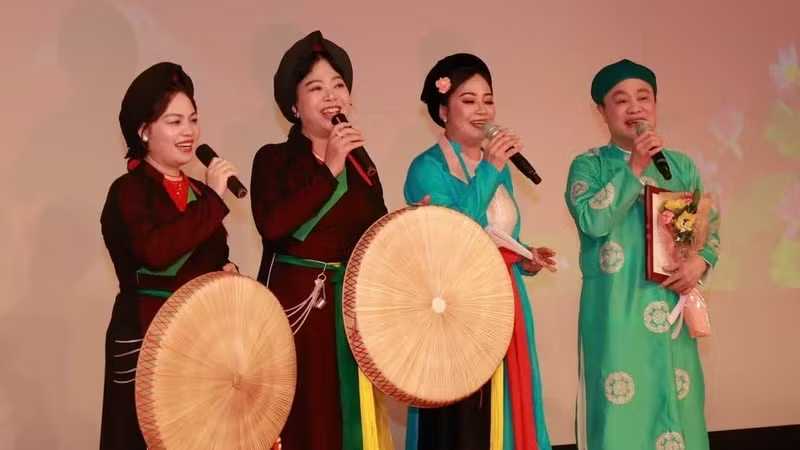
The Ministry of Education and Training has issued regulations allowing general education schools to invite experts, artisans, and artists to participate in teaching. However, the effectiveness of such initiatives hinges fundamentally on how they are organised.
If an artisan merely arrives to deliver a performance during a cultural exchange, students remain spectators rather than active participants.
Conversely, when artisans work alongside teachers throughout the learning process, acting as storytellers, guiding hands-on practice, and designing age-appropriate activities aligned with lesson objectives, the value of passing on traditional knowledge is greatly enhanced.
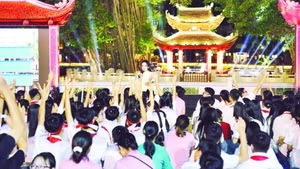
Integrating traditional arts into schools primarily involves forging opportunities for students to meet, understand, practise, and create.
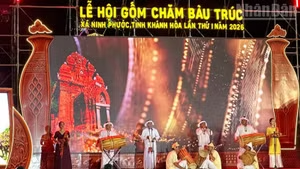
Each locality can start with the resources it already has: artisans, museums, theatres, craft villages, clubs, and distinctive art forms.
When young people recognise the beauty and value of their own hometowns, national cultural values are no longer abstract or difficult-to-grasp concepts.
AI can assist teachers and students to discover resources, experiment with images and sounds, and access heritage that is difficult to experience directly.
However, if learners merely input a few prompts and receive an AI-generated product, the most important part of education faces the critical risk of being entirely neglected: nurturing their ability to observe, feel, experiment without fear of making mistakes, and develop their own means of expression.
While a final work may lack absolute perfection, if a student can explain why they chose a particular motif or material and has personally navigated the entire creative process, it can sometimes be more valuable than an eye-catching product in which most of the work has been done by an algorithm.
Therefore, the question for a modern arts lesson is not how much technology has been used, but whether technology empowers learners to attain a deeper understanding and demonstrate greater proactivity and creativity.
In the digital environment, young people encounter a daily influx of countless artistic products and aesthetic trends from around the world.
Education must ultimately equip them with the ability to make choices: to appreciate the finest aspects of global culture while also understanding the values that shape their own identity.
In this sense, identity is not an anchor that tethers young people to the past, but a foundation from which they can confidently venture further.
Renewing arts education should begin by empowering students to be profoundly moved by beauty, comprehend their cultural roots, and create something new through their own thinking and abilities.
A generation that can master the most advanced modern tools without severing ties with its national heritage, and that can embrace the finest of global culture while retaining its own voice — that is the ultimate goal of arts education in the digital age.