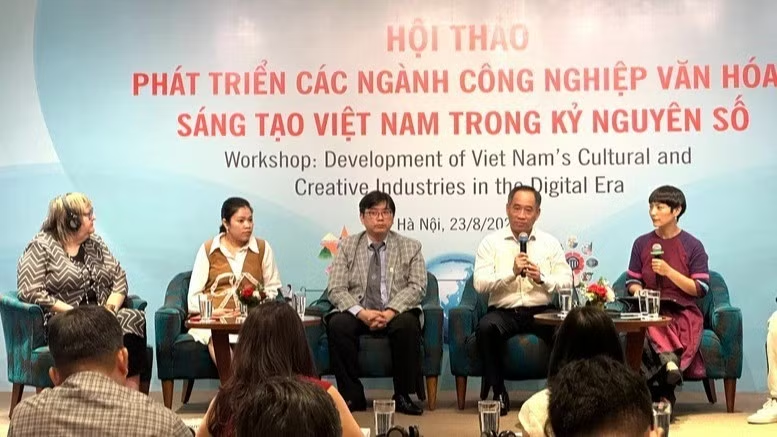
From cultural identity to the strength of Vietnamese brands
Cultural industries are playing an increasingly important role in the creative economy. Market developments in recent years show that domestic cultural products have made notable progress in consumer demand and revenue generation.
In 2025, box office revenue in Viet Nam exceeded 6.1 trillion VND, with Vietnamese films accounting for around 62%. Many domestic performances and concerts have attracted large audiences, with some selling out within just a few hours.
In the mobile gaming sector, Viet Nam is regarded as one of the world’s largest markets in terms of downloads, with more than 200 studios in operation. These figures show that domestic audiences are increasingly willing to embrace products created by Vietnamese people.
According to Annie Quynh Anh, former Marketing Director of VinCSS Cyber Security Services JSC under Vingroup, this is a period in which Viet Nam’s cultural industries are moving from “potential” towards value that can be measured through market indicators. Alongside market growth, the policy framework for the sector is also being further refined, from the Strategy for the Development of Cultural Industries to 2030, with a vision to 2045, to new policies on resources, investment, and markets.
Notably, the allocation of resources to culture is increasingly being viewed from a development perspective. Resolution No. 28/2026/QH16, which commits to allocating at least 2% of total State budget expenditure to culture, together with the draft Law on Cultural Industry Development currently under development, reflects a shift in management thinking: culture is not merely a field to be preserved and enjoyed, but also an economic sector that requires infrastructure, markets, professional standards, and appropriate governance mechanisms.
From the perspective of national brand building, the strength of cultural industries is becoming even more evident. A song, film, game, or influential cultural character can spark international audiences’ curiosity about the language, people, history, and land where the product originated. Appreciation of a particular product can lead to goodwill towards, and a lasting connection with, the country behind it.
Identity remains the core value
The rapid development of digital technology is bringing profound changes to the entire cultural industry value chain, from research and creation to production, promotion, and commercialisation.
Technology has made cultural research and the search for source materials more convenient, shortened the production process for images, videos, and audio, while digital platforms have enabled products to reach audiences at unprecedented speed and scale. Data from these platforms also allows producers to identify what audiences are watching, where they are watching it, and how they respond to products.
However, the convenience of technology also presents new challenges. The explosion of content generated by artificial intelligence (AI) has given rise to the phenomenon known as “AI slop,” referring to large volumes of low-quality, unverified products. In the cultural sector, this risk warrants particular attention because even a single error involving national symbols, traditional attire, historical settings, language, or cultural details can distort the message and affect Viet Nam’s image.

Another concern is the risk of “aesthetic uniformity,” as products created using similar tools and methods increasingly struggle to establish their own distinctive identities. For brand building, this presents a paradox worth considering: technology enables faster production, but without a distinctive identity, products can easily become alike.
“Technology is only a pen, not the author,” Annie Quynh Anh stressed, arguing that people must remain the storytellers, decide on the content, and take responsibility for cultural products. Therefore, the application of technology in cultural industries must be grounded in research and an understanding of culture. Technology can amplify a product, but it cannot create cultural depth for that product on its own. If the original material lacks vitality, amplification will only spread that deficiency more rapidly.
In particular, verification becomes even more important for products related to history, culture, and ethnicity. The use of AI must go hand in hand with controls over input data, content review, and clear human accountability. This issue is also becoming increasingly intertwined with copyright and intellectual property rights in the digital environment.
Copyright and branding must go hand in hand
The year 2026 has seen several notable changes to the legal framework governing creative activities and the digital environment. The amended Law on Intellectual Property took effect on April 1; Decree No. 134/2026/ND-CP on copyright in cases involving the use of AI took effect on April 9; and the Law on E-commerce took effect on July 1. Alongside stepped-up action against infringements of copyright and related rights, these developments show that legal compliance is becoming increasingly urgent for organisations, businesses, and individuals operating in the digital content sector.
Large enterprises have paid greater attention to copyright training and controls. However, gaps remain among small-scale event organisers, content creators, livestream sellers, and many other users who regularly use images, music, videos, and software in the digital environment.
Rather than relying solely on awareness campaigns based on legal provisions that are difficult to understand, guidance needs to be made more practical and accessible: what content may be used, what requires permission, where to seek permission, how to identify the rights holder, and how to retain evidence of usage rights. This should be accompanied by repositories of licensed content at reasonable prices, standard contracts, and clear points of contact for enquiries, enabling users to comply with the law more conveniently.
At the same time, copyright awareness must also include the ability to protect the fruits of one’s own creative work. Copyright is not just about “not taking what belongs to others,” but also about “not letting others take what belongs to you.” As cultural products increasingly become economic assets, establishing, registering, documenting, and protecting intellectual property rights should be regarded as part of the production process from the outset.

In corporate branding, respect for copyright can also become a core value. Transparency in the use of creative assets, proper attribution, and responsible handling of mistakes not only help businesses reduce legal risks but also build trust with the creative community.
Taking cultural industry products to international markets requires a long-term approach, with product quality, cultural storytelling, intellectual property, and marketing capabilities all developed in parallel.
First, cultural storytelling must be accurate and in-depth. For products drawing on historical material, a clear distinction must be made between historical facts and artistic fiction; source materials must be cross-checked, reviewed, and carefully controlled. Artistic quality must also be prioritised, as the power of technology or communications cannot compensate for a product that is weak in content and form.
Next comes the protection of intellectual property. Before bringing a product to market, creators need to assess the risk of infringing rights relating to music, images, fonts, data, and other creative assets, including input data used with AI. In target markets, proactive steps should also be taken to search for and register trademarks, prepare documentation proving copyright ownership, and develop plans to protect those rights.
Marketing and distribution are the next links in the chain. Young people should be regarded as an important audience group. Alongside this, “localising to globalise” is an approach that deserves greater attention. Subtitles, voice-overs, and versions in other languages help lower barriers to access, bringing Vietnamese cultural values closer to international audiences. Technology can strongly support this process, from translation and distribution to measuring user behaviour.
In a search environment increasingly influenced by AI, marketing activities must also adapt. Methods of optimisation that help products be found, cited, and accurately recommended by AI tools are emerging as a new direction alongside traditional digital marketing.
When identity becomes a source of creative value, technology serves as a lever, and intellectual property is protected, Vietnamese cultural products will have a stronger foundation for entering global markets.