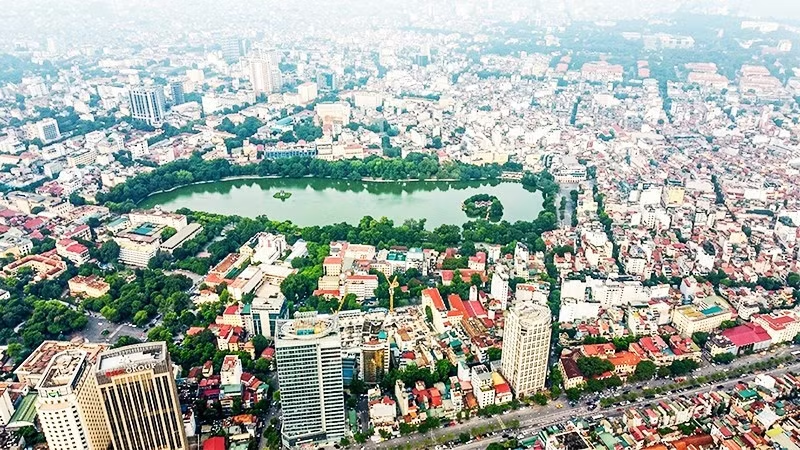
For generations, Hoan Kiem Lake (Sword Lake) has been deeply embedded in the minds of the Vietnamese people as a symbol. Therefore, the story of Hoan Kiem Lake cannot be viewed simply through the lens of an urban planning scheme, even one described as having a 100-year vision. Instead, it must be considered within the long historical development of the nation.
It cannot be viewed simply as an urban planning scheme
Although he lives in southern Viet Nam, architect Nguyen Van Tat, a member of the Architectural and Urban Planning Advisory Council for the late Prime Minister Vo Van Kiet, says that whenever he visits Ha Noi, walking around Hoan Kiem Lake always evokes a profound sense of emotion.
He first visited Ha Noi in 1979. Although he had read the legend of Hoan Kiem Lake and even seen a giant turtle after its death, architect Nguyen Van Tat said that, at the time, legend and history seemed to come alive, inspiring admiration and a desire to explore the nation’s past through layers of time and space and collective memory.
From a professional perspective, he said that talking about Hoan Kiem Lake means talking about its relationship with the surrounding landscape, historical interactions and traditional cultural stories. All of these are connected to the lives of local communities and elements passed down through hundreds of years.
“We cannot talk about a single structure or plot of land, or whether the lake itself is long or short. When we talk about planning, we are not talking about a specific physical form, but about the energy that drives the urban space through time, both in the near and distant future. Urban planners should shape the underlying urban structure, rather than simply draw its physical form,” architect Nguyen Van Tat said.
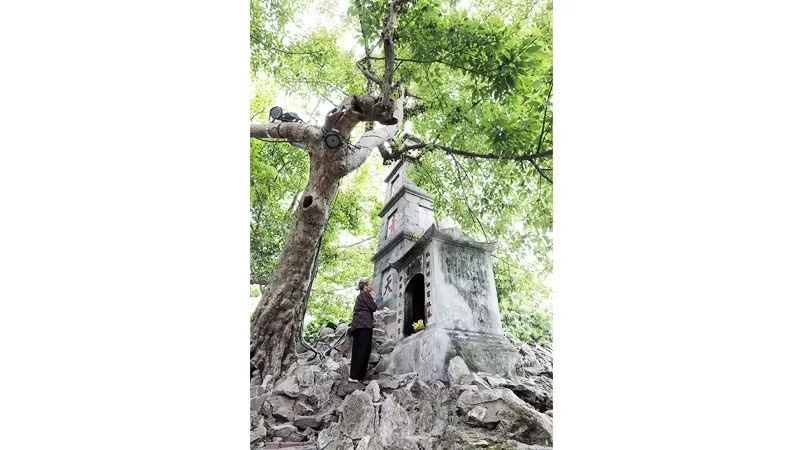
Therefore, any intervention in Hoan Kiem Lake must be carefully considered. Associate Professor, Doctor and Architect Khuat Tan Hung from Ha Noi Architectural University agrees with expanding pedestrian space and creating more green space. However, Hoan Kiem Lake has a very distinctive story. Looking back at history, when the French came to Viet Nam, construction and planning activities had a relatively limited impact on the lake.
Another point to bear in mind is that the Hoan Kiem Lake area serves as a transitional space connecting the east and west, beginning from the Old Quarter through Dong Kinh Nghia Thuc Square and gradually extending southwards with the emergence of buildings from the French colonial period. These colonial-era buildings were carefully placed within the existing context, creating a gentle transition and continuity with structures built both before and after them.
Therefore, architect Khuat Tan Hung believes that the planning proposals recently put forward for Hoan Kiem Lake and its surrounding area appear to intervene too heavily in almost every aspect.
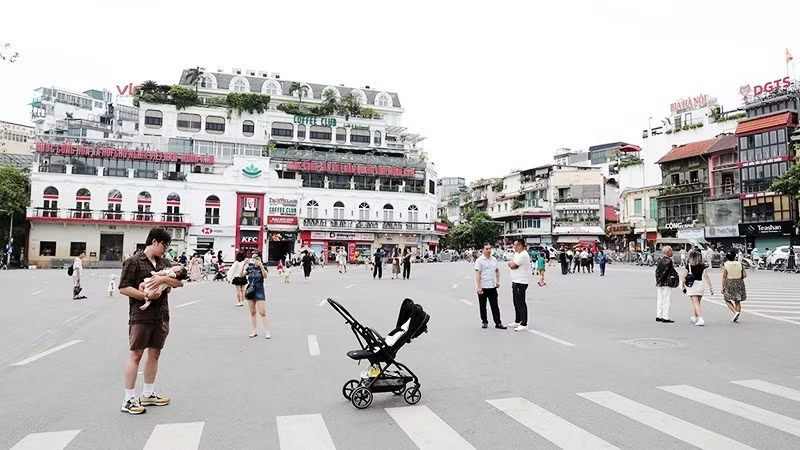
Meanwhile, Vietnamese architecture has traditionally been characterised by moderation, even modest scale, with close attention to human proportions. This creates a sense of belonging, whereas anything overly grand or imposing is considered inappropriate.
Doctor and Architect Nguyen Tri Thanh, Deputy Dean and Head of the Department of Public Architecture at Ha Noi Architectural University, said that Hoan Kiem Lake, the surrounding area and the street network radiating from the lake and leading towards it all need to be preserved. Therefore, expanding the square on a large scale would disrupt these connections.
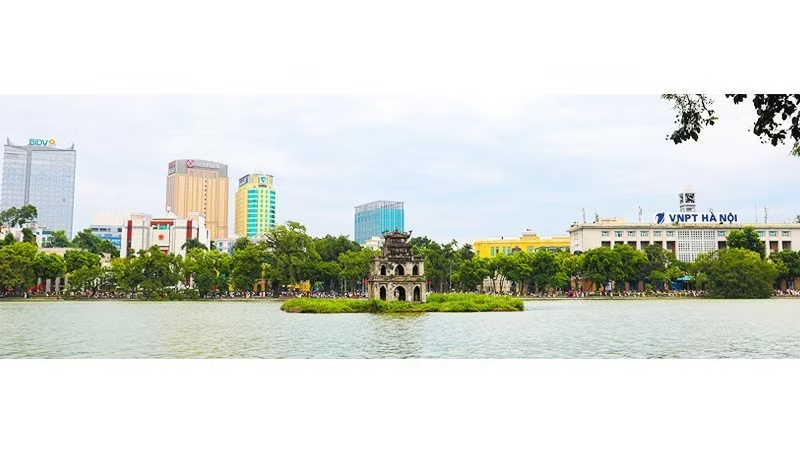
The loss of traces of memory would be irreplaceable
Hoan Kiem Lake is a space layered with legends, historical and political memories, and collective memories passed down from one generation to another, with each generation adding to the story of the place.
Looking at the spatial structure around Hoan Kiem Lake, we can see a long process of transition between architectural structures, from traditional to modern. Buildings such as the Children's Palace and Khan Quang Do Cinema are typical examples of architecture from the period of socialist construction in northern Viet Nam between 1954 and 1986.
Under the proposed plan, structures such as the Children's Palace, Khan Quang Do Cinema and the Post Office would be dismantled. However, Associate Professor, Doctor and Architect Khuat Tan Hung said that the term “dismantling” is misleading.
“It must be made clear that this means ‘demolition’. In conservation terminology, ‘dismantling’ refers to structures such as wooden buildings where, after research and surveys have been completed, the structure is taken apart and subsequently reassembled. That is a conservation term. Why people are using the term ‘dismantling’ to make it sound less severe, I do not understand. In reality, it means demolition. That is highly unreasonable because, when we look at architectural history, structures from yesterday, and even those from today, continue to contribute to and create the spiritual value of a place.”
Compared with the three buildings proposed for preservation — Au Tri Vien, the Indochina Treasury and the former Ha Noi City Hall — would the presence of these remaining structures not become out of place? The reason is that buildings need to form a coherent system and be connected to one another.
Moreover, although the architectural landscape around Hoan Kiem Lake has been affected over time, it has at least retained relatively harmonious proportions, allowing people to experience it as a natural space embraced by an urban setting. In particular, it remains closely connected with people's way of life, thoughts and emotions.
Therefore, the demolition of buildings associated with collective memory needs to be reconsidered. Even separating architectural structures according to whether they are considered beautiful or otherwise could render the remaining buildings meaningless and isolated. In this context, any intervention or addition to the area must take responsibility for both history and the future.
Hoan Kiem Lake is valuable because it sits within a space inhabited by people and surrounded by architecture that is friendly and intimate in scale and connected to everyday life. If it is instead surrounded or enclosed by very large, Western-style public squares populated only by passers-by and tourists coming to take photographs, with no people actually living there, that would be a great pity, Doctor and Architect Nguyen Tri Thanh said.
Doctor and Architect Nguyen Tri Thanh said: “Hoan Kiem Lake needs to be improved to provide greater convenience for people, rather than creating vast empty spaces. The expanded area of greenery and parks is already too large compared with the water surface. The problem is that this diminishes the sense of the lake’s scale within its urban context. High-rise buildings around the lake should be avoided because they would make the area feel cramped. At the same time, expanding the open space around the lake would make it feel more distant.”
Hoan Kiem Lake does not need grandeur or new landmarks, because it is already an important symbol that has endured throughout history. It has developed naturally, survived over time and been embraced by the community. Sudden, large-scale expansion could have consequences that cannot be foreseen without thorough assessment and research. The greatest risk is that it could disrupt the urban structure and erase traces of collective memory that nothing could replace.