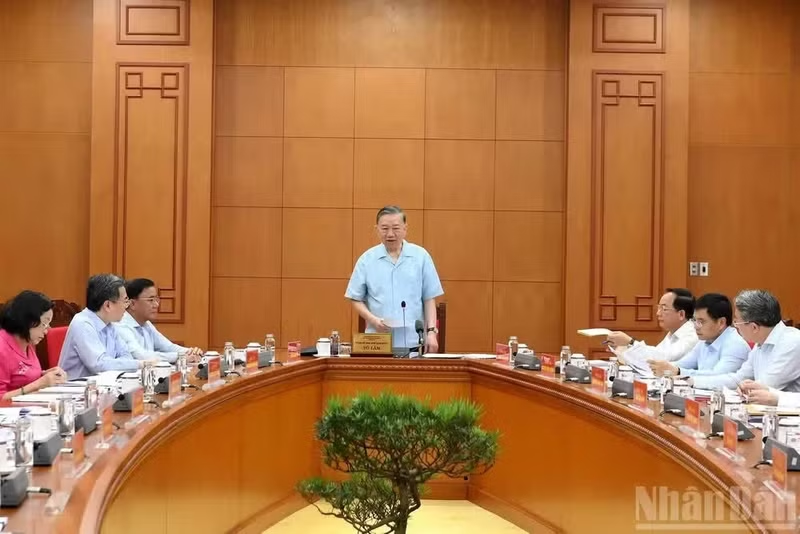
In order to shift Viet Nam’s positioning from a cost-competitive destination to an innovative, green, reliable nation with technological capabilities and cultural identity, the general secretary and president requested a thorough and accurate assessment of the country’s development resources.
This includes identifying resources with outstanding advantages, resources that can be mobilised immediately, and potential resources that have not yet been transformed into drivers of development.
He emphasised the need for a careful assessment of the current state of these resources, especially culture, human resources, national brands, and social trust. These are considered important endogenous resources that have not been fully utilised.
In the new growth model, culture is not only a spiritual foundation but must also be considered a soft power, a source of creativity, a national brand, and a driver for attracting investment, tourism, talent, and technology.
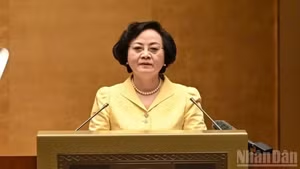
According to Vu Thu Thuy, Director of the Department of Grassroots Culture under the Ministry of Culture, Sports and Tourism, to build a national brand, the cultural sector must identify core values such as the inherent strengths and national identity that we currently possess.
In recent years, Viet Nam has become known internationally as a peaceful country with a safe society and many unique indigenous cultural features.
However, these reputations are only necessary conditions. To go further, we need to build a stronger national brand, with economic self-reliance being a prerequisite.
The 14th Party Congress documents require a shift in the growth model from one based on resources and cheap labour to one based on science, technology, innovation, and digital transformation.
In practice, encouraging domestic businesses to move up to higher segments in research and development, product design, and building their own brands is an effective approach.
Moc Chau Ward, Son La Province, is one of the few localities that has built a national and international brand. With its rich natural resources and cultural identity, Moc Chau has not pursued rapid urbanisation but instead emphasises the cultural identity of its indigenous ethnic minorities, combining them with its raw material production areas as strategic assets.
The locality has successfully socialised and attracted investment in large-scale tourism infrastructure projects with regional significance, such as the Bach Long Glass Bridge, which holds a Guinness World Record, creating a visually striking landmark on the international tourism map. The locality has also created connections between various models linking agriculture and tourism.
As a result, tourism has developed, helping to widely promote the brand of agricultural products. To date, many famous local specialties such as Shan Tuyet tea, plums, and Moc Chau milk have become attractive to tourists, becoming unique characteristics of Moc Chau.
All of this has gradually formed a closed, sustainable value chain, affirming the reputation of the Moc Chau plateau, from an agricultural plateau to a “Leading Nature Destination in Asia and the World” as voted by the World Travel Awards (WTA).
Looking broadly at the provincial level, Son La is a “phenomenon” in building regional agricultural product brands. From a poor mountainous province with mainly intensive slash-and-burn farming, Son La has broken through to become the province with the second largest area of fruit trees in the country and a leading centre for processing and exporting agricultural products to demanding markets such as the US and Europe.
According to Lo Thi Hong Nhung, a lecturer at Tay Bac University, Son La’s success in building a local brand is due to its decisive shift in the growth model towards increasing total factor productivity (TFP).
Strong local brands have been built through the consistent mindset of Party committees and governments at all levels, along with the concerted efforts of the business community and each worker in striving to improve product quality and meet international standards. This is how potential is transformed into a driving force for development, as directed by General Secretary and President To Lam.
![[Infographic] Comprehensive strategic partnership between Viet Nam and Denmark](https://en-cdn.nhandan.vn/images/SCsTDAWshkugd_CR7euN3dJE8R5tBjXTeI_Ei3N1rqlMQ51GV2YGcjvxpQFD7-NjQniu1tgyhNBVDsDJmLSxVpkf6BzifI5ne9fyVawgZKkw1QSqvshBTU8QQcE1uc2tD2kFaBWIxM59QGKFzthJwQ/comprehensive-strategic-partnership-between-viet-nam-and-denmark-8462.png.avif)