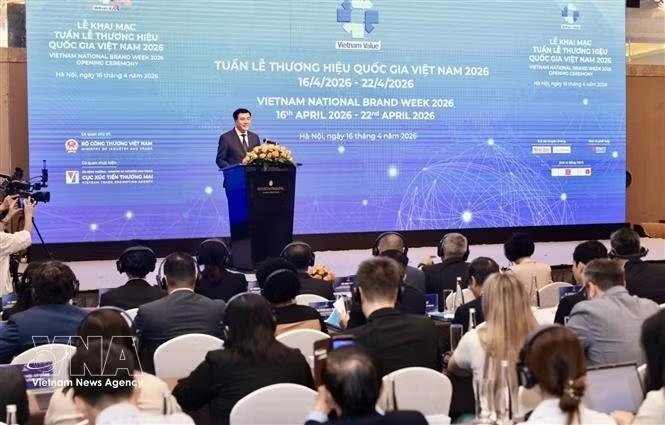
Speaking at the opening ceremony, Deputy Minister of Industry and Trade Nguyen Sinh Nhat Tan said the national brand programme must be redefined beyond traditional trade promotion, becoming a strategic asset that reflects Viet Nam’s overall competitiveness and reputation in global value chains.
In the context of deep international integration, building a national brand is not only about promoting “Made in Viet Nam” products, but also about enhancing the country’s credibility and soft power on the global stage, he stressed.
After more than two decades of implementation, the programme has recorded steady growth in both the number of recognised enterprises and products, demonstrating continuous improvements in technology, quality and brand positioning among Vietnamese firms.
Running from April 16 to 23 nationwide, the Viet Nam National Brand Week 2026 marks the 18th anniversary of Viet Nam Brand Day (April 20, 2008 – 2026). The event serves as a convergence of policy, business and market players, featuring the opening ceremony, the national brand forum, thematic seminars, exhibitions and business networking activities.
The forum is considered the highlight, bringing together representatives from ministries, sectors, localities, international organisations, experts and the business community to discuss brand development trends in the new context.
According to the organisers, the programme has achieved notable results. Since its launch in 2003 with only 30 participating enterprises, the number has risen to 190 in 2026. Viet Nam’s national brand value reached 519.6 billion USD in 2025, ranking 32nd among 193 economies, up more than 200 billion USD compared to 2020.
Several Vietnamese companies have strengthened their global presence. Vietcombank, BIDV and VietinBank have entered the world’s top 500 most valuable banking brands, while Vinamilk ranks among the top 50 dairy brands and Viettel leads the telecommunications sector in Southeast Asia.
However, challenges remain. While the number of national brand products is increasing, their overall value is still modest. The combined value of the top 100 Vietnamese corporate brands reached only about 38.4 billion USD in 2025, down 14% from previous levels.
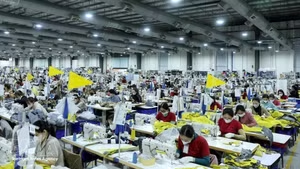
Experts noted that Viet Nam remains largely positioned in lower-value segments of global supply chains, focusing on original equipment manufacturing (OEM), while capabilities in original design manufacturing (ODM) and original brand manufacturing (OBM) remain limited.
Addressing the forum, Hoang Minh Chien, Deputy Director of the Trade Promotion Department under the Ministry of Industry and Trade, stressed that the national brand must become a substantive driver of competitiveness rather than merely an external image, especially as Viet Nam targets developed, high-income status by 2045.
A proposed National Brand Strategy to 2035, with a vision to 2045, outlines three phases, focusing on foundational transformation, the development of competitive enterprises in the region and the world, and ultimately shaping Viet Nam as a modern, innovative and responsible economy.