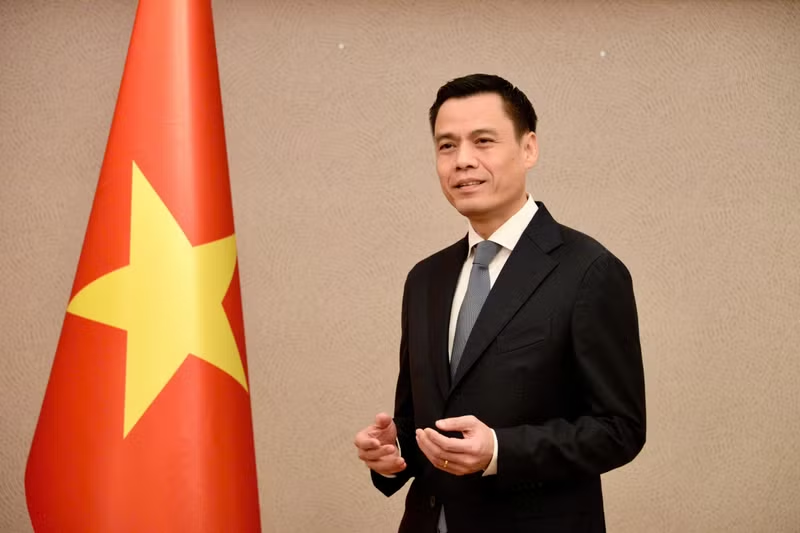
Talking with Viet Nam News Agency (VNA) reporters present in the Philippines, Giang said the meetings wrapped up successfully, adopting a raft of key documents that turned political commitments into practical cooperation.
Ministers welcomed progress in ASEAN cooperation over the first seven months and agreed to fast-track the ASEAN Community Vision 2045 and priorities of the 2026 Chairmanship Year, Giang said. They vowed to deliver on pledges made at the 48th ASEAN Summit and fully carry out the leaders’ declaration on responding to the Middle East crisis.
ASEAN deepened and widened its external relations, with more partners seeking to establish or upgrade ties and boost their role in ASEAN-led mechanisms. The bloc admitted Turkey as its 12th Dialogue Partner, approved Germany and Qatar as Sectoral Dialogue Partners, and greenlit the UK’s entry into the ASEAN Regional Forum (ARF). The moves underscored ASEAN’s rising pull and central role as a hub for aligning interests, coordinating cooperation and shaping regional processes, Giang said.
Celebrations for the 50th anniversary of the Treaty of Amity and Cooperation in Southeast Asia (TAC) reaffirmed the lasting relevance of ASEAN’s norms and principles, he said, with participants calling the TAC the foundational code guiding relations among countries both within and outside the region.
The accession of Romania, Poland, Sweden and Lithuania pushed the number of TAC High Contracting Parties to 62, and more interest from other nations demonstrated the treaty’s enduring vitality and role, he said.
Giang also pointed to the Mekong-Japan and Mekong-RoK foreign ministers’ meetings, which reaffirmed long-term partner commitment to Mekong sub-regional cooperation.
The discussions zeroed in on shared challenges, particularly energy security and cybercrime, while delivering practical benefits to citizens and businesses across the Mekong and supporting ASEAN Community-building process.
On Viet Nam’s participation, Giang said the delegation led by Foreign Minister Le Hoai Trung embodied the foreign policy line of the 14th National Party Congress by acting proactively, responsibly and with leadership inside ASEAN.
“Viet Nam didn’t just attend, but also proactively shaped debates and contributed solutions”, he said.
Viet Nam worked closely with the Philippines - ASEAN Chair and other member states to build unity and consensus, while backing the effective rollout of the Chair’s priorities and initiatives. It also put forward a raft of proposals to bolster ASEAN’s resilience, cohesion and connectivity.
As the only ASEAN member now coordinating ties with two Dialogue Partners, Viet Nam made notable contributions to advancing regional cooperation with both the UK and New Zealand.
Viet Nam chaired negotiations that resulted in the adoption of the ASEAN-UK Plan of Action 2027-2031 and the ASEAN-UK Joint Ministerial Statement on Cooperation on the ASEAN Outlook on the Indo-Pacific (AOIP). It also helped forge ASEAN consensus on admitting the UK as the ARF’s 28th member.
The country also led negotiations and secured the adoption of the ASEAN-New Zealand Joint Statement on Strengthening Regional Resilience, while pushing for the rollout of the ASEAN-New Zealand Plan of Action 2026-2030, with an emphasis on quality over quantity.
Viet Nam also actively contributed to the East Sea/ South China Sea discussions, stressing the need to maintain peace, security and stability, while ensuring ASEAN's principled stance on the issue was fully reflected in the documents.
Co-chaired by Trung, the 17th Mekong-Japan Foreign Ministers’ Meeting agreed to resume the Mekong-Japan Summit at the earliest suitable opportunity.
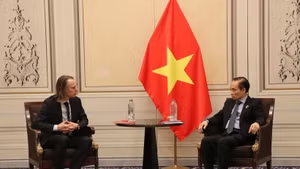
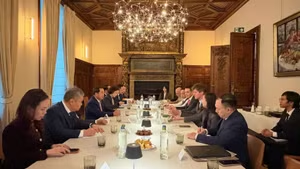
According to Giang, Trung held around 15 bilateral meetings with counterparts. Partners praised Viet Nam’s growing role, international standing and development record, calling the country an increasingly important global and regional player.
Many expressed strong interest in Viet Nam’s ambitious reform agenda, achievements after 40 years of Doi Moi (Renewal), and its development vision through 2030 and 2045.
The discussions reflected a shift in bilateral ties from establishing cooperation frameworks toward following agreements and delivering tangible outcomes.
Both Viet Nam and its partners expressed a desire to expand high-level exchanges, accelerate existing agreements, settle existing issues and broaden cooperation in priority areas, including sci-tech, innovation, digital transformation, energy, green transition, blue economy, supply chain resilience and quality workforce training.
The meetings also covered accelerating negotiations, signing and rollout of free trade agreements, establishing new frameworks for green growth and sustainable finance, boosting business connectivity, expanding investment cooperation, developing capital markets and enhancing workforce training.
Giang said the conversations highlighted diplomacy’s growing role in marshaling external resources to back national development.
Viet Nam also shared its experience in upgrading its market economy framework, fostering private sector development and overhauling its growth model, helping partners pinpoint future cooperation areas that match Vietnam’s priorities and their own strengths.
Another standout outcome, Giang said, is growing recognition of Viet Nam’s role and credibility within ASEAN and the broader international community.
Viet Nam is widely seen as a balanced, responsible partner able to link external players with ASEAN while contributing to peace, stability, maritime security, freedom of navigation, respect for international law and collective responses to shared challenges.
Those outcomes reflect Viet Nam’s ongoing push to follow the foreign policy direction of the 14th National Party Congress, Resolutions 59 and 06, and other Politburo strategic resolutions by translating policy into concrete, practical results, he said.