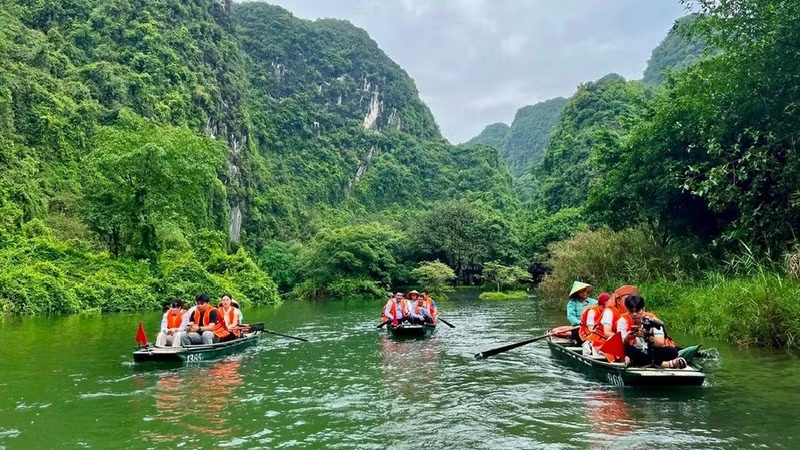
To turn this goal into reality, the approach to heritage needs to shift from a mindset of focusing on preservation and isolated exploitation to one that creates an attractive ecosystem of experiences, enabling the world to recognise and remember Viet Nam through each destination.
When heritage becomes a symbol
With a rich heritage treasure trove and more than 40,000 historical and cultural sites across the country, including nine World Heritage sites recognised by UNESCO, Viet Nam has a favourable foundation for developing outstanding heritage destinations. So far, Viet Nam has been named the “World’s Leading Heritage Destination” by the World Travel Awards six times, in 2019, 2020, 2022, 2023, 2024, and 2025.
This confirms the exceptional appeal of Viet Nam's heritage while also highlighting the enormous potential of heritage destinations in positioning the national brand. This is in line with the viewpoint set out in the Strategy for Tourism Development to 2030: to promote the value of heritage and national cultural identity in order to create unique and distinctive tourism products with competitive advantages, thereby helping to build a prominent brand for Viet Nam's tourism on the global tourism map.
Looking around the world, many countries have successfully turned heritage destinations into symbols that represent their nations. Mention Egypt and the pyramids of Giza immediately come to mind; speak of India and people think of the Taj Mahal; think of Cambodia and the religious wonder of Angkor Wat comes to mind. In these cases, heritage has gone beyond being merely a tourist attraction to become the “face” of the country. This is also how nations position their brands, strengthen their soft power, and enhance their competitiveness.
Compared with other countries, Viet Nam does not lack heritage sites with international appeal and recognition. Destinations such as the Trang An Landscape Complex in Ninh Binh, the Ancient Town of Hoi An in Da Nang, Ha Long Bay in Quang Ninh, and Phong Nha-Ke Bang National Park in Quang Tri are not only magnets attracting tourists for their localities but have also been repeatedly recognised by prestigious international organisations, travel magazines, and awards.
However, there remains a significant gap between being a famous heritage destination and becoming a heritage destination that serves as a national symbol. To bridge this gap, Viet Nam needs a comprehensive strategy to transform heritage values into products, experiences, and high-quality services with a wide-reaching impact, strong enough to be recognised and remembered so that whenever they are mentioned, the world immediately thinks of Viet Nam.
Positioning the brand through experience
From her experience in the travel industry, Doan Thi Thanh Van, Chief Executive Officer of Lux Travel DMC, a company specialising in high-end inbound travel, believes that Viet Nam possesses heritage resources, particularly natural heritage, that are far more beautiful and distinctive than those of many countries in the region. However, she said, a weakness of the country's heritage tourism is the limited positioning of its destination brands on the international map.
According to Van, modern travellers no longer simply want to visit places and take photographs or check in. They also want to explore the cultural depth of the destinations and experience a connection with the local life and people. Therefore, each heritage destination needs to find a way to become memorable by telling its own story based on its distinctive values.
An important solution is to train local people to work professionally in tourism while retaining their natural simplicity and sincerity, thereby preserving the authenticity of the experience and allowing the “soul” of the heritage to be conveyed by local communities in the most natural and convincing way.
In addition, rather than allowing individual destinations and businesses to carry out fragmented promotional campaigns, Viet Nam needs a national-level communications strategy that identifies destinations capable of becoming symbols. It can then develop distinct stories and images for them, promote heritage internationally in a coordinated and consistent manner, and create a voice representing the country's cultural image.
In the Republic of Korea, many heritage destinations, such as Changdeokgung Palace, are not merely places to visit but have also become sources of inspiration for films, television, and music. Similarly, in Japan, many heritage destinations have been featured in comics, games, animated films, and festivals. This is a noteworthy approach that Viet Nam can learn from and adopt, transforming heritage sites from mere locations on a tourism map into a national cultural identity that is disseminated through various channels.
Culture, tourism, communications, and diplomacy cannot tell separate and fragmented stories on their own. They need to work together to place heritage within a long-term and unified promotional strategy and jointly build destination brands capable of competing globally.
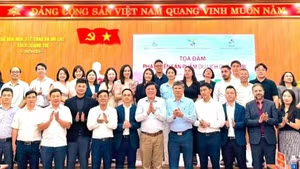
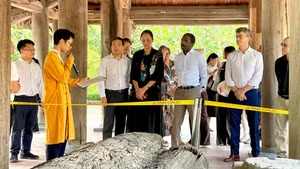
From UNESCO's perspective, Jonathan Wallace Baker, UNESCO Representative to Viet Nam, affirmed that UNESCO has always emphasised that having a heritage site inscribed is not the final goal. What truly matters is how such recognition is used to create lasting value for people and communities by placing culture and heritage at the centre of inclusive, resilient, and people-centred development strategies.
Developing sustainable heritage tourism does not mean removing all restrictions to provide visitors with the greatest possible convenience. Well-designed regulations, meaningful community participation, and fair benefit-sharing mechanisms will help strengthen conservation efforts and improve the quality of visitors' experiences.
The UNESCO Representative to Viet Nam emphasised that heritage should be placed within a broader creative ecosystem, connected with craft villages, public spaces, performing arts, design, and new cultural products, becoming a resource for innovation and sustainable growth.
To bring heritage values to a wider public, Viet Nam needs to continue investing in young creators and building a comprehensive heritage education system. It also needs to strengthen cooperation between the state, the private sector, and communities so that creative ideas can be scaled up and sustained over the long term, maximising the contribution of heritage to sustainable development and contributing to creating an image of a culturally distinctive and easily recognisable Viet Nam in the international arena.


![[Video] Viet Nam among Top three Asian destinations for return visitors](https://en-cdn.nhandan.vn/images/nyM650OGFWrOVWc-xajqN-rTZ68Rlmc1fiGJOhBRYHErj-E25MBpvJqrpphXazfrpe9t-fYCGuQU4CN0yXo3Rg/du-lich-vietnam.jpg.avif)