However, this potential can only be transformed into genuine appeal when destinations are closely connected, tourism products and services are organised into integrated value chains, and local people become active participants in telling the story of their homeland.
Opportunities for multi-layered travel experiences
Tuyen Quang today offers a rich and diverse tourism landscape. In the south lies the Tan Trao Special National Relic Site — home to Na Nua Shack, Tan Trao Communal House, and Hong Thai Communal House. From there, visitors can continue their journey to the Na Hang-Lam Binh lake area, where mountains, forests, waterways, and the villages of Tay and Dao ethnic communities create an attractive ecological tourism destination.
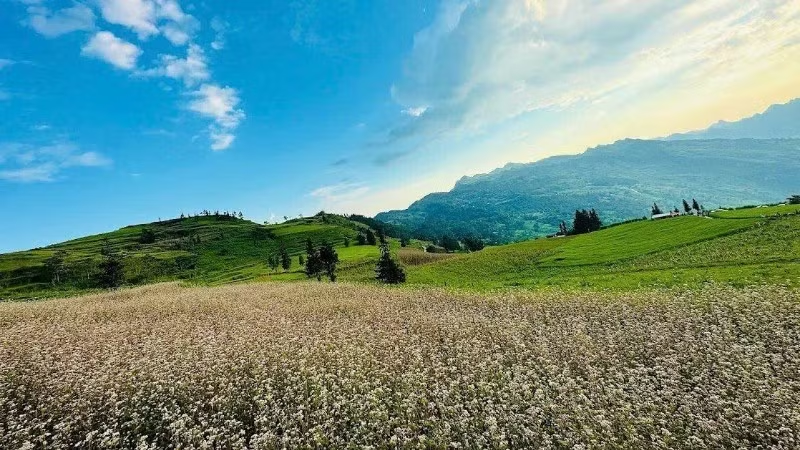
Further north are the terraced rice fields of Hoang Su Phi, winding roads through Vi Xuyen, Quan Ba, Yen Minh, Dong Van, and Meo Vac, as well as Ma Pi Leng Pass, the Nho Que River, Lung Cu Flag Tower, and the UNESCO Dong Van Karst Plateau Global Geopark.
Scattered throughout this spectacular landscape are traditional markets, festivals, handicrafts, local cuisine, and villages that have preserved the distinctive architecture, customs, and lifestyles of the Mong, Tay, Dao, Lo Lo, Pa Then, and other ethnic groups.
These advantages provide opportunities for the province to develop multi-dimensional tourism routes, taking visitors from historical sites to natural landscapes, from geological heritage to community life, and from lakeside retreats to highland adventures.
In 2025, the province welcomed nearly 3.93 million visitors, generating around 10.633 trillion VND in tourism revenue. In the first six months of 2026, Tuyen Quang continued its positive momentum, receiving more than 2.09 million visitors, with total spending estimated at 5.857 trillion VND.
Despite this progress, most visitors have long travelled to Tuyen Quang on separate itineraries: visiting the Dong Van Karst Plateau, checking in at Ma Pi Leng Pass, admiring terraced rice fields during the harvest season, or touring a cluster of historical sites before returning home.
As a result, visitors' stays remain relatively short and average spending per tourist remains below the province's potential. Sustainable tourism development requires a stable flow of visitors throughout the year.
Strengthening connectivity
Enhancing connections among destinations across the province has been identified by many experts as the way forward. Achieving this will require not only improved transport infrastructure but also the integration of attractions, accommodation, dining, transport, tour guiding, and community-based experiences into a unified tourism chain.
At present, the quality of homestays, restaurants, and transport services across the province remains uneven. Many households engaged in tourism rely mainly on practical experience and still have limited foreign language skills, communication skills, problem-solving abilities, food hygiene and safety knowledge, and digital marketing capacity. These shortcomings need to be addressed in the coming period.
Nguyen Vu Ha, member of the Executive Committee of the Tuyen Quang Tourism Association and Director of Explore Ha Giang Trading and Tourism Co., Ltd., suggested developing integrated, multi-experience itineraries. According to him, visitors could travel by expressway to the Na Hang lake area, continue exploring Na Hang–Thuong Lam by motorbike, experience community-based tourism, and then proceed to the northern highlands.
To achieve this, tourism businesses and associations need to make joint efforts to design tourism products, share markets, and distribute benefits, rather than each operator independently exploiting only one section of a route.
Drawing on many years of experience in the travel industry, Nguyen Tien Dat, Vice Chairman of the Ha Noi Tourism Association, said Tuyen Quang should attract investment in eco-resorts that complement the area's lakes, forests, and indigenous culture, targeting high-spending visitors, particularly international tourists.
In his view, tourism products should evolve from simple sightseeing to experiential activities such as trekking, hiking, kayaking, traditional cake-making, weaving, cloud hunting, and photography.
He also stressed the need for tour guides capable of telling engaging stories and involving visitors in local life rather than merely providing factual information that can easily become repetitive.
From the local perspective, Bui Thi Xuyen, Chairwoman of the People's Committee of Na Hang Commune, said the commune is improving landscapes, preserving cultural heritage, supporting community-based tourism models, and upgrading service quality. It is also strengthening cooperation with the communes of Lam Binh, Thuong Lam, and Hong Thai to connect ecological, leisure, cultural, and adventure tourism products in order to attract more visitors.

Shaping a place on the tourism map
Tuyen Quang has demonstrated its determination to make tourism a key driver of development through concrete policies and strategies. On May 13, 2026, the Standing Board of the Tuyen Quang Party Committee issued Resolution No. 92-NQ/TU on developing tourism into a spearhead economic sector for the 2026–2030 period, with a vision to 2050. This marks the first time the province has clearly identified tourism as a leading economic sector based on an assessment of its expanded tourism space, resources, and development potential following the merger.
The province aims to develop green, sustainable, professional, and modern tourism, with culture serving as the foundation, nature as the advantage, people at the centre, and businesses as the driving force.
Nguyen Trung Ngoc, Director of the Tuyen Quang Department of Culture, Sports and Tourism
Nguyen Trung Ngoc, Director of the Tuyen Quang Department of Culture, Sports and Tourism, said the province aims to develop green, sustainable, professional, and modern tourism, with culture serving as the foundation, nature as the advantage, people at the centre, and businesses as the driving force.
The province's new development space places responsibility on the entire political system, businesses, and local communities to transform existing advantages into competitive tourism products.
Alongside this strategic direction, Provincial People's Council Resolution No. 23/2026/NQ-HĐND on tourism development support policies for 2026–2030 has been designed to address practical local needs. Specifically, the policy provides financial support of 100 million VND for preserving each traditional yin-yang tiled roof, 100 million VND for newly built homestays, and 40 million VND for homestay renovations. Ethnic art performance teams operating at tourist attractions are eligible for support of 70 million VND each.
The resolution also allocates funding for pedestrian walkways, lighting systems, landscape improvement, public toilets, rest stops, and environmentally friendly tourist transport powered by green energy. If implemented effectively, these support measures will help local communities preserve their cultural identity while creating additional livelihood opportunities.
According to Nguyen Trung Ngoc, the province will build a unified tourism brand under the slogan "Tuyen Quang — A Land of Heritage, Ecology, and Identity", replacing the previous approach of promoting destinations individually. The guiding vision is "one province, many journeys; one destination, countless experiences."
Alongside integrated tourism routes, the province is focusing on developing high-value tourism products, building a smart tourism ecosystem and standardising service quality, while concentrating resources on high-impact areas such as the Dong Van–Meo Vac–Tan Trao–Na Hang corridor.
At the same time, tourism linkages should extend beyond the province by strengthening cooperation with Ha Noi, other northern midland and mountainous provinces, and localities along the border tourism corridor to expand markets and reduce seasonality.
With its newly expanded geographical space and the shared commitment of authorities, businesses, and local communities, Tuyen Quang now has a rare opportunity to redefine its position on Viet Nam's tourism map.
![[Video] Viet Nam among Top three Asian destinations for return visitors](https://en-cdn.nhandan.vn/images/nyM650OGFWrOVWc-xajqN-rTZ68Rlmc1fiGJOhBRYHErj-E25MBpvJqrpphXazfrpe9t-fYCGuQU4CN0yXo3Rg/du-lich-vietnam.jpg.avif)

![[In Pictures] Nui Chua Rock Park: A million-year-old outdoor museum of landforms on the Khanh Hoa coast](https://en-cdn.nhandan.vn/images/nyM650OGFWrOVWc-xajqNz57td8idIAL_VG9puyG2UZEKOnmq1DVlT1--ZclbO3z2WBaWZhbt6O3e8kjPZqJMWkfEz7RO9qhcwg8o8LQFK8/ndo-br-cao-nguyen-da-moi.jpg.avif)