Charting a fast-track roadmap
Resolution No. 80-NQ/TW on the Development of Vietnamese Culture sets the objective of establishing between five and ten national brands in the cultural industries by 2030. Priority sectors with strong potential include cinema, performing arts, cultural tourism, design, and fashion.
"The target is entirely achievable within the next 15 years," said Associate Professor Dr Pham Ngoc Trung, former Dean of the Faculty of Culture and Development at the Academy of Journalism and Communication.
However, Trung stressed that the goal will remain merely an aspiration unless more detailed roadmaps are developed for each stage. In the near term, efforts should focus on one or two priority sectors with the greatest potential for spillover effects. Targeted investment serves as a key strategy for addressing current limitations in financial and human resources.
Nevertheless, he expressed concern that Viet Nam has seemingly spent recent years laying merely the first foundation stones. To change this situation, Ton That Hac Minh, Adviser to the Startup Viet Nam Foundation community, suggested that the country needs a fundamental shift in thinking.
According to Minh, cultural promotion should move beyond campaign-based activities towards a systematic strategy for building a portfolio of national brands.
As a first step, the State should develop a dedicated set of criteria for identifying national brands in the cultural industries. The guiding principle should be "few but strong," allowing resources to be concentrated on areas of comparative advantage. Importantly, each selected brand must embody distinctive elements of Vietnamese cultural identity.
Above all, Minh argued, the concept of a "national brand" should be restored to its proper economic meaning.

Building a launchpad at home
Minh emphasised that no brand can thrive in isolation. It must operate within a coordinated ecosystem comprising high-quality human resources, modern technological platforms, and flexible financing mechanisms. Only within such an ecosystem can leading brands fully realise their potential.
Drawing on international experience, Tran Manh Ha, a UNESCO Officer in Ha Noi, noted that successful models invariably require the State to play an active role in ecosystem-building.
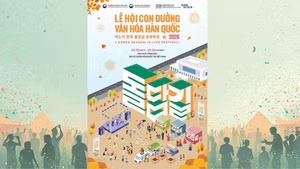
Over the past three decades, the Republic of Korea (RoK) combination of public investment, young creative talent, digital technologies, and national media support has transformed Hallyu, or the Korean Wave, into a global cultural phenomenon.
France, meanwhile, treats culture as a public asset, supported by long-established institutions, strong copyright protection, and the principle of a "cultural exception" in international trade. The country maintains one of the world's most effective support systems for cinema and contemporary arts, while extending its cultural influence through the network of French Institutes, renowned museums, and artistic exchange programmes.
The French model demonstrates how preservation, creativity, and cultural diplomacy can be effectively balanced.
In Latin America, particularly in Mexico, Colombia, and Brazil, the growth of the creative industries has been driven by community resources and the vitality of music, cinema, design, and indigenous heritage. These examples show that cultural strength can emerge from local communities and identities when national policies create conditions for bottom-up creativity rather than relying exclusively upon top-down initiatives.
Avoiding short-lived success
Beyond strengthening the domestic ecosystem, Trung said Viet Nam must proactively participate in international associations and professional networks.
Such engagement should not merely be symbolic or restricted to financial contributions. More importantly, it requires understanding operational rules and learning how to access international markets in compliance with global standards.
He highlighted the case of Nguyen Ha Dong and the mobile game Flappy Bird from over a decade ago as a valuable lesson. Although the game became a global sensation, its success proved short-lived due to limited legal preparation and insufficient support from international organisations.
Overcoming challenges to reach global markets
To develop the human resources required for the cultural industries, Trung proposed that once priority sectors are identified, Viet Nam should actively send talented individuals to study in countries with strengths in those fields.
Students should not only absorb foreign knowledge, schools of thought, and practical experience, but also integrate them with Vietnamese cultural values. In doing so, a new generation of highly skilled professionals can create artistic products that embody Vietnamese identity while remaining competitive internationally.
At the same time, policymakers should avoid fragmented investment focused on individual artists or one-off events.
Minh argued that national brands can achieve their full value only when operating within an integrated ecosystem that covers the entire value chain, from training and production to copyright distribution and data management.
This ecosystem should be supported by investment funds, copyright centres, creative infrastructure, tax incentives, and international promotion programmes.
Specific mechanisms should also be developed for each sector. The film industry, for example, requires script development support and international distribution networks. For music, effective copyright protection, major music festivals, and stronger digital platform visibility are essential.
In design and fashion, brand strength should stem from close integration with tourism promotion and high-end retail systems, rather than relying on a handful of prominent individuals.
For video games and digital content, success depends on strategic collaboration between programmers, software engineers, and content creators.
Consequently, advancing institutional reforms and eliminating regulatory bottlenecks remain urgent priorities. A more open legal framework is needed to foster a competitive cultural ecosystem capable of participating successfully in the global creative economy.