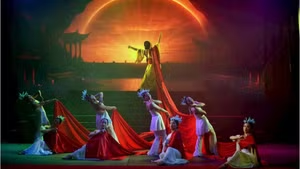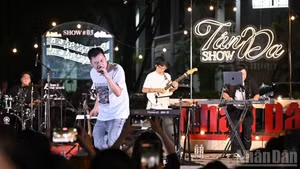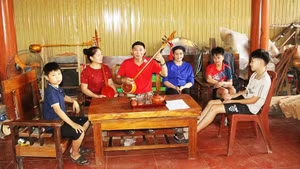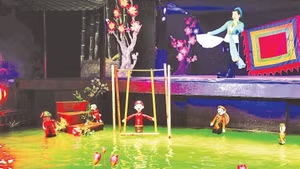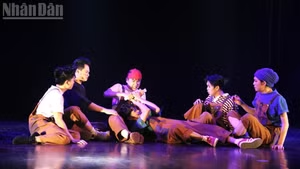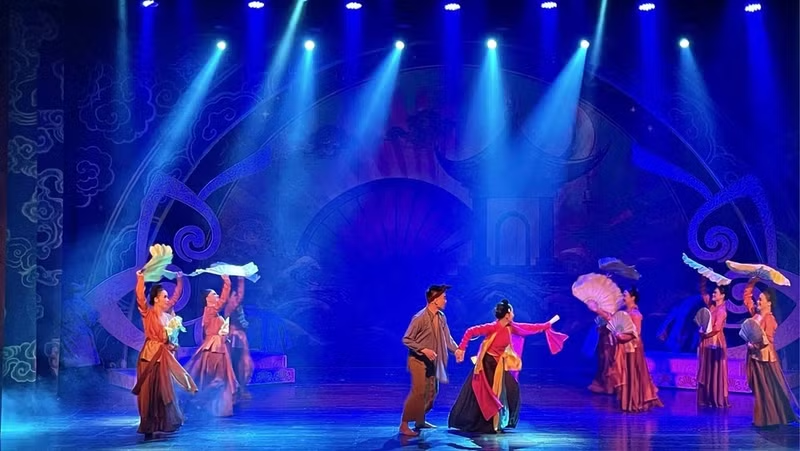
Encompassing a diverse range of performance genres — such as spoken drama, “Cheo”(traditional opera), “Tuong” (classical drama), “Cai luong” (reformed theatre), puppetry, and circus arts — Vietnamese theatre possesses invaluable cultural and historical resources for creating distinctive cultural industry products. Recent positive market signals demonstrate the immense potential of theatre as it integrates into the cultural industry value chain. In late July, the Ha Noi Cheo Theatre launched "The Charm of Ha Noi Cheo," marking a new experimental step in theatrical production. Neither a full-length play nor a collection of familiar excerpts, the programme is staged as a continuous artistic flow. It connects iconic “Cheo” characters, such as Thi Mau, Suy Van, and the Luu Binh, and Duong Le, through modern theatrical language, offering fresh experiences while preserving the traditional spirit of “Cheo”.
Notably, "The Charm of Ha Noi Cheo" serves as the starting point for a series of high-quality, Ha Noi-branded artistic programmes. Developed under the direction of the Ha Noi Department of Culture and Sports, these programmes aim to attract tourists and promote the image of the capital city. Other productions, such as "Ha Noi Stories – A day truly Ha Noi" by the Thang Long Song, Dance, and Music Theatre, "The girl of Ha Noi" by the Ha Noi Cai Luong Theatre, and "Children of Ha Noi" by the Ha Noi Drama Theatre, have been scheduled for regular, long-term performances, thereby contributing to the development of the cultural industry. This approach is increasingly adopted by arts organisations to create vibrant, enduring stage productions. Notable examples include the circus-cai luong fusion piece "Tran Nhan Tong" staged by the Viet Nam Circus Federation in collaboration with the Viet Nam National Traditional Theatre, which maintains its appeal through numerous commercial performances, and "Emotions of Long Thanh" by Viet Nam National Puppetry Theatre, which has enjoyed a continuous run since its premiere in late 2025. These signs indicate a shift in the domestic theatre sector: moving beyond a mindset of mere preservation and basic performance toward creative innovation and value connection, gradually aligning with the development model of the cultural industry.
However, it is evident that these bright spots remain largely isolated; they are not enough to generate the momentum needed to establish a vibrant and sustainable theatre market. In fact, a significant gap persists between the current state of theatre and the requirements of cultural industry development. Many arts organisations still struggle to attract audiences, and numerous elaborately produced works are staged only for festivals or competitions before being shelved.
")
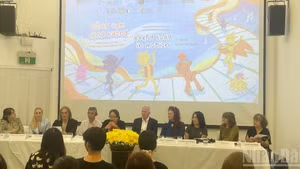
Candidly identifying the "bottlenecks" hindering the theatre sector's transition toward a cultural industry development model, Director Duong Minh Giang said that the mindset of "waiting for state-commissioned funding" remains deeply ingrained in many art units. This fosters a hesitant attitude and a lack of initiative regarding market dynamics. Furthermore, there is a "gap" in the succession pipeline — a critical shortage of young directors with a global mindset, professional producers, and top-tier playwrights. In addition, the infrastructure, sound and lighting equipment, and stage technologies at the vast majority of theatres are now outdated. All these factors leave the theatre sector struggling to compete with modern forms of entertainment, making it difficult to create branded productions that are capable of operating under market mechanisms. According to Director Duong Minh Giang, in the digital era, when audiences can access the entire world with a single screen tap, theatre will struggle to draw crowds unless it offers unique, exclusive experiences that resonate deeply with emotions. Crucially, artists must step out of the "comfort zone" of traditional performance techniques, shifting their mindset from merely performing what they already possess to creating what the times demand.
Within the landscape of cultural industries, the future of theatre depends not only on the quality of the productions themselves but also on the ability to transform artistic values into resources for sustainable development. Consequently, rather than focusing solely on staging, theatre practitioners must prioritise communication, branding, market development, digital transformation, and intellectual property exploitation to extend a production's lifecycle and broaden its audience reach. Author Nguyen Thi Van Kim suggests that a play need not be limited to live performance; its script and character designs can be copyrighted for commercial use, such as adaptation into films, publication as comics, or licensing for other productions. Capitalising on a play's appeal, producers can also launch merchandise — including T-shirts, ceramic mugs, character figurines, and notebooks — to generate revenue sources that may even surpass ticket sales. Furthermore, closely integrated with tourism, turning performances into a "must-see speciality" for visitors to the locality. Repositioning theatre through connections with tourism, education, technology, and media opens new avenues for development, allowing productions to achieve both artistic and economic value. This, in turn, ensures the sustainable preservation of theatrical heritage and nurtures Viet Nam's cultural soft power.
Drawing on his practical experience in staging and managing theatrical productions, People's Artist Trung Hieu, Director of the Ha Noi Drama Theatre, asserts that no matter how high the quality of a play, it will struggle to reach the public without an appropriate strategy for positioning, communication, and distribution.
Therefore, alongside investment in the quality of productions and the modernisation of facilities to create contemporary stages capable of accommodating creative ideas, it is also necessary to study audiences, innovate promotional methods, and apply digital technology to management, marketing, ticket sales, and market data analysis. This will enable theatre productions to be professionally "packaged" and delivered to each target audience.
Therefore, alongside investment in the quality of productions and the modernisation of facilities to create contemporary stages capable of accommodating creative ideas — it is essential to study audiences, innovate promotional methods, and apply digital technology to management, marketing, ticketing, and market data analysis. This enables the professional "packaging" of theatrical products tailored to specific audience segments.
Only when artistic value and market-oriented thinking go hand in hand can the theatre sector truly attract the needed resources to become a unique type of "commodity" that helps disseminate culturally distinctive values and serves as a driving force for the development of Viet Nam's cultural industries.