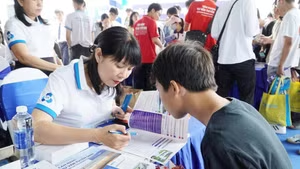
According to a report by the Party Committee of the Ministry of Education and Training, access opportunities have been expanded, universal education and literacy eradication have been maintained, and the enrolment rates of children and students of school age have basically met or exceeded targets.
The network of schools and classes has been reorganised and expanded. In particular, the initial phase of the policy to build inter-level boarding schools in border communes has added 4,396 classrooms for nearly 113,000 students. These results show that access to schooling is becoming increasingly open, creating conditions for more children and students, especially those in disadvantaged areas, to have more opportunities to study and develop.
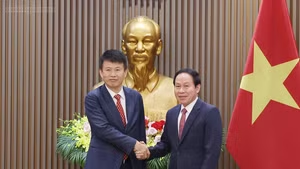
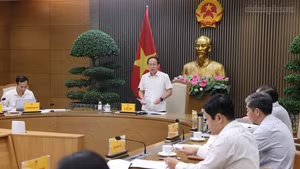
Along with expanding coverage, the requirement to ensure equality in access to education has received growing attention. At a working session with the education and training sector, Party General Secretary and President To Lam directed the Ministry of Education and Training to develop a set of indicators to monitor educational equity among regions, population groups and vulnerable groups. He also requested the implementation of the principle that more disadvantaged areas should receive greater support, teachers working in more difficult areas should receive better treatment, and greater attention should be paid to ethnic minority, mountainous, border and island areas.
The direction of the Party General Secretary and President sets out an important requirement: renewing the way education is viewed, organised and resourced, so that each policy can be translated into concrete changes in practice. Education development cannot be separated from socio-economic development goals, but must be placed within the overall planning, plans and development programmes of each locality.
This is also a basis for local Party committees and authorities to include education development goals and tasks in their overall socio-economic development plans, linked with clearly identifying priorities and concentrating resources for implementation.
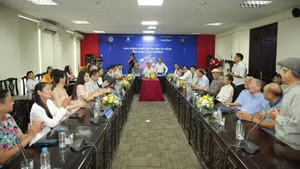
In Ha Tinh, the Standing Board of the Provincial Party Committee has issued an action programme to implement Resolution No. 71. To concretise this programme, the Party Committee of Nghi Xuan Commune issued its own action programme, while the communal People’s Committee developed an implementation plan setting out tasks and solutions to raise awareness of education reform and quickly translate policies into specific actions.
From communication activities and thematic meetings to incorporating the resolution’s contents into Party cell meetings, as well as dissemination through the public address system and social networks, implementation has been linked with practical issues at the grassroots level.
Under the direction of the communal Party Committee, the communal People’s Committee develops monthly and quarterly plans to concretise goals, tasks and solutions for education and training development. Priority is given to allocating resources and conditions for implementing local education and training tasks. Relevant mechanisms and policies on education and training are implemented, especially specific and outstanding policies aimed at removing bottlenecks and obstacles in education and training development.
At present, 12 out of 13 schools in the commune meet national standards; 100% of preschool children aged three to five attend school; universal preschool education for five-year-old children has been completed; the commune has met level-3 standards for universal primary education, level-3 standards for secondary education and level-2 standards for literacy eradication. The communal People’s Committee has issued five decisions approving investment items for four schools in the area, with total funding of nearly 39 billion VND.
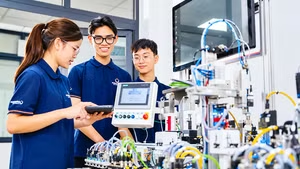
Along with expanding learning opportunities and improving conditions to ensure quality, Resolution No. 71 sets out the requirement to renew methods of management, teaching and learning. The resolution identifies the need for comprehensive digital transformation, universal access to and strong application of digital technology and artificial intelligence in education and training, while allocating sufficient resources for investment in facilities and technological infrastructure to serve management and educational activities at all levels.
Together with expanding learning opportunities and improving quality assurance conditions, Resolution No. 71 also requires innovation in management, teaching and learning methods.
In Nghi Xuan, this requirement has been concretised through investment in technological infrastructure and data digitisation. To date, 100% of schools have completed the digitisation of records and data; 100% of schools have stable internet connections for management and teaching. All classrooms and nearly 80% of subject rooms and other functional rooms are equipped with smart TVs or multifunctional projectors.
Smart education platforms have been put into use, gradually promoting the application of science, technology and artificial intelligence in renewing teaching, learning, testing and assessment methods.
Many Party cell secretaries and school principals said that the gradual renewal of infrastructure, technology and methods of organising education in the spirit of Resolution No. 71 is expanding access to better learning conditions, thereby laying a foundation for improving education quality.