Challenges from the downsides of technology
Cyberspace has become the “second living environment” of pupils and students. Their learning, communication, entertainment, and information-seeking activities are closely associated with digital platforms, from social networks and academic forums to messaging and content-sharing applications. Young people today can access vast sources of knowledge, enrol in open courses, connect with international friends, and enhance their adaptability in a globally competitive environment.
This brings many opportunities for knowledge development and new skills, but also poses challenges relating to information safety, ethics, and online conduct. The massive volume of online information requires young people to be able to select, analyse, and evaluate content. Fake news, harmful information, sensational content, and deviant trends can create confusion and distort perceptions if critical thinking skills are lacking. Influences of foreign cultural elements, materialistic lifestyles, and individualism may negatively affect the ideals, ethics, and value systems of a segment of pupils and students.
According to Nguyen Thi Nhung, Deputy Director of the Department of Pupils and Students, Ministry of Education and Training, alongside the enormous benefits of technology, the online environment also contains significant risks, from harmful information to misuse of personal data, especially for younger pupils who may face violations of children's rights such as bullying, scams, and online addiction.
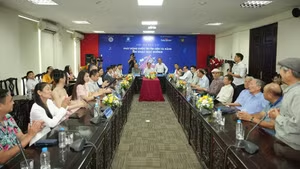
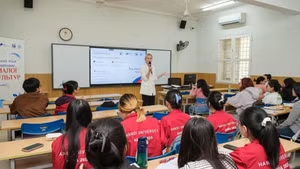
“There are currently over 26 million pupils and students nationwide, of which pre-school children, primary pupils, and secondary pupils account for around 20 million, or 80%. This means the education sector manages an extremely large number of children, posing major challenges for the sector in protecting them from harmful influences in general and on the internet in particular,” Deputy Director Nguyen Thi Nhung said at a training session on strengthening the capacity of staff and teachers responsible for child protection in cyberspace, organised by the Ministry of Education and Training in September.
In recent years, schools have paid greater attention to digital citizenship education. A number of extracurricular programmes, communication activities, and experiential models have been implemented to raise awareness among pupils. However, in practice, digital culture education still faces shortcomings, such as: weak management and organisation of education on online behaviour; inadequate monitoring of information trends; and limited guidance on political ideology, ethics, and positive lifestyle values for pupils.
The transformation of digital life, combined with challenges arising from the negative side of technology, requires significant reform in moral and lifestyle education for pupils and students.
Equipping “digital culture” as part of moral and lifestyle education
Political and ideological education has always been a core and consistent task throughout the entire education sector. In the context of digital transformation, international integration, and the powerful impact of social media, orienting ideology, morality, and lifestyle for pupils and students becomes even more urgent to build a generation with strong character, aspirations, and responsibility toward the nation.
According to Deputy Minister of Education and Training Le Quan, over the past period, localities, Departments of Education and Training, and educational institutions nationwide have made efforts and shown responsibility in implementing the contents of Decision 1299/QD-TTg, Directive 08/CT-TTg, and Decision 1895/QD-TTg on building cultural behaviour, educating morality, lifestyle, and revolutionary ideals for young people and children.
The Ministry of Education and Training has also submitted to the Prime Minister for approval and implemented Decision No. 311/QD-TTg dated March 5, 2022, approving the Programme on “Education of Revolutionary Ideals, Morality and Cultural Lifestyle for Young People and Children on Cyberspace for 2022–2030.”
To date, according to the Ministry of Education and Training, 100% of educational institutions have developed and implemented behavioural culture codes of conduct in schools. Moral and lifestyle education is becoming more structured, with quality and effectiveness significantly improved. Social work and psychological counselling in schools have been synchronously deployed, forming support networks for pupils and helping prevent and deal with emerging problems. Educational environments and school landscapes have been gradually improved towards being safe, friendly, democratic, and disciplined, contributing to progress in building school culture.
Work on preventing school violence, social evils, crime, and legal violations has been integrated into moral and lifestyle education as well as self-protection skills through a variety of measures and implementation forms.
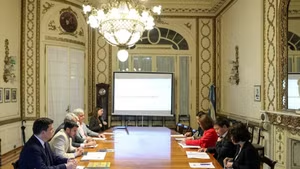
“There are many school culture models being expanded, and coordination among schools, families, and society has become more substantive. Teachers have been trained in psychological counselling and life skills. Ethical and lifestyle values are effectively integrated into the curriculum and experiential activities,” Deputy Director of the Department of Pupils and Students Nguyen Thi Nhung said at the Review Conference on Building Behavioural Culture for Young People and Children organised by the Ministry of Education and Training on December 5.
However, according to Deputy Minister Le Quan, in the coming period, the education sector must continue to innovate strongly and creatively in educating morality, lifestyle, revolutionary ideals, and life skills for young people. One of the key tasks is to strengthen digital culture education and online behavioural skills for pupils and students.