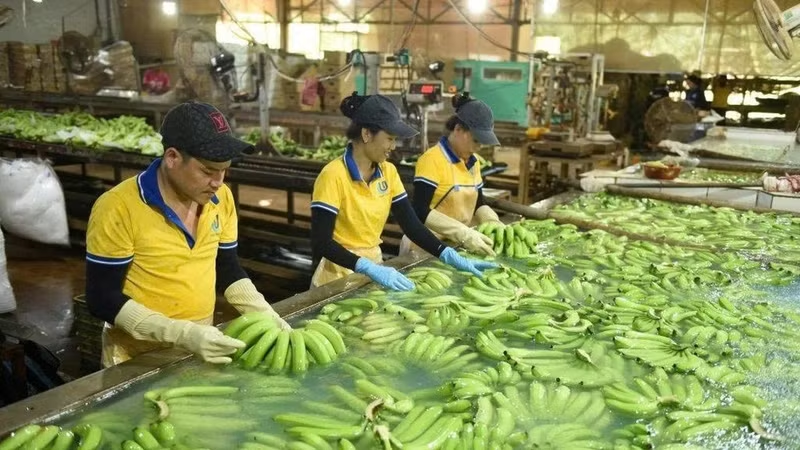
The initial success of banana and pineapple cultivation models for export has laid a solid foundation for the goal of building a green, modern agricultural ecosystem that is deeply integrated into international markets.
According to calculations, converting rubber-growing land to high-tech agriculture can deliver returns many times higher, prompting numerous VRG member units to actively implement this policy.
Positive results from crop restructuring
With local authorities’ approval of plans to convert rubber-growing areas to other crops under high-tech agricultural models, VRG member units have actively carried out the conversion, achieving clear results.
Taking us on a tour of a lush green field of tissue-cultured Cavendish bananas, where sturdy plants more than four months old were growing vigorously in red basalt soil, Le Xuan Ho, Deputy Head of the Technical Management Division at Phu Rieng Rubber One Member Company Limited, said: “The company has converted more than 50 hectares to specialised cultivation of bananas using high technology. In addition to using disease-resistant tissue-cultured seedlings imported from the Philippines and a fully automated irrigation system, we use unmanned aerial vehicles (drones) to spray pesticides and support crop care.”
According to Phung Quang Phu, Deputy General Director of Phu Rieng Rubber One Member Company Limited, the company’s project to shift towards high-tech agriculture has been carefully planned to enable proactive large-scale production, with approximately 2,550 hectares scheduled for conversion between now and 2030. To date, the company has converted more than 500 hectares to banana cultivation. It has surveyed the land and clearly identified areas suitable for conversion in terms of soil conditions, water resources and other factors, while making thorough preparations in terms of technical expertise, human resources and cultivation procedures before expanding into new crops.
At Dong Phu Rubber Joint Stock Company, the search for new cultivation models has also stemmed from cost pressures and a declining labour force. The company has chosen to partner with businesses that already have established markets and technology to cultivate 214 hectares of bananas. Under its 2026 plan, the company will develop an additional 135 hectares of bananas and approximately 44 hectares of pineapples.
Tran Vinh Tuan, in charge of the Agricultural Engineering Division at Dong Phu Rubber Joint Stock Company, shared that when the company first moved into high-tech agriculture, it had not yet mastered the production technology or established its own distribution system. Through partnerships to implement high-tech agricultural projects, the company receives infrastructure revenue of approximately 30 million VND per hectare per year, significantly higher than the returns from rubber cultivation amid rising land rental costs. Under its plan, Dong Phu Rubber expects to convert approximately 640–648 hectares of rubber plantations to high-tech agriculture by 2030.
Given the clear benefits of high-tech agriculture compared with rubber cultivation, other VRG member units are also accelerating their conversion efforts. Chu Se Rubber One Member Company Limited has developed more than two hectares of disease-free, tissue-cultured MD2 Invitro pineapples that meet GlobalGAP standards, and has subsequently expanded the area by a further 39 hectares.
From 2024 to 2025, Ea H’leo Rubber One Member Company Limited converted nearly 68 hectares of rubber-growing land to commercial sweet potato cultivation, generating profits of 80–100 million VND per hectare per crop. In 2026, the company converted this area to high-tech coffee cultivation.
Under its plan for 2027–2029, the company will expand the area devoted to specialised high-tech coffee cultivation to 855 hectares, with plans to increase it to 5,000 hectares during 2030–2045. Coffee is expected to generate profits of approximately 80–90 million VND per hectare per crop, opening up prospects for the development of modern coffee-growing areas.
Restructuring land resources, with economic efficiency as the key measure
Although the benefits of converting rubber-growing land to high-tech agriculture are clear, careful calculations, thorough planning and well-structured implementation are essential to avoid large-scale, indiscriminate conversion without due consideration of soil conditions, markets and other factors. In addition, the shift from traditional rubber cultivation practices to modern agricultural supply-chain management, while meeting stringent standards for export agricultural products, also requires member units to proceed cautiously.
According to Phan Quang Ba, Deputy General Director of Dong Nai Rubber Corporation One Member Company Limited, the biggest challenge facing the company in implementing the conversion is water availability. Many areas are far from major river systems and can only make use of small streams. Consequently, crops requiring substantial irrigation, such as bananas and coffee, would not be suitable for these areas. Crop restructuring must therefore be assessed with great care and not implemented across the board. Decisions must be based on water availability, soil characteristics and the ability of state-owned enterprises to preserve their capital. In 2027, Dong Nai Rubber plans to pilot 100 hectares of banana cultivation and 300 hectares of coffee cultivation before considering longer-term steps.
Analysing the direction of rubber crop conversion, Nguyen Quoc Cuong, Acting Head of VRG’s Technical Management Department, said that rubber currently generates profits of 8–26 million VND per hectare per year, whereas Cavendish bananas yield more than 100 million VND per hectare per year. The difference in returns, ranging from sixfold to 14-fold, provides the basis for the group to establish four breakthrough guiding principles: making returns per hectare the central benchmark; proactively implementing conversion in accordance with planning; identifying the technology and markets before expansion; and comprehensively renewing management models.
VRG currently manages more than 480,000 hectares of agricultural land, of which rubber accounts for 78.3%. Under its 2026–2030 plan, the area devoted to rubber will be reduced substantially, with more than 53,000 hectares converted to non-agricultural uses and approximately 26,231 hectares allocated to high-tech agriculture.
In response to the need for innovation, VRG Deputy General Director Pham Hai Duong emphasised that traditional agricultural production models are facing considerable pressure from economic inefficiency, labour shortages and declining soil quality in some areas. Renewing cultivation models, applying high technology and advancing digital transformation are not only immediate requirements but also foundations for long-term sustainable development.
“The group’s development strategy to 2030 focuses on three main crop groups. The highest priority is given to Cavendish bananas and MD2 pineapples, with a target area of 6,000 hectares, followed by high-quality coffee aimed at European and US markets, and finally the retention of rubber cultivation in suitable areas in conjunction with mechanisation. The group is shifting decisively from partnership-based cooperation towards direct investment, striving to raise the proportion of direct investment to more than 70%. Every new project must undergo a rigorous three-stage appraisal process covering technical feasibility, financial viability and market prospects, with signed offtake contracts required,” VRG Deputy General Director Pham Hai Duong added.
In parallel, VRG is accelerating the application of digital technology and automation. The VRG GIS system has been brought into operation to manage the entire land portfolio. Its digitalisation roadmap will be implemented in two phases: from 2026 to 2028, the focus will be on managing production through Internet of Things (IoT) systems; from 2028 to 2030, the group will complete value-chain traceability. By 2028, VRG aims to have 10,000 hectares of high-tech agricultural land, generating expected revenue of 200–300 million VND per hectare per year and contributing more than 2.5 trillion VND in total annual revenue.